- Introduction
Under the SPARK (Supporting Peace in Yemen through Accountability, Reconciliation, and Knowledge-Sharing) program, DT Institute and its local partners, the Abductees’ Mothers Association (AMA) and SAM for Rights and Liberties (“SAM”), launched raising awareness initiatives and restorative justice pilots to generate cooperation and reconciliation, resolve societal disputes caused by the war prolonging human rights violations and suffering, and foster community-level understandings of transitional justice.
This model was designed in response to the findings of The Path Towards Peace, a research study published by SPARK in April 2025. This study captured local understandings of transitional justice across Yemen, revealing that 64.3 percent of community members prioritize reconciliation and war-ending efforts over retributive accountability. Moreover, 75 percent of community member respondents expressed their support for initiatives and activities to support reconciliation and peaceful coexistence.
Through effective engagement, the SPARK pilots activate all segments of society – from the community level to civil society, experts, and high-level governmental stakeholders. This enables these groups to not only be participants, but central drivers of Yemen’s transitional justice journey. Raising awareness campaigns similarly educate community members, governmental stakeholders, and others on transitional justice mechanisms and engage experts and decision makers in thought provoking and effective dialogues and initiatives to advance Yemeni transitional justice.
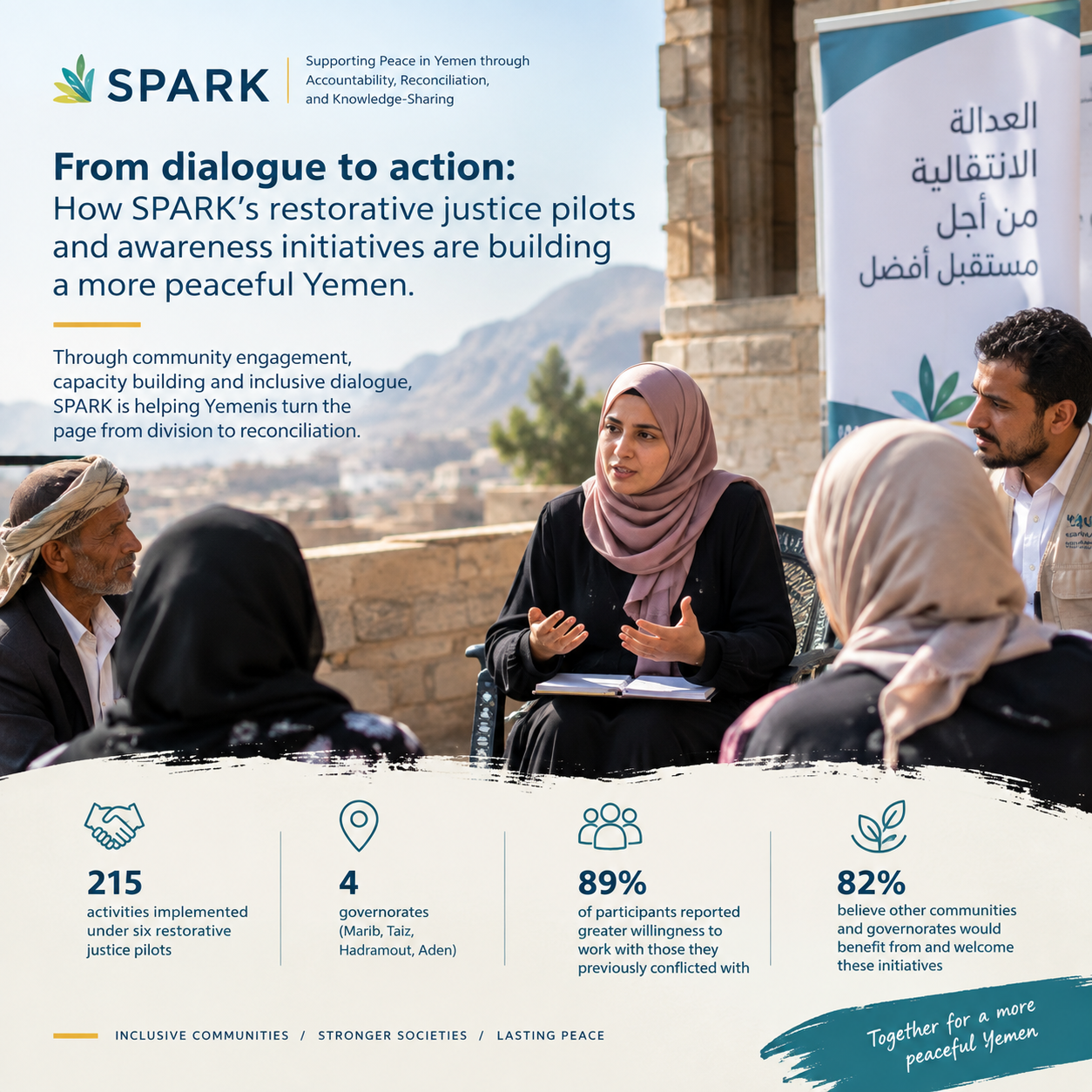
Under the SPARK program, these pilots have achieved key successes and enabled diverse Yemeni stakeholders to work together to repair societal fragmentation throughout the country. In total, SPARK partners implemented 215 activities under six restorative justice pilots. Pilot activities were implemented throughout four governorates, including Marib, Taiz, Hadramout, and Aden. They included isolated and rural areas, including the village of Al-Sarari in Taiz.
Restorative justice pilots achieved many long-lasting successes in Yemen. In Marib, SPARK partners restored use of the Al-Maneen Health Unit and Rural Women’s Community Center. This restored the Unit’s ability to provide medical services to approximately 20,000 civilians and the Center’s ability to provide agricultural and health services to approximately 30,000 women. Under another pilot, SPARK partners addressed the violent, undocumented impacts of the Taiz Siege in 2015. They documented 71 human rights abuses, identified 111 victims (many of whose fates were completely unknown), and collected 40 death certificates. Documentation culminated in the Memory Museum, a first of its kind, community-led initiative sharing victims’ stories.
Additionally, pre- and post-surveys were administered with each pilot at the outset and closing. Surveys assess the pilot’s impacts on participants and their willingness to engage with and champion transitional justice processes in Yemen. On average between all the pilots, 89 percent of participants reported improved willingness to collaborate with members of groups they are in conflict with. Additionally, 82 percent of participants think that other communities or governates would benefit from and welcome the pilot activities.
- The Need for Such Initiatives in Yemen
The conflict in Yemen has raged on for over a decade now. It’s continuous and destructive nature continue to decimate the country, splintering its social fabric by dividing the country into competing territorial zones of political influence, collapsing the national economy, pushing civilians to the brink of desperation and need, rupturing traditional tribal and community safety nets, and exasperating decades-old social fragmentation and deep-rooted societal conflicts.
As held by the SPARK publication, Peace Engineering in Yemen, the current crisis has seen a relative halt in major military maneuvers under delicate ceasefires. In place of these violent confrontations are equally as violent and even more dangerous structural forms, including institutional fragmentation, economic disintegration, and the deterioration of the country’s social fabric.
As the paper explains, “what was once a struggle over political power has evolved into an existential conflict threatening the very existence of the state. Yemen has effectively fractured into cantons, governed by multiple de facto authorities and sustained by entrenched war economies, rendering traditional political settlement tools inadequate for either comprehending or dismantling this complexity.”
💬 “Yemen is a unique case study in the Middle East: a state that has endured decades of chronic instability, with localized tribal and regional conflicts deeply intertwined with acute regional and international power struggles.” – A quote from the SPARK publication, Peace Engineering in Yemen.
Social fragmentation issues include the reshaping of local dynamics as communities are politicized, militarized, and exploited by conflict parties and local authorities provoking sectarian affiliations and longstanding tensions. The conflict has also pitted various communities against one another, including local authorities and the Muhamasheen (“the marginalized”) as well as religious leaders and female activists.
Societal consequences have also arisen from massive, repeated displacement, resulting in over 5.2 million internally displaced people (IDPs) throughout Yemen, according to the United Nations High Commissioner for Refugees (UNHCR). This displacement, in addition to military takeovers, has resulted in the looting and takeover of civilian homes and public facilities preventing them from meeting urgent civilian needs, including housing and medical and education services.
In almost all cases, social fragmentation and societal divisions in Yemen are accompanied by the inability and/or refusal of governmental institutions and local authorities to effectively address these issues. This inability and/or refusal to act allows these challenges to fester, aggravating pre-existing tensions and resulting in deeper-embedded conflicts. Moreover, they point to the need for new methods of resolution.
- Restorative Justice Pilots and Raising Awareness Initiatives Addressing Yemen’s Social Fragmentation
Participants under The Path Towards Peace research study made several suggestions for activating the role of civil society in the transitional justice process. Key suggestions included initiatives for dialogue, reconciliation, and peacebuilding; providing material and legal support to victims; raising community awareness on the importance of transitional justice; and monitoring and documenting violations. SPARK pilots and initiatives address each of these suggestions and needs.
Initiatives for Dialogue, Reconciliation, and Peacebuilding: The Al-Sarari and Al-Shamayatayn Restorative Justice Pilots
Under the Al-Sarari and Al-Shamayatayn Restorative Justice Pilots, SPARK partners worked towards social reconciliation and peacebuilding through joint dialogue sessions bringing together individuals from disputing parties. The Al-Sarari Restorative Justice Pilot addressed deep-seated tensions between communities in Al-Sarari village, which was captured by the Houthi (Ansar Allah) group in 2015. In response to the occupation and broader war, community members aligned themselves with conflict parties for protection – some with the Houthis, others with the international recognized government of Yemen (IRG).
Over time, these tensions grew and became pervasive throughout society, remaining even after the Houthi withdrawal. Over time, tensions manifested in community members’ limited access to basic resources and services, such as water distribution and land, which were already scarce in Al-Sarari. To resolve these social tensions and their resulting conflicts, AMA utilized a bottom-up approach, which began with careful field coordination efforts to overcome security challenges and rough terrain, preparing the community for productive dialogue sessions.
AMA fostered dialogue aimed at rebuilding trust and understanding among 28 local community members and key stakeholders, including political party figures, local authority representatives, soldiers, and religious leaders. The repeated dialogue sessions created positive momentum, pushing the participants from initial discussions focused on personal and legal disputes to address past violations and root causes of the conflict, fostering long-term understanding and trust. AMA’s effective engagement resulted in participants’ acquiescence to the formation of the community committee, tasked with resolving ongoing violations and disputes to ensure sustainability.
The Al-Shamayatayn Restorative Justice Pilot addressed longstanding tensions between the Muhamasheen community (“the marginalized ones”) and security forces in Al-Shamayatayn District. These tensions originated five years ago, when a Muhamasheen man was killed by security forces. His body remained unburied throughout this period, against Yemeni religious and cultural norms, deepening community trauma and creating a cycle of mistrust and marginalization.
To resolve this conflict, the SPARK team leveraged their extensive local networks to communicate with security representatives, hold meetings with the Director of Al-Shamayatayn District, listen to the victim’s family’s demands, and facilitate engagement between the victim’s family and security actors. After five years of stalemate and judicial inaction, both parties signed a formal reconciliation agreement, bringing the case to a peaceful resolution.
On July 29, 2025, the victim was finally laid to rest with a dignified funeral. The security forces publicly acknowledged responsibility and paid reparations of 5 million Yemeni Rials to the family. This agreement resulted in a sustained change in relations between the community and security actors, underscoring the long-lasting impact of this initiative. To enable future similar initiatives, SPARK partners also published a video, documenting the pilot and detailing its approach to addressing the roots of conflict.
💬 “After the initiative was implemented, a noticeable level of community relief emerged. … Importantly, the initiative gave marginalized communities a stronger sense that the state does not disregard their rights and that loss of life will not go unaddressed. Bringing marginalized representatives to the table with relevant stakeholders helped create a greater sense of parity.” – AMA
Monitoring, Documentation, and Provision of Material and Legal Support to Victims – The Marib, Tanker Massacre, and Looted Homes Restorative Justice Pilots
Under the Marib, Tanker Massacre, and Looted Homes Restorative Justice Pilots, SPARK partners championed the transitional justice pillars of reparations, truth-telling, and memorialization. In doing so, they conducted monitoring and documentation efforts to record human rights violations, allowing them to understand the pervasiveness of these violations and how they are impacting victims. With each of these pilots, the legal, psychological, and material support was provided to community members based on their strong needs.
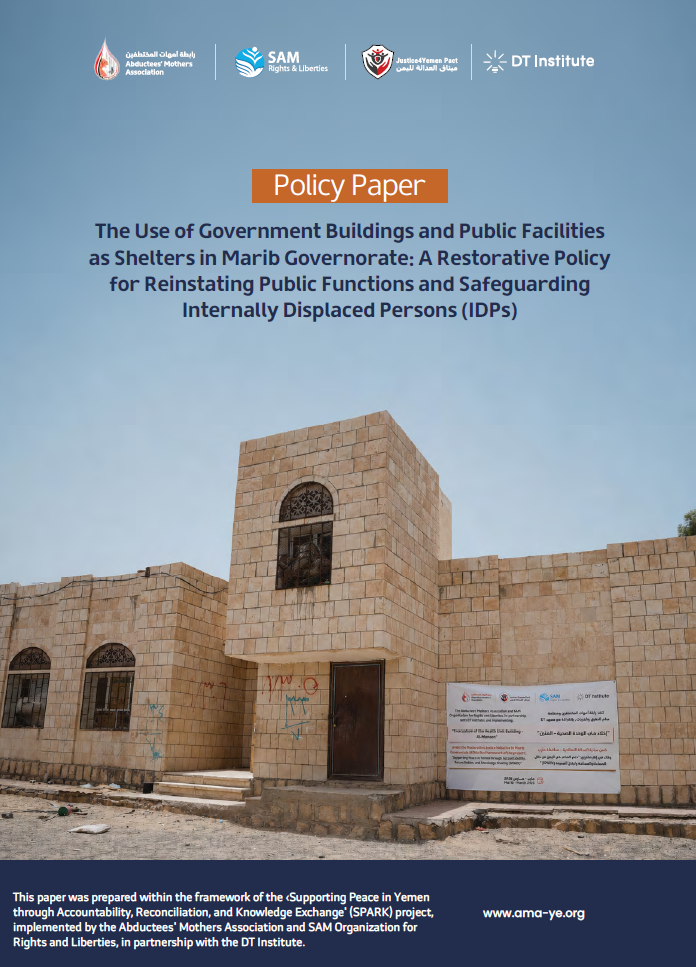
Under the Marib and Looted Homes Restorative Justice Pilots, SPARK partners addressed issues arising from the misuse of public buildings and civilian homes. In the case of the Marib Restorative Justice Pilot, public buildings were being used by displaced families with nowhere to turn. The use of these public buildings as shelters prevented them from providing the public with urgently needed services, including medical care and education. The Looted Homes Restorative Justice Pilot involved civilian homes that were occupied by security forces and other actors involved in the greater war. This resulted in illegal displacement of thousands of residents and their families.
The Marib Restorative Justice Pilot revealed the presence of approximately 1,144 displaced families, sheltering within nine public facilities, while the Looted Homes Restorative Justice Pilot resulted in the documentation of over 320 homes subject to looting and takeovers. These databases were integral to the broader initiatives, aiming to address and resolve these issues. The Marib database enabled the partners to understand where displaced families were located, and institute cut-off dates for selection of families for voluntary relocation. Similarly, the Looted Homes database included crucial information to address the lootings, including the relevant perpetrators, controlling authority, and other pertinent details.
Likewise, the Tanker Massacre Restorative Justice Pilot resulted in documentation of 71 human rights abuses. This led to the identification of 111 victims, many of whose fates were completely unknown, and the collection of 40 death certificates. Documentation efforts provided a comprehensive record on the tanker massacre, enabling the recognition of this significant tragedy that remained unacknowledged for over 10 years.
This pilot also resulted in the provision of 30 legal and psychological sessions, conducted both jointly and individually for over 88 attendees, depending on need. The support included preparation of five legal complaints and assistance in submitting 12 cases. Relatedly, AMA recruited a legal consultant under the Marib Restorative Justice Pilot to provide displaced families with legal guidance and ensure their rights are respected as they signed agreements to relocate and were moved from public facilities.
Raising Community Awareness on the Importance of Transitional Justice – The Transitional Justice Ambassadors Forum and Role of Religious Leaders Initiatives
SPARK partners launched the Transitional Justice Ambassadors Forum (TJAF) and Role of Religious Leaders Initiative to create sustainable pathways to raise community awareness and understanding of transitional justice. The TJAF is a national platform for 230 members from 15 governorates, bringing together victims, activists, and civil society actors to advance transitional justice in Yemen through discussions, regular meetings, webinars, and awareness sessions.
Over the life of the TJAF, they held 12 webinars, drawing attention to crucial transitional justice discussions, including the role of the international community in supporting peace processes and lessons from other countries’ transitional justice experiences. Through webinars, member meetings, and digital campaigns, the TJAF worked to promote transitional justice while disseminating key outcomes and lessons learned and demonstrated within SPARK activities.
In August, the TJAF launched an influencer-led, where each was featured in a short video and accompanying poster linking a SPARK initiative to broader messages on conflict prevention, dialogue, rights restoration, reconciliation, and peacebuilding. The campaign translated practical experiences from transitional justice initiatives into accessible public messages, enabling further understanding of the practical impacts of transitional justice in Yemen. It reached over 270,157 individuals and generated 7,666 engagements.
The Role of Religious Leaders Initiative uses a varied approach to achieve the same goal – to raise of awareness of transitional justice and its application in Yemen. Religious discourse maintains a significant influence in Yemen. Under this initiative, partners leveraged the strong influence of religious leaders and institutions, who hold critical importance in their communities, to raise awareness of transitional justice.
SPARK partners engaged 20 preachers, including three women and 17 men, in a comprehensive, three-day workshop on transitional justice. Subsequently, they sent the preachers back to their communities, wherein they delivered 25 sermons to draw parallels between religion and the values and implementation of transitional justice. Sermons highlighted the similarities and areas of convergence between transitional justice and religious values.
Moreover, they helped communities perceive transitional justice, not as a foreign concept imposed upon society by outsider culture, but as a process that aligns with local cultural and religious values. In total, preachers reached 8,817 local listeners, including 8,026 men and 1,791 women, through sermon delivery under this pilot.
💬 “I held very negative thoughts about transitional justice, seeing it as an external influence aimed at normalizing relations between conflict parties and imposing western rights. After listening to the khotba (sermon), my perception completely changed, and I now encourage this process.” – A community member engaged in a sermon presented by one of the preacher-trainees under the Peace Dialogue Restorative Justice Pilot.
As held by DT Institute’s Senior Program Manager, Feras Hamdouni, “When religious leaders understand and support transitional justice, they help communities see that principles such as truth-telling, accountability, forgiveness, reconciliation, and restoring victims’ dignity are not foreign concepts, but values deeply rooted in religious teachings and Yemeni traditions. This creates a bridge between transitional justice frameworks and local realities, making peacebuilding efforts more legitimate, accessible, and sustainable.”
Conversely, when influential religious leaders oppose transitional justice or portray it as a foreign, political, or anti-religious agenda, the consequences can be significant. In conservative communities, such messaging can undermine public trust, discourage participation by victims and survivors, reinforce social polarization, and create resistance to accountability and reconciliation efforts. Negative religious discourse can also legitimize exclusion, deepen grievances, and perpetuate cycles of revenge rather than healing. This is particularly dangerous in post-conflict settings, where communities are searching for trusted guidance on how to move forward.
For this reason, investing in the awareness and capacity of religious leaders is not simply an outreach activity, it is a strategic peacebuilding intervention. By empowering religious leaders to become advocates for justice, tolerance, and coexistence, we create local champions who can help transform transitional justice from a technical concept into a community-owned process that contributes to lasting peace in Yemen.
- Replicability and Scaling Up
SPARK pilots and initiatives employed replicable models that not only were made to be long-lasting within the community but also were intended to be easily tailored and reproducible in other similar contexts across Yemen. Accordingly, each pilot included outreach materials designed to communicate the model employed, how it was implemented, the impacts it achieved, and how it effectively mitigated challenges and addressed community needs.
These included detailed reports, policy papers, guides, articles, booklets, case studies, videos, webinars, PowerPoint presentations, and social media content, including posts, posters, and reels. Publications, videos, webinar reports, case studies, and reports are all featured on the Justice4Yemen Pact (J4YP) website, which champions the aims of the J4YP Coalition – to advocate for the rights of all Yemeni people, particularly those who are most vulnerable and marginalized.
In addition to the replicability, SPARK activities were also each designed with the ability to be scaled up beyond the local level. Within SPARK’s midline assessment, a strong need for nationalization of transitional justice projects was demonstrated by 99 percent of respondents. Moreover, participants in The Path Towards Peace study highlighted nationalization and expansion of transitional justice concepts and projects as essential for Yemen’s future and for successful peacebuilding endeavors.
💬 “SPARK’s restorative justice pilots are particularly powerful in actualizing transitional justice across Yemen. These local initiatives not only envision community ownership and victim-led, participatory transitional justice, they actualize it. By creating and successfully implementing scalable models within Yemen, SPARK’s restorative justice pilots lay the groundwork for successful national transitional justice. They demonstrate that reconciliation and restoration is not only possible but also sustainable and desirable when implemented by the people, for the people with victims intimately involved.” – Lynn Arbid, Program Officer, DT Institute