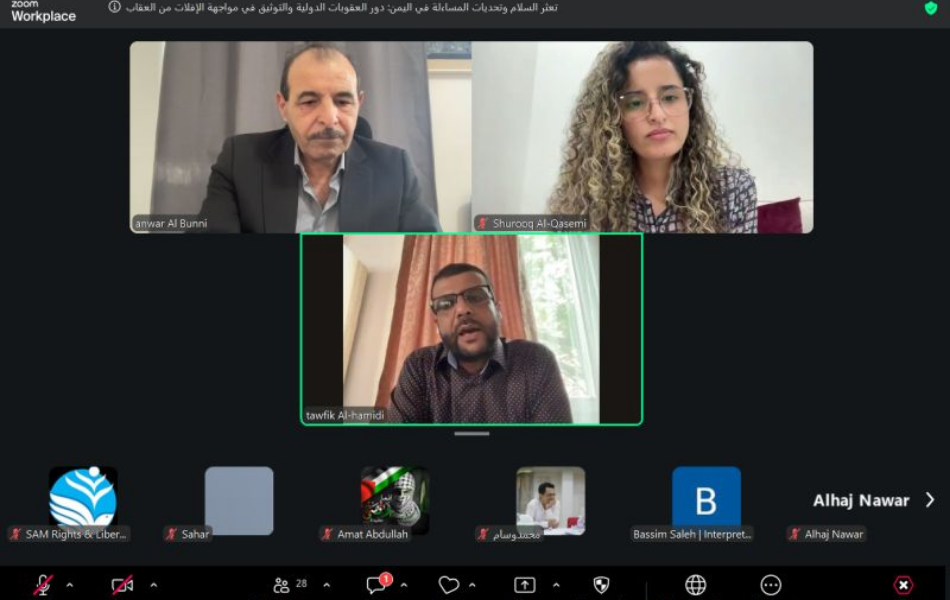
This report provides a summary of the webinar titled “The Stumbling Blocks to Peace and the Challenges of Accountability in Yemen: The Role of International Sanctions and Documentation in Countering Impunity,” organized by DT Institute in partnership with the Transitional Justice Ambassadors Forum, SAM for Rights and Liberties, the Abductees’ Mothers Association, and the Justice4Yemen Pact Coalition.
Yemen’s Transitional Justice Path:
The Problem of Accountability
Today, after over a decade of conflict, Yemeni civil society has complied a significant amount of documentation of human rights violations throughout the country. This has resulted in a collection of thousands upon thousands of pieces of documentary evidence, including victim and witness testimonies, documents, pictures, and other materials. This documentation has also been distilled, providing us with significant knowledge of violations, including violation patterns and perpetrators. Such violations include those committed inside detention centers, the looting of properties, torture, bombings, and many other human rights abuses.
The problem lies with translating this evidence into accountability. Justice institutions in Yemen are weak – both judicially and institutionally – resulting in a significant lack of justice. During the years of heavy conflict, monitoring activities focused on proving that human rights violations and grave incidents actually occurred and providing the victims with a platform and voice to speak out about these atrocities. This was done to alert the international community, place pressure on Yemeni political parties to halt violations, and engage in national memory keeping. These were important tasks during the conflict as they focused on reducing the intensity of violence that had overtaken the country.
As the conflict has tampered down, civil society is looking at the documentation it has amassed through an accountability lens. The question is: Can the evidence collected be used to compile legal files and effectively serve prosecution and investigation of these violations? For this task, it is not enough to prove that a person was tortured at a particular facility, we need to know who was running the detention center, what was the chain of command, who was providing the orders, and what evidence is available to prove these claims. Again, it is not enough to know that these weapons were delivered to this party, we need to know who provided the funding to procure the weapons, who facilitated the delivery of the weapons, and so on. This challenge is being faced collectively by all of Yemeni civil society.
Challenges Plaguing Yemeni Civil Society
Yemeni civil society – those who have been monitoring and documenting human rights violations – suffer from a number of challenges. Firstly, many Yemeni civil society organizations suffer from structural issues preventing them from maintaining consistent documentary teams with sufficient experience and expertise to produce reliable evidence that will withstand judicial scrutiny. Pervasive security threats have played a significant role in weakening civil society, contributing to these structural issues.
Secondly, Yemeni civil society is politically polarized. Many civil society documentation efforts have focused on one or few political parties as perpetrators while neglecting violations committed by other political actors. In some cases, documentation efforts have lacked a systematic methodology or sufficient documentation of the methodology or mechanism that facilitated the collection of evidence. Thus, various civil society organizations have adopted diverse and sometimes unorganized documentation methodologies. Additionally, it has resulted in different organizations classifying violations in different ways.
Thirdly, in documenting human rights violations, many civil society organizations focus on the direct perpetrators without understanding or taking note of the chain of command.
Fourthly, each civil society organization has operated within a silo resulting in fragmented information of human rights violations. Organizations end up keeping information to themselves and not sharing it with one another, rather than having one joint database for all to contribute to.
Lastly, while Yemeni civil society organizations did receive international funding and support for documentation, this support did not exceed 15 percent of the total support provided. Most of the projects supported focused on awareness raising, peacebuilding, fostering dialogue and similar initiatives. Additionally, this support was not always necessarily focused on building long-term organizational capacities. Thus, civil society organizations were unable to use this support to build specialized expertise and experience from consistent, organized, and refined practices.
Today, this has left us with the burden of having to sort through all the evidence collected by various, sometimes unclear means, to establish legal files and accountability-centered products. Many pieces of information need to be restructured to be established into effective evidence and proof to serve litigation purposes and Yemeni transitional justice.
Peacebuilding, Political Rehabilitation, and Accountability
Some advocate for an approach that prioritizes peace over accountability. According to this way of thinking, Yemeni civil society should wait for peace before pursuing accountability. Advocates may also support forgiving or not pursuing accountability in certain cases “for the sake of peace.” However, this is not the right approach. Countries that neglect justice in the name of peace are countries that have failed. Colombia remains unstable until now. Lebanon can never be stable unless their criminals are held accountable and the warlords are prevented from becoming politicians. The same applies to Iraq.
A country cannot be built by criminals. Those who make war cannot make peace. They cannot be part of the State, especially those that committed crimes against humanity. For instance, some criminals committed the crime of torture to interrogate people and extract information. These people, who torture others for joy and pleasure, cannot be rehabilitated or reintegrated into society. For example, Alaa Mousa was a Syrian doctor in a military hospital, who killed and tortured detainees that were sent to him. A psychologist held that Mousa has psychological disorders and therefore should not be released, because he cannot be rehabilitated and reintegrated into society. He was prosecuted by a court in Frankfurt. Thus, there is a duty to prevent the political rehabilitation of these people through mediations or negotiations. Such people are criminals. They can never be part of any future peace process. Prevention of the political rehabilitation of such perpetrators is an objective that Yemeni organizations must aspire to achieve.
War creates an improper environment both for individuals and for communities. The problem is that war redefines terms that are circulated at the academic and popular levels. For example, the notion of the country or the nation is clear in normal circumstances and times of peace. However, during times of war, this notion may be different. It may refer to the group or the party. Thus, it creates a framework where, in times of war, you can be forgiven if you betray Yemen, but you cannot be forgiven if you betray your party or your armed group. Therefore, the patriotic concepts and concepts of loyalty are perverted and co-opted due to the conflict.
You cannot build peace on a ruined environment. People who assaulted or operated against the country cannot build peace. Lebanon is an example of this. Since the Trilateral Framework Agreement in Lebanon, the parties have not been able to establish a proper State. The same applies to Yemen. In Yemen, there were preexisting conflicts in both the north and the south. Today, Yemen’s ongoing conflict is the outcome of the lack of accountability and peacebuilding to address Yemen’s historic northern and southern conflicts. Yemen did not clean the ground or establish a proper foundation for peace to be founded upon and to prosper.
Today, civil society in Yemen is concerned that pathway of transitional justice is being designed by politicians – the same actors who consistently failed to reach sustainable peace deals in the past, because these deals were based on self-interest and did not take victims and communities into account. Thus, the fear is that that politicians will draw this pathway without incorporating victims and the people’s national interest into account.
The Syrian Transitional Justice Experience:
Transitional v. Retributive Justice
In Syria, the file on transitional justice is not yet called such. It is not referred to as the transitional justice file. It is still a file that we can call retributive or even selective justice. A new term was added in Syria – “show-off justice” – that is, justice for the purpose of showing off. Judicial institutions in Syria are not yet ready to handle the transitional justice file. The laws in Syria are completely unsuitable to address transitional justice effectively.
The entity that is responsible for the file is not the transitional justice commission, rather it is the Ministry of Justice. This should be considered as it further demonstrates that this file is focused on retributive rather than transitional justice. It should be noted that the first transitional justice in the world was retributive justice, because the victors prosecuted those they defeated. This was the case when the Nazis fell in Berlin. Iraq also implemented retributive justice. No one held the United States accountable for the crimes it committed in Iraq.
In Syria, the justice file is now in the hands of the Ministry of Justice, so the winning party is holding those defeated accountable although the winning party in Syria also committed crimes in Idlib and elsewhere. Moreover, Syrian law does not account for crimes against humanity or war crimes. Rather, Syrian law defines ordinary crimes. Thus, there is no accountability now in Syria for crimes against humanity or war crimes as such. For example, Amjad Youssef, a former Syrian military intelligence officer, killed more than 400 people, and he was prosecuted for killing more than one person.
Not All Prosecutions Are Effective for Transitional Justice Purposes
In Syria, Atef Najib, former head of the political security branch in Daraa and nephew of former leader Bashar Al-Assad, was prosecuted and sentenced to death by a Syrian criminal court in August 2026 for crimes against humanity. In this case, the legal framework applied was the Syrian Penal Code and Constitutional Declaration. Moreover, the Syrian code embedded international legal standards within its law without fully harmonizing the national text with the international law.
This case is an example of Syrian “show-off justice.” It was done to demonstrate that action is being taken against certain actors, including Najib. However, Najib could not be effectively reached by Syrian law. Rather, he could only be properly prosecuted for his crimes under international criminal law, because he did not directly commit a crime himself. Rather, he gave the orders to do so. Moreover, he left Syria in 2011, and the statute of limitations in Syria runs out after 10 years.
In August 2026, when he was prosecuted, it had been 15 years since his crimes were committed. Therefore, if he was to be prosecuted in Syria rather than transnationally or internationally, this should have been done through a transitional justice mechanism or authority via a special tribunal that applies international criminal law. Such special tribunals must maintain their own prosecution teams, enforcement (or policing) agencies, and so on to ensure that there is a fair trial.
Prosecuting any criminal who participated and furthered the atrocities committed in Syria is a worthwhile pursuit. This includes Najib as a criminal who committed crimes against humanity. He deserves punishment. However, with “show-off justice,” there is no justice for the victims of the crimes. Although Najib was sentenced to death, this is not justice. This trial did not involve effectively truth-telling. It did not prioritize victims and allow them to share their stories. For example, they did not discuss his crimes in torturing children in Syria, which is a severe crime with several victims, including not only the children themselves but also their families. Thus, the ends do not justify the means in this case. Moreover, justice and access to justice must accompany one another as required by transitional justice standards.
This is one example demonstrating why other countries have refused to extradite Syrian criminals at the request of the Syrian government. They do not trust the Syrian government, courts, and law to prosecute these people effectively, and their opinions have merit. Justice must be achieved in the right way to guarantee that it is accepted and serves society and the victims. It must focus on truth-telling and other aspects of transitional justice.
The Role of Syrian Civil Society
Syrian civil society is similar to Yemeni civil society and civil society elsewhere. Syria does not necessarily have one unified strategy or methodology that all civil society organizations abide by. Different organizations focus on different topics. For example, some current organizations focus on crimes committed by Arab perpetrators, while others focus on crimes committed by Kurdish perpetrators in Sweida and on the coast of Syria.
Contrasts and Comparisons: Between Yemen, Syria, and Other Countries
Universal Jurisdiction
Universal jurisdiction may be beneficial in prosecuting many human rights violations and war crimes in Yemen and many other countries in the Middle East (including Iraq, Tunisia, and Egypt) as it has been for Syria. The documentation landscape in Yemen and the challenges faced by Yemeni civil society were similarly felt and experienced by Syrian civil society as well. In fact, this situation and challenges are applicable to many other countries. Within many countries, civil society monitoring and documentation activities are fragmented and lack joint leadership.
The difference between Yemen and Syria is that in Syria there was European leadership. Potentially, there was a political decision in Europe to support and assist the Syrian revolution. European organizations were helping Syrian organizations to organize workshops and meetings with politicians, diplomats, the Security Council, the General Assembly, the European Parliament, and European governments and Ministers of Foreign Affairs. This helped Syrian organizations to deliver concrete, actionable documentation evidence.
In Germany, Sweden, and Norway, universal jurisdiction may be applicable to criminals that are located outside Europe. Thus, within these countries universal jurisdiction may be used to reach and prosecute perpetrators inside Yemen if there is a file with sufficient evidence made up of victim and witness testimony and evidence. Direct and indirect perpetrators (for instance, those who gave the orders or were responsible based on the chain of command) can be hunted down and prosecuted, even if they are in Yemen. In the Syrian case, Syrian civil society has used universal jurisdiction laws in other countries to present legal files for criminals who were still located in Syria. Such efforts were targeted against multiple Syrian perpetrators, including Former President Bashar Al-Assad. In response, arrest warrants were issued in absentia against these criminals, both in Germany and France.
Different Types or Levels of Accountability
Accountability can happen at different levels. Firstly, it can occur at the ethical or moral level to uncover crimes, pinpoint perpetrators, and reveal violations to the public. Secondly, it can occur on a political level. This involves working with governments or international entities, such as the Human Rights Council, the Security Council, the General Assembly, or the European Union, that are interested. Here, periodic reports are vital. They need to be presented to these organizations. For example, the Universal Periodic Review was an opportunity to consolidate all the efforts of Syrian civil society and to present them collectively to the Human Rights Council. This could also be used in Yemen by Yemeni civil society organizations.
The strongest file that Yemenis can work (i.e., the file that could deliver the most significant results at this time) on is the political accountability file (as opposed to operating on the moral or ethical accountability level). The difference between the political and the moral level is the standard for documentation. Judicial litigations and decisions require a more robust and stricter level of reliability and proof in the evidence submitted. To pursue this avenue, Yemeni civil society must analyze and decide, not only what documentation information to include as evidence and how to organize this but also which judicial mechanism to pursue in bringing this legal file.
Yemen v. Syria and International Justice
Many perpetrators of war crimes committed in Yemen remain in Yemen. In comparison, in the case of Syria, many of these perpetrators left to Europe. This allowed them to be subject to European jurisdiction and more easily hunted down and prosecuted utilizing universal jurisdiction.
The Yemeni situation is more complication than that of Syria, because there is still a government in Yemen, although it has only partial control of the country. Thus, the Yemeni judiciary has jurisdiction. Moreover, Yemen is dissimilar to Syria in that Yemeni perpetrators did not flee the country and go to Europe or other countries that have universal jurisdiction.
There was an international committee tasked with monitoring human rights violations in Yemen and developing a list of perpetrators. This was the Group of Eminent Experts on Yemen (GEE). They were tasked with this work to foster and ease future accountability efforts in Yemen. Sadly, its mandate was not renewed. Conversely, the mandate of the Independent International Commission of Inquiry on the Syrian Arab Republic (COI Syria) is still operational and being renewed. This demonstrates the strong interest Europe has in Syria, which, sadly, it does not have in Yemen.
Unfortunately, the situation in Yemen is not as important in the eyes of Europe as the Syrian situation, because Europe is not facing the same amount of pressure from Yemeni migrants as they are from Syrian migrants. Moreover, other countries within the region have more control in Yemen preventing Europe from interfering in some cases in Yemen. This has resulted in Yemenis feeling largely abandoned in facing influential political actors.
However, there is still hope for Yemen and the Syrian model can be used as an effective model for Yemen. In transitional justice experiences around the globe, politicians are often the ones who charge its path. This was observed in Nuremberg, Rwanda, Colombia, and elsewhere. In Syria, the current landscape is unique in that Syrians have broken the political monopoly on justice. Arrest warrants and claims made against Syrian political criminals have resulted in some politicians, like Bashar Al-Assad, being completely removed from the Syrian landscape.
Yemeni civil society can trace the footsteps of the Syrian landscape to break the vicious cycle shaped by continuous, unsustainable peacebuilding made between Yemeni politicians to the detriment of the victims and community. There is hope through arrest warrants, indictments, and actions against Yemeni politicians, which can be achieved if Yemeni civil society submits actionable case files against these political perpetrators utilizing universal jurisdiction. This will prevent these criminals from becoming part of any negotiations or peace processes in the future. It will further send a message to politicians that they should not touch the transitional justice file. It should be firmly held and led by civil society, victims, and the people, rather than political parties.