The Prevalence of Violations Against Children Throughout Yemen History Still Pervasive Today
The Yemen conflict – marred by widespread hunger, displacement, and coined one of the world’s worst humanitarian crises – continues to rage on after over a decade of violent clashes inhibiting civilian livelihoods and ability to access urgently needed humanitarian aid. From the start, the conflict’s causalities included society’s most vulnerable – children.
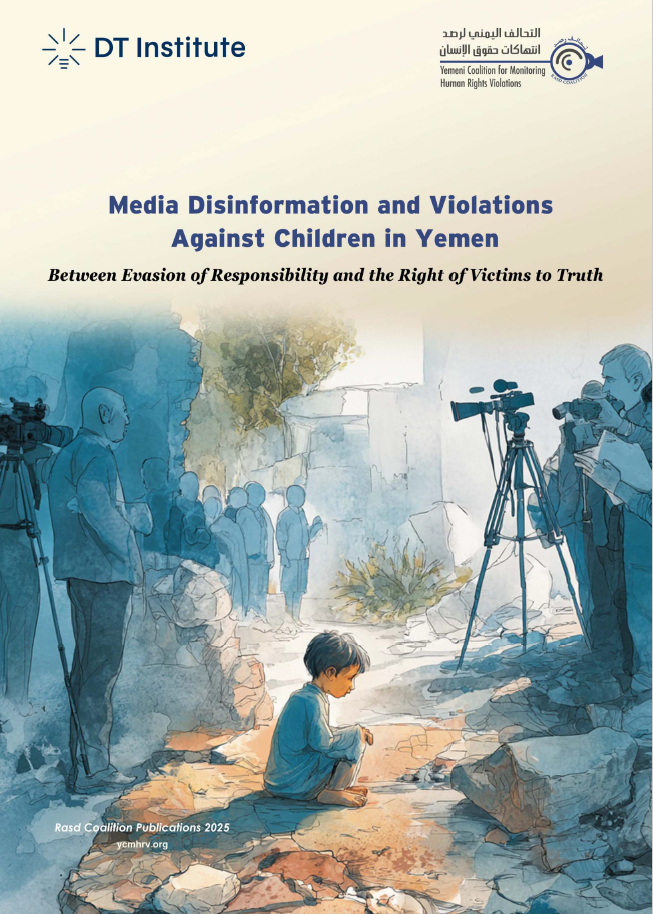
Over the life of the SAFE (Supporting Awareness, Facilitating Enforcement of Children’s Rights in the Yemeni Conflict) Program, local partners have documented 428 human rights violations committed against children. The Yemen Coalition for Monitoring Human Rights Violations (YCMHRV, also known as “Rasd”), along with their partner under SAFE II, the INSAF Center for Rights and Development (“INSAF”), stress that the vast majority of these are not only human rights violations, but also grave violations against children’s rights in times of war, as identified and condemned by the United Nations Security Council (UN SC) due to their egregious nature and severe impacts on children.
Child recruitment and the killing and maiming of children (both grave violations) represent the bulk of the crimes documented by SAFE partners at approximately 56 percent (238 violations). Combined with the rest of the grave violations, of which there are only six – denial of humanitarian access, attacks on schools and hospitals, sexual violence, and child abductions – these atrocities accounted for over 90 percent of the human rights violations documented.
💬 “On average…every single day, for an entire year, a boy or a girl in Yemen became a victim. There are no schools or institutions that remain open to a specific group of people throughout the entire year – not even employees work every day of the year. Yet in Yemen, weapons and graves are open to children all year round.” – YCMHRV via the X platform.
The State’s Obligations under International Human Rights Standards
Despite pervasive commitments to do better, the State remains at a loss. In Yemen’s last two Universal Periodic Review (UPR) cycles, in 2019 and 2024 respectively, the State’s recommendations included a significant focus on children’s rights and protection measures. This included ending child recruitment, rehabilitation of former child soldiers, and harmonization of national laws with Yemen’s international legal commitments, among others.
Both years, the Yemeni government expressed support for a vast majority of the recommendations put forth (80 percent of recommendations in 2019 and 79 percent in 2024). However, in 2025 alone, SAFE partner, YCMHRV noted that 349 children in Yemen were either killed or injured. Ongoing SAFE analysis further stresses the ongoing nature of children’s violations and the need for implementation of pertinent UPR recommendations to address child protection issues.
Moreover, according to YCMHRV’s SAFE analysis, Yemeni stakeholders, including victims, community members, political actors, and children’s rights experts and institutions, echoed the most pressing recommendations put forth by the UPR Working Group. These include non-compliance with international treaties relevant to children’s rights, including the premier Convention on the Rights of the Child (CRC) (which 79.7 percent of respondents cited). Compliance with international obligations, and with the CRC in particular, was proposed by multiple UPR Recommendations from both the third and fourth cycles.
Additional concerns put forth by Yemeni stakeholders include the weak protection mechanisms (86.8 percent) and poor institutional coordination (80 percent), which the UPR also insists the State enhance via action plans and other methods as appropriate to combat child violations. These demonstrated systematic weaknesses in institutional performance present key obstacles negatively impacting children’s rights and implementation of UPR recommendations required for effective child protection.
Over time, SAFE analysis and UPR processes have demonstrated a pattern of calling for similar, often identical, actions to address children’s rights in Yemen. Moreover, the HRC emphasizes the UPR as providing “an opportunity for all States to declare what actions they have taken to improve the human rights situations in their countries and to overcome challenges to the enjoyment of human rights.”
In doing so, the process attempts to encourage continuous improvements by fostering self and peer review through the perspective of other States, international UN organizations, and – importantly – national non-governmental and human rights organizations. Such stakeholders present fruitful, on-the-ground perspectives from qualified experts with direct relationships and insights into victims (especially children), communities, and the impact of grave violations upon both. Under SAFE II, local partners aim to actualize UPR recommendations on children’s rights by continuing engagement with the State beyond the UPR cycles.
Ongoing SAFE Engagement of Governmental Stakeholders on UPR Recommendations
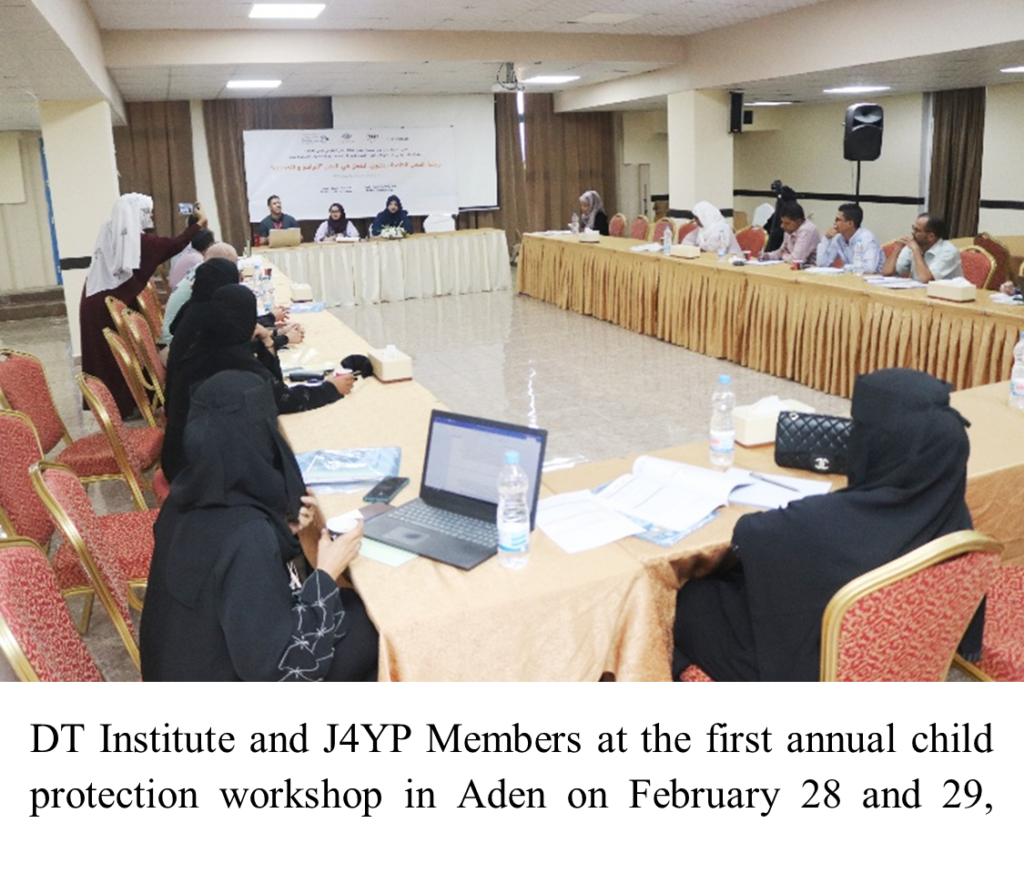
In February of 2024, SAFE launched its first annual child protection workshop in Aden. At the time, the workshop’s main objective was to facilitate dialogue between stakeholders from the government, relevant authorities, civil society, concerned parties, and legal sector on child protection. The workshop brought together over 32 Yemeni stakeholders, including several governmental ministries and key international partners such as Save the Children and the UN Children’s Fund (UNICEF).
The workshop resulted in increased familiarity with international human rights frameworks on children and armed conflict (among 58 percent of participants). However, in assessing the workshop’s implications after implementation, organizers noted, “participants didn’t show willing to collaboration in child human rights efforts.” This observation bolstered YCMHRV’s steadfast commitment to children’s rights and to the SAFE program.
Under the second phase of the SAFE Program (SAFE II), YCMHRV, and the recently recruited, INSAF, translated this commitment into action. YCMHRV sought to continue and further entrench itself in high-level dialogues and engagement of national stakeholders, responsible for child protection throughout Yemen. In doing so, YCMHRV facilitated coordination between governmental institutions and relevant national civil society organizations on implementation of UPR recommendations in online and in-person engagements.
YCMHRV set out to further engage key child protection decisionmakers in meetings, monitoring institutional cooperation and implementation of UPR recommendations. In July 2025, YCMHRV engaged with the Undersecretary of Legal Affairs and Human Rights. Within the meeting, the Undersecretary confirmed the number of recommendations accepted (i.e., supported) by the State in their fourth UPR cycle. He also emphasized ongoing coordination with the Ministries of Interior and Defense to ensure adherence to these commitments, particularly with regard to banning child recruitment.
YCMHRV noted that the Undersecretary also highlighted the success in removing the forces of the internationally recognized government of Yemen (IRG) from the UN’s “list of shame” (officially, an annex to the Report of the Secretary-General on Children and Armed Conflict, identifying armed forces and groups responsible for grave violations against children). He assured YCMHRV that there were no current cases of child recruitment within IRG forces.
In building off the meeting, YCMHRV held its two additional coordination meetings with Yemeni government agencies to enhance cooperation on matters related to the protection and promotion of children’s rights in Yemen and follow up on the implementation of UPR recommendations. Both meetings included representatives from the Ministries of Defense, the Interior, Health, Education. Legal Affairs and Human Rights, and Justice, as well as the National Commission to Investigate Alleged Violations of Human Rights (NCIAVHR), Public Prosecution, the Juvenile Court, and the Juvenile Welfare Home in Aden.
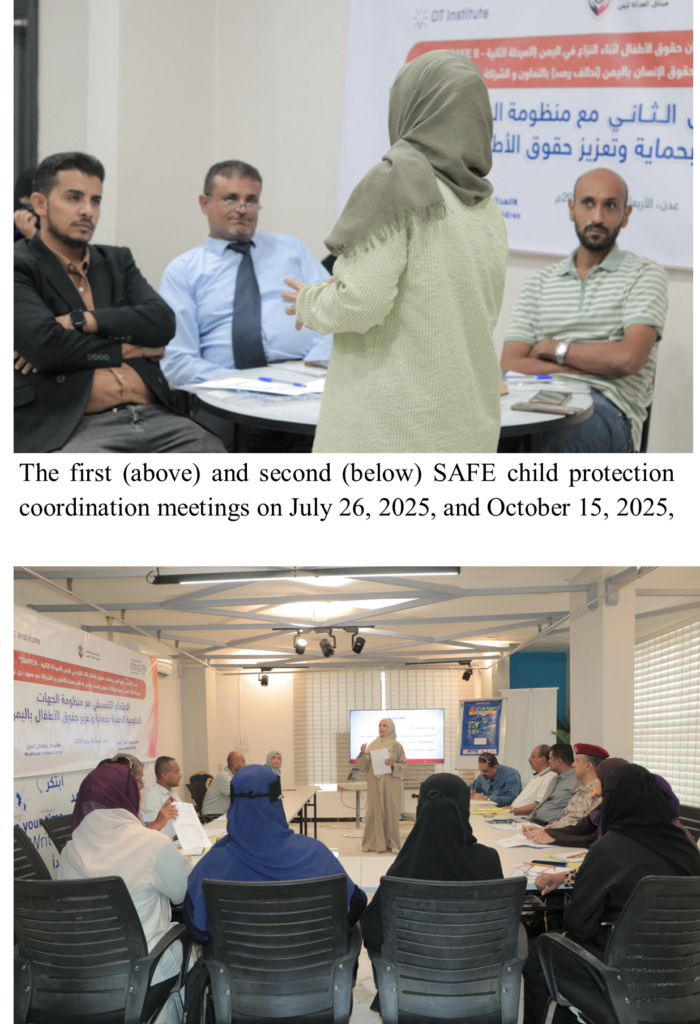
Within the first meeting, over 35 participants engaged in robust and fruitful discussion on UPR implementation. Specifically, within this first meeting, there were two primary subjects of concern – (1) establishment of child protection units in the governorates of Marib and Aden and (2) implementation of strategies to prevent child recruitment and address sexual violence against children.
On each of these subjects, the discussion focused on current obstacles and challenges as well as opportunities and next steps to overcome such difficulties. Participants identified multiple challenges surrounding protection of children’s rights in Yemen, notably lack of awareness among police and detention center managers regarding children’s rights and insufficient funding to provide awareness trainings.
In response, over SAFE II, INSAF engaged approximately 113 law enforcement actors in awareness-raising and education sessions, held within law enforcement training facilities. This resulted in increased understanding and acceptance of child protection obligations. In the sessions, participants, including the Brigadier General of the Yemeni Armed Forces, stressed their obligation in preventing grave violations of children’s rights like forced recruitment and child involvement in hostilities.
Discussion regarding implementation of UPR recommendations included six areas of focus, distilled from the UPR recommendations accepted by Yemen in 2024. These centered on prominent Yemeni child rights issues, including recruitment and use of child soldiers, military use of educational facilities, humanitarian access for children, data collection and reporting human rights violations (HRVs) of children, and strengthening accountability for such violations.
Participants also reviewed current action, existing challenges, and proposed next steps for each of the UPR focus areas. Such next steps included activating a joint verification and monitoring mechanism, operated by the government and civil society, issuing government directives to evacuate educational facilities, and creating a national child protection roadmap.
In the second meeting, participants built off dialogue of the first session by initiating discussion with a review of the first session report. This initiated a candid discussion, wherein governmental institutions shared documentation and implementation challenges. The Ministry of Defense expressed obstacles in resource-funding impeding its ability to effectively rehabilitate and reintegrate child victims. YCMHRV made a note to address this concern, among others, in the future as resources are made available.
Governmental ministries also shared progress reports, revealing encouraging advancements in children’s protections. This included verification by a formal committee that there was no child recruitment in IRG military facilities in all of Yemen. It also included cooperation on child rehabilitation initiatives between the Ministry of Legal Affairs and Human Rights and local civil society organizations and heightened conscription regulations.
The ministries also shared updates on establishing reporting units, coordination mechanisms, and training staff. The Ministries of the Interior and Defense confirmed the creation of 80 Child Protection Points and participation in interministerial technical committees.
The parties also identified several obstacles that must be overcome to enable further child protection. To combat these obstacles, they agreed on priorities to be tackled during the national workshop planning, including establishment of accountability mechanisms and a national referral and data-sharing system; legislative reforms aligned with international treaties; improved documentation, monitoring, and reporting; and a unified vision on the national child protection strategy post-conflict.
In closing the meeting, the parties called for a joint coordination mechanism between the government and civil society to monitor and respond to child HRVs. Participants also renewed calls for creation of a national child protection roadmap – to be implemented in coordination with civil society.
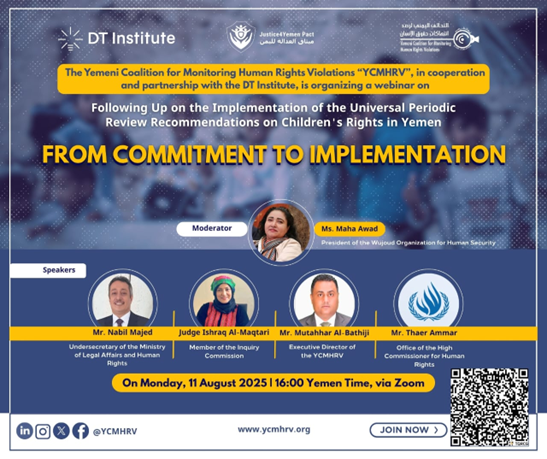
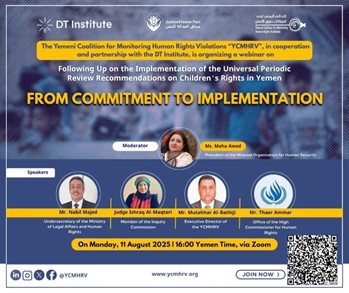
To raise awareness of the ongoing coordination between civil society and government stakeholders on UPR implementation, YCMHRV hosted an online , entitled From Commitment to Implementation: Monitoring the Implementation of Universal Periodic Review (UPR) Recommendations on Children’s Rights in Yemen.
The webinar featured key speakers from the Ministry of Legal Affairs and Human Rights, National Commission to investigate alleged violation of human rights (NCIAVHR), and Office of the United Nations High Commissioner for Human Rights (OHCHR). and brought togetherabout 50 stakeholders. These included representatives from the government, UNICEF, the European Union (EU), civil society, and media
Within the webinar, YCMHRV pointed to alarming statistics, prompting engagement of local and international stakeholders, including prominent contributions by the NCIAVHR and Dr. Thaer Ammar, Human Rights Officer at OHCHR.
💬“Good intentions have not translated into tangible improvements for children’s rights.”– Judge Ishraq Al-Maqtari, Commissioner of the National Commission of investigate alleged violation of human rights (NCIAVHR), while criticizing the failure of several past accountability efforts and calling for renewed engagement during SAFE’s From Commitment to Implementation webinar.
The event successfully bolstered awareness – garnering significant media attention with coverage from 11 media outlets, including Ain Aden, Sama al-Watan, and Al-Muwatin.
SAFE’s Annual National Child Protection Workshop
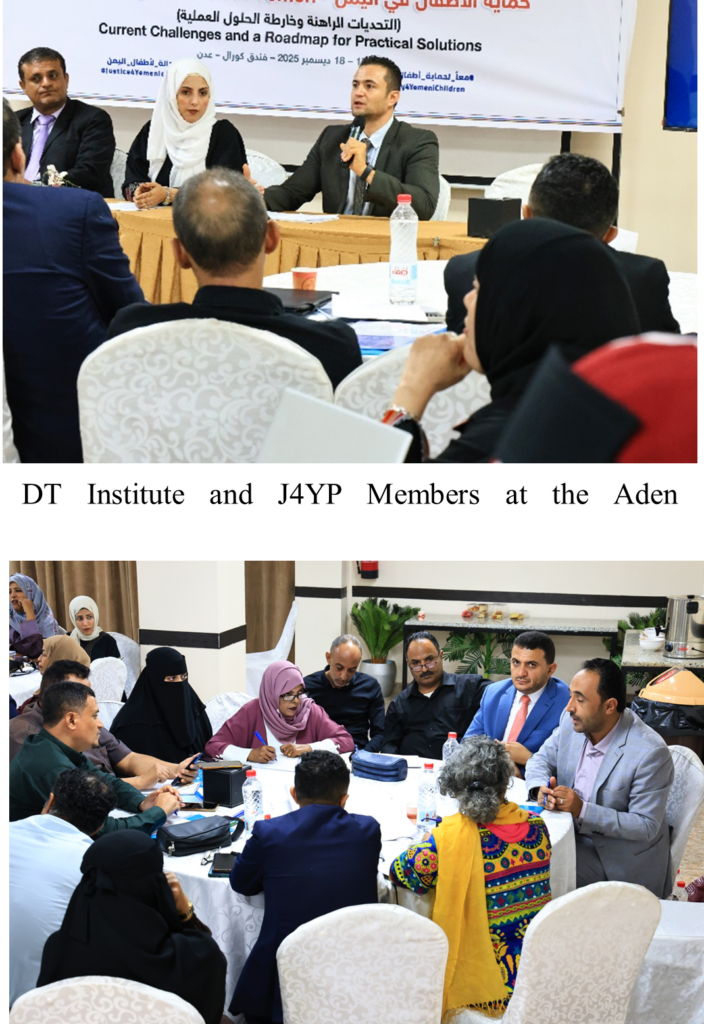
YCMHRV’s ongoing efforts culminated in the second annual national child protection workshop in Aden in December of 2025. The workshop, entitled Children’s Rights in the Yemeni Conflict: Reality and Challenges, brought together over 60 participants, representing 33 governmental institutions, 26 international non-governmental organizations, and 12 local non-governmental organizations, among other attendees.
Prominent participants included governmental ministries, such as the Ministries of Legal Affairs and Human Rights, the Interior, and Social Affairs and Labor. Additionally, Global Rights Compliance, UNICEF, DT Institute, and seven Justice4Yemen Pact (J4YP) Coalition members were also in attendance.
Over the two-day workshop, participants engaged in open-ended discussions within four working sessions aimed at activating their roles in child protection. Each session contained a specific focus. The first two sessions focused on children’s rights during the armed conflict and the compounded impacts of over ten years of grave violations upon children, respectively.
The third centered on protection, rehabilitation, and reintegration of child victims and survivors, while the fourth focused on an actionable plan to make all other recommendations possible – the highly and repeatedly recommended child protection roadmap.
Ten working papers were presented in the working sessions, including a one by INSAF, documenting HRVs against marginalized and IDP children. The paper analyzes factors increasing victim vulnerability and contributing to societal ignorance of serious violations, culminating in actionable recommendations. The paper was also circulated among key stakeholders, including the Ministry of Human Rights, UNICEF, OHCHR, Save the Children, and the United Nations Office for Project Services (UNOPS).
The remaining working papers, presented throughout the workshop by experts, government leaders, judges, prominent international and local organization representatives, and senior human rights researchers, will be published in the coming months.
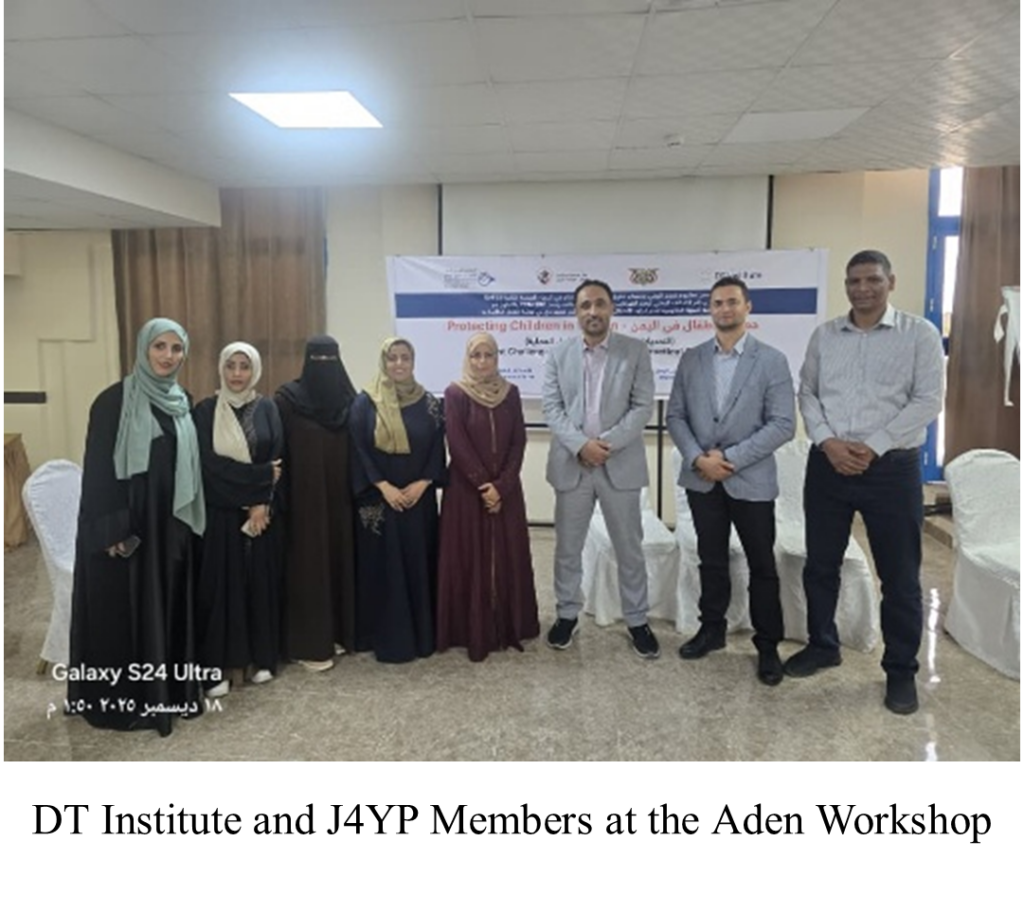
In closing the workshop, organizers affirmed that it represented the beginning of a broader path of collective action aimed at placing the best interests of Yemeni children at the center of policies and decisions, and turning recommendations into practical, actionable steps to sustainably protect Yemen’s children and safeguard their future.
💬 “The scale of violations committed against children confirms that the protection system still suffers from deep imbalances, and that international commitments have not yet been translated into effective measures on the ground, which entrenches a culture of impunity unless serious and urgent steps are taken.”– Mutahar Al-Buthaiji, Executive Director of YCMHRV, in his opening remarks during the second annual national child protection workshop.
Workshop Outcomes and Looking Forward
As held by DT Institute’s Program Assistant, Sahar Mohammed, “The workshop was an impactful culmination of SAFE’s extended efforts to break the ice among stakeholders and unify the vision for strengthening child protection mechanisms.” She pointed to the workshop’s ability to address the government’s openness and willingness to move forward on child protection issues in a candid and effective manner.
In reflecting upon the national workshop, DT Institute’s Senior Program Manager, Feras Hamdouni, stated, “I have witnessed firsthand the tangible impact of SAFE in advancing children’s rights across Yemen. From the in-person workshop in Aden to ongoing coordination with government stakeholders, the program has successfully combined advocacy, evidence-based documentation, and capacity-building to protect children from grave violations.”
“Yet,” Hamdouni continued, “the challenges remain significant: ongoing conflict, limited resources, and restricted access in certain areas make reaching vulnerable children extremely difficult. Strengthening coordination among civil society, government institutions, and humanitarian actors is critical, as is scaling localized successes into sustainable national interventions.”
As Hamdouni emphasized, the path of child protection in Yemen is a long but worthwhile endeavor. In looking forward, YCMHRV and INSAF, in their steadfast commitment and sustained engagement under SAFE I and II, have honed their expertise, networks, and involvement in this area. This effective expertise has culminated in an effective understanding of the obstacles and needed interventions looking forward, and the networks to push for actualization of such initiatives.
Mohammed also emphasized that the current dynamic shifts in the Yemeni context as creating opportunities for children’s rights. She noted that these changes create opportunities to enhance child-related policy reforms and translate recommendations into tangible actions through joint efforts between the government and civil society.
In line with Mohammed’s reflections and SAFE findings, the workshop’s key recommendations focused on strengthening child protection through multiple integrated measures. On the legislative level, participants proposed the formation of technical legal committees focused on legal reforms. The committees’ tasks are envisioned to include drafting laws and amendments with explanatory notes and establishing specialized courts or judicial units to address cases involving serious violations against children.
At the government level, workshop recommendations include establishing a clear national coordination mechanism to define roles and responsibilities among relevant agencies, creating integrated response points, and building the technical capacity of staff in rights reporting, monitoring and evaluation, and translating UPR recommendations into practical, measurable implementation plans.
For civil society, the focus is on enhancing networking and standardizing monitoring and documentation methods, developing secure national community databases, and building capacity for parallel reporting and UPR follow-up. At the international level, recommendations emphasize integrating child protection into peace and transitional justice processes and supporting government and civil society capacity-building to convert international obligations into actionable, measurable plans.
To actualize these recommendations, SAFE is currently working diligently to put together a national child protection roadmap, as requested by multiple diverse stakeholders throughout the workshop, webinar, and coordination meetings. In doing so, SAFE partners envision actionable roles for governmental institutions, civil society organizations, and other child protection stakeholders in line with their engagements in the workshop and in prior coordination efforts.
The roadmap will be circulated will enable effective implementation by the line by promoting joint review and action between government, civil society, and international actors in developing this practical path forward. It is also strengthened and will continue to be informed based on the National Child Protection Plan for Yemen 2026–2029.
SAFE II partners will continue to see this path through by further implementing the roadmap jointly through sustained coordination between government, civil society, and international actors. In doing so, SAFE will continue its promotion of justice and accountability for children’s rights, requiring them to be treated, not only as protection and legal compliance issues, but also as drivers of conflict transformation and peacebuilding.
💬 “I am deeply grateful to our local partners, Yemeni civil society organizations, and government colleagues for their unwavering commitment and collaboration. Together, we are laying the foundation for a child protection system that not only responds to violations but actively safeguards the rights and futures of Yemen’s child.”– Feras Hamdouni, Senior Program Manager at DT Institute, in reflecting upon SAFE’s work in promoting coordination and joint efforts on child protection.