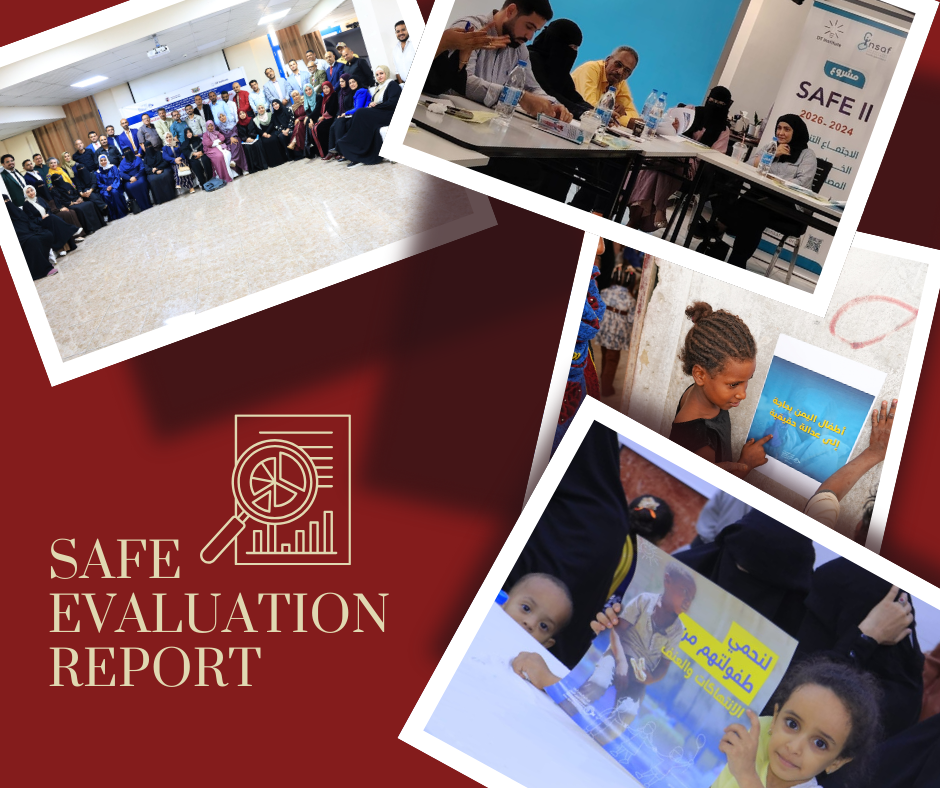
In a conflict where children’s suffering is widespread yet rarely documented, the SAFE Project operated at the intersection of protection, justice, and institutional survival. This brief presents findings from an independent external evaluation, examining what SAFE achieved, where it struggled, and what must come next if child protection in Yemen is to move beyond emergency response toward systemic change.
Evaluation Methodology
This brief draws on findings from an external final evaluation, conducted using a mixed-methods design aligned with the OECD-DAC evaluation criteria and a Human Rights–Based Approach (HRBA).
The evaluation relied on:
- Key Informant Interviews (KIIs) with government officials, civil society partners, psychosocial facilitators, beneficiaries, and project staff
- Review of project documentation, including quarterly narrative reports, monitoring data, case documentation, advocacy materials, and media outputs
- Endline community and stakeholder surveys, triangulated with qualitative insights
Findings were cross-validated across sources to ensure analytical rigor and reduce bias. Despite constraints related to security, access, and internet connectivity, the evaluator concluded that the available evidence was sufficient to assess SAFE’s contributions and draw credible conclusions.
Prominent Impacts Identified by the Evaluation
1. From Silence to Agency: Survivor Readiness to Act
The evaluation documents a clear shift among children and caregivers — not toward full empowerment, but away from resignation.
- 75% of community members reported improved understanding of children’s rights and conflict-related violations.
- 80% reported increased confidence to seek support or report violations, a significant change in a context where fear and stigma dominate.
- Psychosocial support enabled children to become more expressive and caregivers to adopt calmer, more protective behaviors at home.
As one caregiver explained during evaluation interviews:
“After attending the sessions, my understanding of the six main violations children face during conflict improved. I recognized the risks my children could be exposed to, such as harassment or recruitment. After the sessions, my communication with my children improved, and my children now feel safe sharing everything with me.”
The evaluator emphasizes that psychosocial support was not merely therapeutic. It functioned as a catalyst, enabling families to absorb legal information and consider reporting pathways that previously felt inaccessible.
Another caregiver noted the practical household impact:
“While I sometimes lose my temper, I learned stress-relief techniques, such as controlled breathing. This has decreased tension in my family and created a safer environment for my children.”
2. Evidence That Travels: Documentation Linked to Accountability
SAFE’s documentation component emerged as one of its strongest contributions.
- The project exceeded documentation targets and introduced OSINT-based verification to counter misinformation and denial.
- Project-supported evidence contributed to concrete accountability outcomes, including the conviction and maximum sentencing of a perpetrator in a child sexual violence case.
- Digital reporting mechanisms enabled survivors and caregivers to disclose violations, including multiple sexual violence cases reported during implementation.
From the evaluator’s perspective, this linkage between documentation and justice was decisive. As one civil society partner stated:
“Documentation alone is not enough. What made the difference was connecting evidence to advocacy and legal pathways — otherwise cases would remain just files.”
The evaluation stresses that these outcomes represent credible contribution rather than attribution, but nonetheless demonstrate that accountability pathways can function, even within Yemen’s constrained justice system.
3. When the State Listens: Institutional Engagement in a Fragmented System
One of the most significant evaluation findings is SAFE’s contribution to rebuilding channels between civil society and the state.
- Government counterparts reported the designation of Child Protection Focal Points within security institutions.
- SAFE supported the development of Yemen’s first National Child Protection Roadmap, creating a shared reference for coordination.
- Engagement with police and military personnel led to changes in practice, including referring children to juvenile centers instead of detention.
- A ministerial directive institutionalized the broadcast of SAFE-produced child protection content through national radio.
A human rights officer from the Ministry of Human Rights in Aden reflected on this shift:
“We thought international treaties were not binding on us. Through these sessions, we understood that if our country signed them, we are obligated.”
This change in understanding translated into operational practice. As another official noted during KIIs:
“Children are no longer detained in police stations. They are now referred to juvenile centers, which reduces further violations.”
The evaluation characterizes these outcomes as early but meaningful system-level shifts, particularly rare in Yemen’s fragmented governance environment.
4. Changing the Conversation: Early Normative Shifts at Community Level
The evaluation does not overstate social transformation. Instead, it identifies something more foundational.
- Stakeholders reported improved community attitudes toward child protection and reduced tolerance of violations.
- Acts such as child recruitment and sexual violence were increasingly framed as violations — not unavoidable by-products of war.
Community demand for continued engagement underscored this shift. A psychologist working in IDP camps explained:
“Social and psychological support is as essential as food and water. Unfortunately, these families did not have access to free psychological support before. That is why they keep asking for these sessions to continue.”
The evaluator describes this change as a “rejection of silence” — an essential precondition for longer-term protection, reporting, and accountability.
Key Challenges Identified
The evaluation also clearly documents the constraints SAFE operated under:
- Restricted access and insecurity, particularly in areas under Houthi control
- Disinformation and anti-aid narratives, undermining trust and increasing risk
- Weak referral pathways and the absence of a centralized national violations database
- Institutional inertia and bureaucracy, slowing coordination and approvals
- Funding disruptions, affecting continuity and scale
These constraints were repeatedly emphasized by stakeholders. One psychosocial specialist noted:
“Families are ready to engage, but the system around them is weak. Without permanent services, progress remains fragile.”
The evaluation assesses these challenges as contextual rather than design-related, underscoring the limits of short-term, project-based interventions in protracted conflict settings.
Evaluation Recommendations: What Comes Next
Building on SAFE’s achievements, the evaluation puts forward forward-looking recommendations:
1. Institutionalize Psychosocial Support as Protection Infrastructure
Psychosocial care should be treated as a core child protection function, enabling agency, reporting, and prevention — not as a supplementary service.
2. Reinforce the Accountability Ecosystem
Documentation should remain tightly linked to advocacy and legal pathways, with expanded use of OSINT aligned with the Berkeley Protocol to protect evidence integrity.
3. Move Beyond Awareness to Standard Practice
Short-term sensitization should evolve into formal Standard Operating Procedures (SOPs) within security and justice institutions.
4. Consolidate Civil Society–State Coordination
The Child Protection Roadmap and focal point network require operational resourcing to prevent regression once project support ends.
5. Scale Localized, Decentralized Models
The evaluation strongly recommends scaling SAFE’s localized delivery model, which proved effective in maintaining access, trust, and continuity in fragmented governance contexts.
Conclusion
The external evaluation concludes that SAFE demonstrated strong relevance and effectiveness, delivering meaningful intermediate impacts across individual, community, and institutional levels under extreme constraints. While long-term transformation depends on political will, security conditions, and sustained investment, SAFE established foundational capacities, coordination mechanisms, and normative shifts that materially strengthen Yemen’s child protection landscape.
As one child from an IDP camp in Taiz simply expressed during the evaluation:
“I hope the psychologist will come back. She gives us hope.”
In Yemen’s current reality, the evaluation suggests, hope backed by systems may be the most realistic form of protection available.