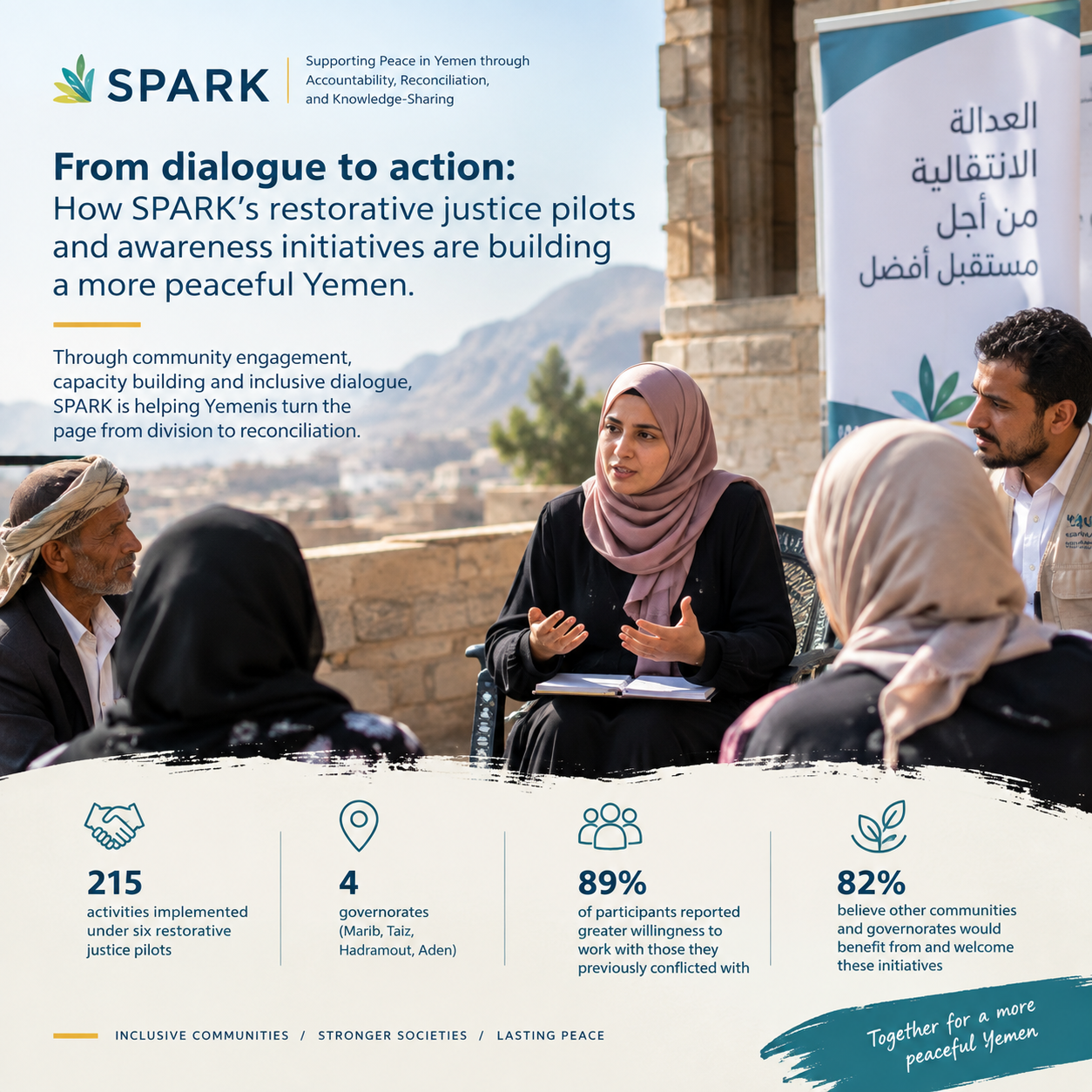
Marib Dam Foundation for Social Development (MDF), member of Justice4Yemen Pact Coalition, has released a groundbreaking policy paper exploring how Yemen’s rich tribal heritage can play a central role in building justice and peace after years of war. The report, produced under the SPARK Program funded by DT Institute, offers a bold vision for integrating tribal customs with formal justice mechanisms to achieve accountability, reconciliation, and sustainable peace.
At a time when Yemen’s state institutions remain fragmented, tribal systems have continued to function as trusted mechanisms for conflict resolution. The paper argues that transitional justice in Yemen cannot succeed if it ignores local customs, which have long served as pillars of social balance and dispute resolution.
Drawing from field experiences in governorates such as Marib, Shabwa, and Taiz, the study reveals how tribal mediations have resolved blood-feud cases, opened vital roads, and supported prisoner exchanges — achievements that underscore the strength and legitimacy of Yemen’s local justice traditions.
The paper also highlights how Islamic values, such as forgiveness, fairness, and reparations, naturally align with transitional justice principles. It proposes practical policy recommendations — including training tribal mediators, documenting positive customs, and establishing coordination frameworks between tribal councils and judicial authorities.
Among its key findings:
- Tribal customs are not opposed to modern justice; with proper reform, they can complement formal mechanisms.
- Yemeni proverbs and oral traditions preserve deep values of accountability and fairness that can inspire reconciliation.
- Women and youth must be empowered as mediators and participants in reconciliation processes.
- A unified national vision is needed to integrate tribal customs into Yemen’s future transitional justice framework.
By rooting justice in Yemen’s own culture and faith, the report shows that a uniquely Yemeni model of transitional justice is not only possible — it is essential.
Read the full report: