Grave Violations of Children’s Rights Rampant Throughout Yemen
Despite international commitments and ratification of treaties, official bodies responsible for promoting and protecting children’s rights in Yemen continue to fall short. Over the life of the SAFE (Supporting Awareness, Facilitating Enforcement of Children’s Rights in the Yemeni Conflict) Program, local partners have documented 428 human rights violations committed against children.
SAFE partners, which include the INSAF Center for Rights and Development (“INSAF”) and the Yemen Coalition for Monitoring Human Rights Violations (YCMHRV, also known as “Rasd”), stress that the vast majority of these are not only human rights violations, but also grave violations against children’s rights in times of war, as identified and condemned by the United Nations Security Council (UN SC) due to their egregious nature and severe impacts on children.
Child recruitment and the killing and maiming of children (both grave violations) represent the bulk of the crimes documented by SAFE partners at approximately 56 percent (238 violations). Combined with the rest of the grave violations, of which there are only six – denial of humanitarian access, attacks on schools and hospitals, sexual violence, and child abductions – these atrocities accounted for over 90 percent of the human rights violations documented.
Conflict Parties and State-Affiliated Actors’ Patterns of Abuse
The likely perpetrators, uncovered through detailed SAFE documentation and analysis, unsurprisingly include conflict parties (and among these state-affiliated actors), accounting for 97.2 percent of the documented violations. Further SAFE analysis has also revealed the patterns that have compounded violations and led to further continued atrocities. These include complex violations – the propensity for one violation to lead to another – frequently observed with cases of child recruitment, which often involves and/or leads to child abduction, attacks on schools, the killing and maiming of children, and sexual violence against children.
Violations against children in Yemen, including complex and grave violations, have also been found to be part of further systematic abuse patterns of marginalized children. INSAF’s investigative reporting reveals how conflict parties, including state-affiliated actors, repeatedly abuse child victims – initially, indirectly by subjecting them to displacement and loss of livelihood as causalities of the greater conflict, then directly through grave violations committed against child victims. The report also involved further documentation and verification by INSAF’s field team finding that over 62 percent of the documented report cases were linked to military formations associated with the Internationally Recognized Government of Yemen (IRG).
The State’s Obligations
Further SAFE analysis has also demonstrated systematic weaknesses in institutional performance as key obstacles negatively impacting children’s rights throughout Yemen. Yemeni stakeholders, including victims, community members, political actors, and children’s rights experts and institutions, have identified several key institutional issues hindering child protection. These include non-compliance with international treaties relevant to children’s rights, including the premier Convention on the Rights of the Child (which 79.7 percent of respondents cited), absence of accountability (96.9 percent), and poor institutional coordination (80 percent).
Combined, these statistics draw alarming and compelling conclusions about what can be done to advance children’s rights in Yemen. If the State’s inherent duty to its people is not enough, these statistics further place the burden upon the State to set the example in upholding children’s rights amidst Yemen’s conflict parties. This standard requires commitment not only to enforcement of child protection standards but also in ensuring respect and upholding of children’s rights in the actions of military formations and State affiliates.
SAFE Engagement of Law Enforcement Officers
INSAF, under SAFE, is working to foster the State’s commitment to children’s rights and protection via the engagement of law enforcement actors. Through sustained, in-person awareness-raising and education sessions, held within law enforcement training facilities, INSAF has engaged of 113 law enforcement actors and officers throughout Yemen – transforming their understanding of and capacity to protect children’s rights.
These sessions came about because of INSAF’s extensive monitoring and documentation activities and persistent engagement of national authorities and institutions. These activities sparked the attention of the Ministries of Justice, the Interior, and Human Rights and Legal Affairs – which INSAF quickly leveraged into action. In cooperation with INSAF, these national institutions agreed to conduct an advocacy campaign to enhance law enforcement’s commitment to obligations under international treaties and increasing their capacity for institutional coordination.
As part of this campaign, INSAF agreed to coordinate with government technical committees and the Ministry of Justice to conduct in-person training sessions at law enforcement institutions and military camps in Yemen. It was further agreed that the sessions would do so by raising awareness of the dangers of child recruitment and children’s rights under international law and the importance of access to violation reporting mechanisms.
In spearheading this initiative, INSAF developed an action plan, which it shared with the Ministries previously consulted as well as with several other national and international stakeholders. These entities included the Women and Children’s Rights Division of the General Deputy Office, United Nations Children’s Fund (UNICEF), the Yemeni Women’s Union (YWU), and the National Commission to Investigate Alleged Violations of Human Rights (NCIAHRV).
The action plan was shared within the third session of a series of coordination meetings aimed to enhancing Yemen’s institutional commitments to the protection of children’s rights. This ensured alignment with broader, joint objectives between key national and international entities, experienced in child protection and directly engaged in addressing humanitarian crisis.
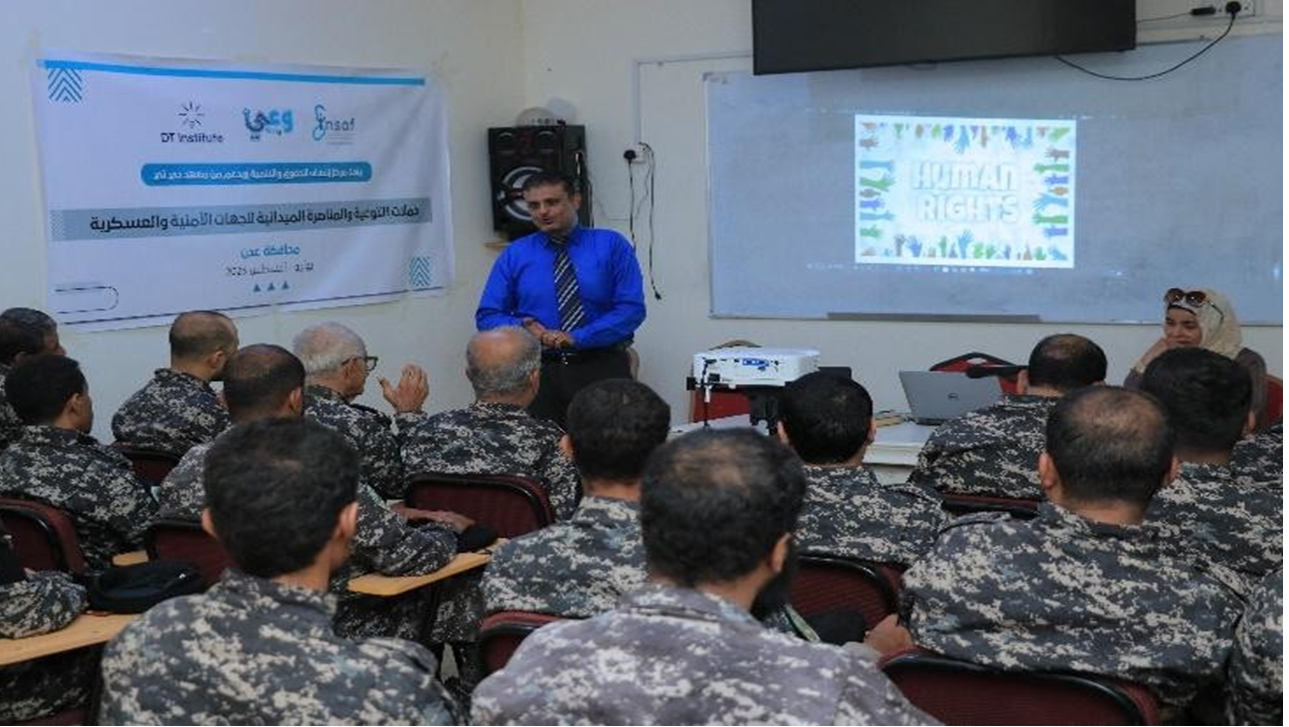
Under the action plan, INSAF conducted two awareness sessions for 64 security and military actors. The sessions promoted adherence to national legislation and international child protection commitments, while also bringing awareness to international mechanisms for the protection of child rights.
Session attendees included military leaders, officers, and field commanders, including the Chairman of the Transitional Council Committee, Commander of the Protection Brigade, Commander of the Military Police Brigade, and multiple Brigade Generals. The sessions were held at Al-Solban and Badr military camps, respectively.
The selection of attendees and camps to host the sessions was determined based on their strategic importance and ability to effectively promote institutional coordination and adherence to national and international obligations protecting children’s rights. Both camps are strategically important to the interim capital, Aden, and are amongst the most prominent training and rehabilitation centers for security and military forces.
Al-Solban Camp, where the first session was held, is a vital military facility that plays a key role in training government protection forces. Thus, INSAF was determined to conduct an awareness-raising session here to effectively educate the officers and actors that continue to train and supply military forces. Within this first session, INSAF engaged 32 military leaders, officers, and field commanders.
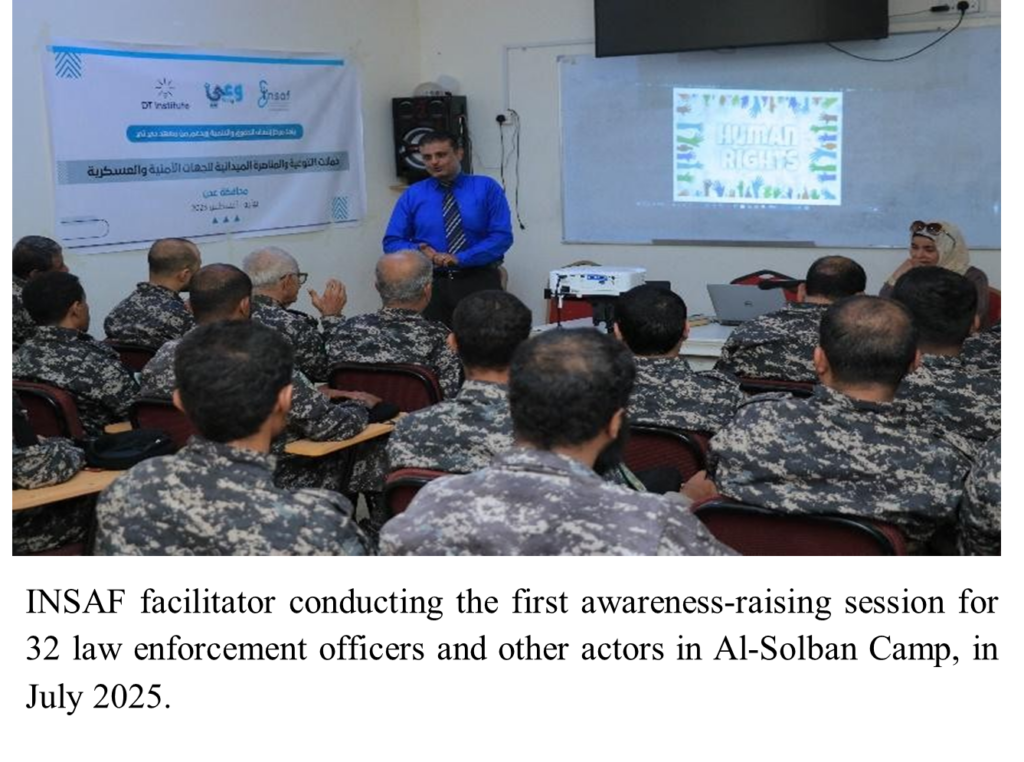
Similar to Al-Solban, Badr Camp, where the second session was held, is also used to train and qualify military units – specifically those belonging to the third brigade. To facilitate implementation of this session, it was conducted in coordination with the Commander of the Military Police Forces. The session included prominent attendees, including several high-level commanders and generals affiliated with military police forces as well as the Southern Transitional Council (STC).
In total, 32 participants attended, including Chairman of the Transitional Council’s Committee, Commander of the Protection Brigade, Brigade Generals, and Commander of the Military Police Brigade.
Both sessions witnessed significant positive engagement from attendees as they shared their practical field experiences and expressed their opinions on child recruitment. They also demonstrated a keen interest in understanding the legal and humanitarian framework of grave violations of children’s rights.
Through open discussion, the facilitators garnered strong interest and interesting interactions from participants, who affirmed their readiness to cooperate with INSAF to further child protection objectives. This included a commitment to enforce the legal age of recruitment and ensure that children are not being used as soldiers within the war.
During the second session, Brigadier General Aref Al-Basisi, who also contributed to the initiative by coordinating with INSAF on session logistics and inviting personnel, made a statement. In this statement, he affirmed the commitment of military police leadership to refrain from recruiting children under the age of 18. He further stressed that the military police are a regulatory body serving order and discipline, and as such, bear a major responsibility in monitoring recruitment of the armed forces.
💬 “The military police must be more careful in monitoring the units and preventing any cases of recruitment below the legal age. It is our duty as leadership to set this standard as the basis for any recruitment process in accordance with military laws and the system of the armed forces.” – Aref al-Basisi, Brigadier General in the Yemeni Armed Forces.
Continued Engagement Looking Forward
These sessions worked, not only to educate law enforcement actors, but also to bridge the gap between civil society and government institutions, in line with the recommendations of Yemeni stakeholders. Building off the successes of the training sessions, INSAF held two coordination meetings with representatives from the Ministry of Justice and the Aden Social Defense and Security departments.
Within the meetings, the parties agreed to continue similar initiatives, due to the success of previous coordination and the field visits. Their coordination resulted in an agreement to implement two structured training workshops targeting police departments, Juvenile Prosecution, and the Juvenile Court in Aden. The workshops will combine theoretical and practical components, focus on real-life cases, and be delivered at the Child Protection Center in coordination with relevant authorities.
In addition to these two new training workshops, the parties also agreed on the development of tailored training materials aligned with SAFE II project objectives and continued high-level engagement with security leadership. They further agreed to strengthen coordination mechanisms to ensure effective implementation and improved child-sensitive responses within the justice and security sectors.
They also suggested participants for inclusion, including assistants to the Women’s Affairs Directors – due to the recent appointment of female staff in this position to handle women’s and children’s cases. Suggested participants also included representatives from the Juvenile Prosecution and Court and jailers, shift officers, criminal investigation directors, and police investigators, as they are often in close contact with child victims.
Connecting Engagement to Larger Activities
Engagement of law enforcement officers and national government protection institutions is only part of INSAF’s – and SAFE’s – broader agenda to combat grave violations of children’s rights and enforce child protection throughout Yemen. However, it is a significant step.
“After more than a decade of conflict in Yemen, state institutions — particularly core security and law-enforcement bodies — have suffered profound deterioration, limiting their ability to protect civilians and uphold the rule of law. From a child rights and advocacy perspective, this institutional erosion represents a critical protection gap that must be addressed through targeted reforms and coordinated interventions to ensure a safer and more protective environment for children,” explained Sahar Mohammed, DT Institute’s Program Assistant.
Moreover, these workshops – and the ongoing coordination required for their implementation – have significantly contributed to necessary and effective engagement of national institutions on children’s rights. This is crucial as their cooperation is vital to achieving a Yemen in which children are shielded from conflict, rather than used as weapons of war. In doing so, INSAF continues to document, advocate, and report on children’s rights issues with the understanding that sustainable protection of children’s rights requires whole-of-society engagement.