1. Overview of the SPARK Program
In April 2025, the SPARK team, composed of DT Institute and its local partners, the Abductees’ Mothers Association (AMA) and SAM for Rights and Liberties (“SAM”), formed the Community and Reconciliation Consensus Committee (CRCC, also known as the al-Wefaq Committee). The CRCC includes 10 prominent social figures in Taiz, who aim to foster reconciliation, document key issues threatening peace community coexistence, and to empower communities to resolve such disputes through community-led resolution processes. CRCC members were selected according to strict criteria taking into account their local influence, the communities represented, and their reputation for trustworthiness, legitimacy, and commitment to transitional justice and to human rights.
The CRCC’s scope of work was designed in response to the findings of The Path Towards Peace, a research study published by SPARK in April 2025. This study captured local understandings of transitional justice across Yemen, revealing an urgent need for legitimate local mechanisms that can translate community grievances and priorities into accountable and effective governance responses.
Study findings held that while most (79 percent) of community members in the study also expressed a need for institutional reforms throughout Yemen, focusing on legal and law enforcement institutions due to their failures to bring justice for victims. In response, the CRCC was designed as a community-based governance mechanism to complement, rather than replace or recreate, the role of state institutions. The CRCC does so by acting as a trusted intermediary between communities, formal governance structures (including local authorities, security actors, and national institutions), and supplemental stakeholders, such as donors, influencers, international non-governmental organizations, and local civil society.
By engaging and coordinating the responses of these entities, the CRCC has enabled state institutions to effectively address local accountability gaps. Moreover, the CRCC also functions in a watchdog-like capacity by actively involving itself in the resolution of public grievances from start to finish. Through this role, it combats law enforcement corruption – especially in cases where the perpetrators are security members or affiliates – reaching cases in both more dense and rural areas (where additional difficulties in reporting, such as mobilization, exist).
2. The Community Consensus and Reconciliation Commission’s Strong Start, Entrenching Their Reputation in Restorative Justice and Reconciliation
Upon the launch of documentation efforts in April, the CRCC immediately hit the ground running. Thus far, the CRCC has documented over 115 significant community disputes involving serious community tensions threatening peaceful coexistence and fostering unrest. Of these, 38 have been resolved by the CRCC, acting as an intermediary between communities, formal governance structures, and additional stakeholders, including SPARK partners and other local and international non-governmental organizations.
💬 “In a matter of weeks, the committee has been able to unlock solutions to disputes that government institutions, despite their mandate, have been unable to initiate due to the current context. This impact goes beyond resolving individual cases; it demonstrates a practical model that can inform and inspire government-led approaches in other communities.” – Feras Hamdouni, Senior Program Manager, DT Institute.
Each of the disputes addressed by the CRCC reflects broader patterns impacting transitional justice, including community disputes over limited resources (primarily water) and tensions related to internally displaced persons (IDPs). Moreover, each dispute arises from complex and interlocking factors, underpinned by the lack of effective governmental mechanisms for accountability, action, and justice. In the absence of good governance, civilians’ situations have continued to deteriorate – gravely impacting community cohesiveness, disrupting community members’ livelihoods, and turning factions against one another.
In addressing these deeply decisive disputes, the CRCC has been able to accomplish in weeks what formal mechanisms had been unable to address in years. Their steadfast, trauma-informed, and survivor-led handling of community disputes has gained widespread attention and appreciation throughout implementation areas. The Chairman of the Presidential Leadership Council (PLC) Committee in Taiz stressed the importance of continuing such initiatives to “strengthen the cohesion of society.”
Moreso, the CRCC, itself has gained a strong reputation, entrenching itself into the Yemeni civil society landscape as a key coordination mechanism between all parties relevant to community disputes. These include, but are not limited to, governmental institutions, local authorities, security units and affiliates, local and international non-governmental organizations, philanthropists and donors, and local community members and survivors.
“During my recent visit to Yemen, the most consistent feedback I heard from civil society, and local authorities was the strong credibility and trust the CRCC has earned,” shared Feras Hamdouni, Senior Program Manager at DT Institute. He further explained, “importantly, the CRCC is not intended to replace state institutions, but to bridge critical gaps at the local level and translate community-driven solutions into coordinated action with authorities. This linkage between local initiatives and national-level engagement is essential for sustainability and for embedding reconciliation and accountability within longer-term governance systems.”
A testament to its credibility – the CRCC also enjoys regular meetings with key decision makers and influential figures throughout Yemen to coordinate and follow up on ongoing key issues. These include governmental entities and figures, such as the Ministry of the Interior (MOI), Presidential Committee, and local authorities, among others.
This trust is also deeply reflected throughout communities in Taiz, which regularly call upon the CRCC to resolve complex and debilitating community disputes and grievances after appealing to authorities and others to no avail. This has solidified its status as a strong, unifying entity that can effectively push for accountability and action from local authorities, governmental institutions, and other relevant parties – even when these parties are ineffective on their own.
3. Strengthening Good Governance and Accountability Through the Resolution of Community Disputes Throughout Taiz
By bridging the gap between disputing parties and activating the responsibility of local authorities and governmental institutions, the CRCC has created sustainable solutions contributing to good governance and accountability. Such solutions serve not only to resolve singular or one-off conflicts but as living resolutions, to be benefited from, recreated, and expanded upon by local communities in coordination with relevant authorities.
Taiz – Yemen’s Third Largest City in Disarray
After over 10 years of pervasive and violent conflict, Yemen’s third largest city remains in state of high violence and devastation. Fighting between government forces, Houthi fighters, and other local actors continues to plague the city, which has been under Houthi siege for years. The siege has restricted the entry of essential resources, deepening humanitarian crises and further impacting widespread lack of food, clean water, and adequate housing.
The security situation remains highly volatile and dangerous, caused by the ongoing conflict and the pervasive impunity, further justifying violations. Community members within Taiz have reported several negative impacts of the conflicts, including serious human rights violations. Among these, looted homes and lack of access to safe water were chief shared concerns, exacerbating pre-existing tensions, devolving community relationships, and deepening dividends. However, despite community members’ insistence regarding the seriousness of their concerns and their significant negative impacts on their respective communities, their pleas are largely ignored.
Governmental systems, including local authorities, the Presidential Committee, and judicial institutions have failed to adequately address many of these cases – leaving civilians to fend for themselves. Informal mechanisms, including tribal systems and civil society, have also faltered. With nowhere to turn, community members continue to turn against one another.
Through SPARK activities, partners and the CRCC have observed the impact of deterioration of government services on community members. Inability or refusal of official entities to respond to the population has bolstered all other violations throughout Taiz, as it champions impunity, heightening risks and enabling further violations.
💬 “I … portrayed people’s struggles with water, electricity, and closed roads, to send a message that Taiz will remain steadfast despite everything.” – Nada Mahmoud, a victim of Taiz’s siege and continuing instability and SPARK Memory Museum participant, sharing her painting prepared for the initiative.
- Initiatives Spotlight: Addressing Severe Governmental Shortages in Responding to Looted Homes and Water Scarcity
Restoration of Looted Homes in Taiz
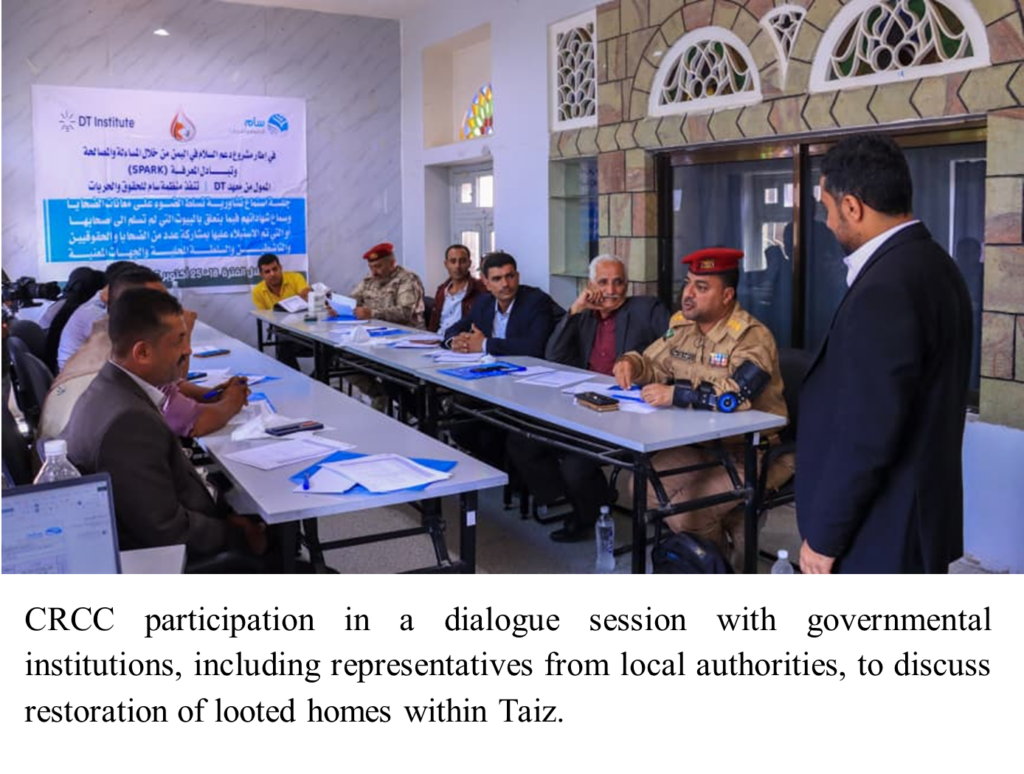
Community members, who had their homes looted, shared their experiences with the CRCC, attesting to years of displacement fraught with fruitless appeals to both formal and informal mechanisms. Among these mechanisms was the Presidential Committee, unable to bring justice in cases that it was established under the former President of Yemen, Abdrabbuh Mansur Hadi, to address.
In response, the CRCC stepped up, working with SAM to establish a sustainable community resolution mechanism. This mechanism, largely formed by CRCC and SAM team members, provides displaced civilians with a reliable place to submit and effectively address their grievances. It does so by assigning roles to key stakeholders needed to handle the cases looted and occupied homes – of which over 72 percent are occupied by military and security affiliates – and restore them to their rightful owners.
The role of each key stakeholder is clear, avoiding needless duplication, while simultaneously ensuring that each required entity does its part. Local authorities manage databases, shelters (for IDPs, who are also occupying looted homes), repairs, and livelihood support for affected community members. Civil society organizations work to monitor houses, facilitate dialogue between stakeholders, provide legal aid, and raise awareness of affected populations. The security sector’s role is to ensure safe evacuations and conduct appropriate risk management. Finally, the Presidential Committee supports complex cases, coordinates with authorities, and works with the judiciary to verify ownership and expedite rulings restoring legal ownership.
Responding to the inability of the Presidential Committee, local authorities, and other official institutions by leveraging coordination to effectively harness their roles, the CRCC’s mechanism has enabled restoration of 39 homes in less than three months – after years of occupation and owners’ numerous unanswered attempts to restore them.
To support this mechanism and ensure its sustainability, a plan was agreed upon and a diverse coordination team was formed. The team was formed from representatives of each of the cooperating entities, including from the Taiz Axis, Police Department, and Governorate Off ice, as well as civil society, community members and survivors, the judiciary, and the Executive Unit for IDPs.
The success of this mechanism is reflected within the coordination team – formed from diverse community members, including official institutions working to hold perpetrators, including their own military and security affiliates, accountable. This further underscores the CRCC’s great impact in promoting good governance accountability – both by requiring governmental institutions to fulfill their obligations to the people, but also by pushing them to demand accountability from their own affiliate-perpetrators.
Despite these difficult asks, the CRCC has only furthered its positive relationship with the Chairman of the Presidential Committee, who praised the CRCC’s field and community efforts in restoring looted homes. He further noted that the CRCC’s work represents an important tributary to the efforts of the Presidential Committee in consolidating the principles of justice and building trust between citizens and official authorities. He also expressed the readiness of the Presidential Committee to fully cooperate with the CRCC and facilitate its tasks in implementing the eviction decisions and restoring the rights to their owners.
Providing Access to Water and Supplementing Basic Service Delivery
Throughout Yemen’s greater conflict, water has also remained a pervasive issue in Taiz. Conflict parties, including government-affiliated forces, have repeatedly hindered public access to safe drinking water and interfered with public water services. This has exacerbated already depleted systems. An in-depth field study analyzing the water crisis, conducted by South24 (an independent, media and research nonprofit, based out of Switzerland), argued that failed governance and the lack of sustainable management are also to blame.
SPARK partners have, in the past, called out governmental institutions for their responsibility in perpetuating the water crisis, drawing attention to the widespread collapse of infrastructure, record-high prices, and lack of adequate services. The CRCC continues to push SPARK one step further – by involving itself as an active and reliable actor in responding to Taiz’s water crisis and insisting upon joint action.
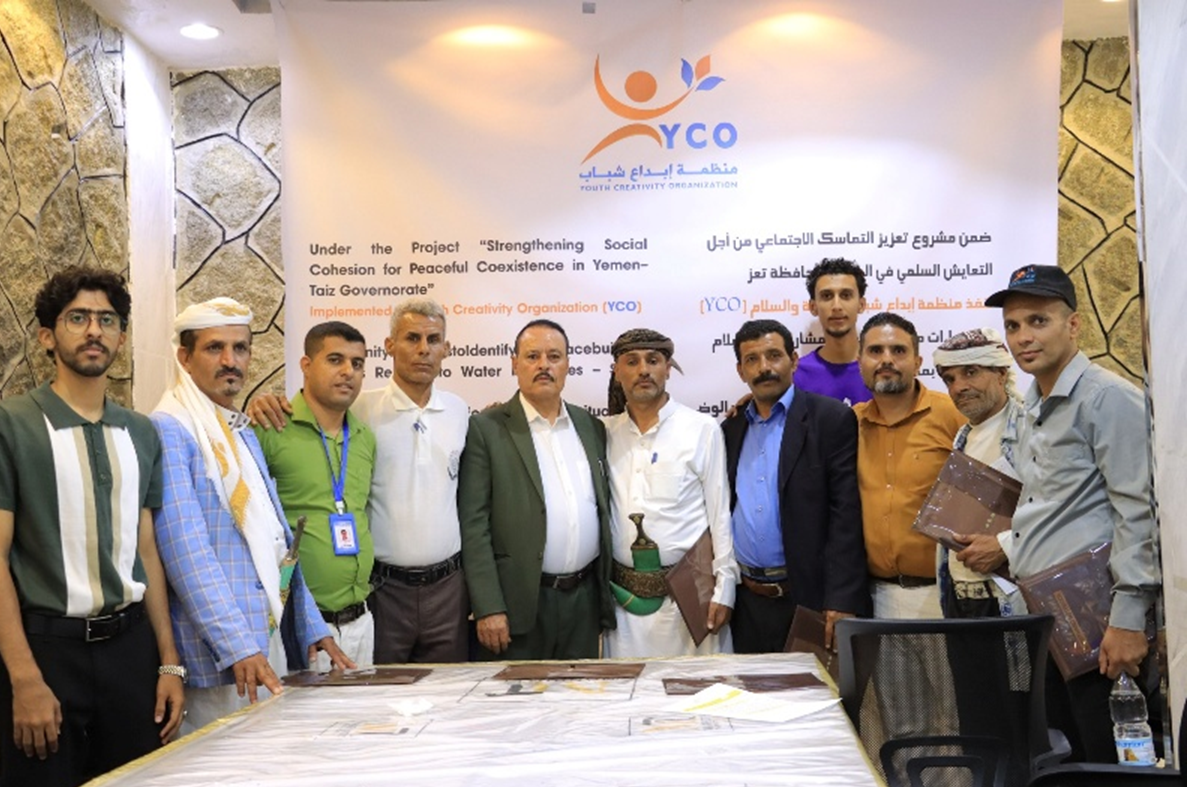
Over the CRCC’s lifespan, it has established itself as a responsive and effective actor in addressing Taiz’s greater water crisis – resolving pervasive community disputes surrounding water in Maqbanah, Al-Shamayateen, and Saber Al-Mawadem, among other areas. This has culminated in the CRCC’s invitation and participation in high level discussions and workshops, including the Social Cohesion and Resolving Water-Based conflicts and Identifying Peacebuilding Projects Workshop, held by the Youth Creativity Organization.
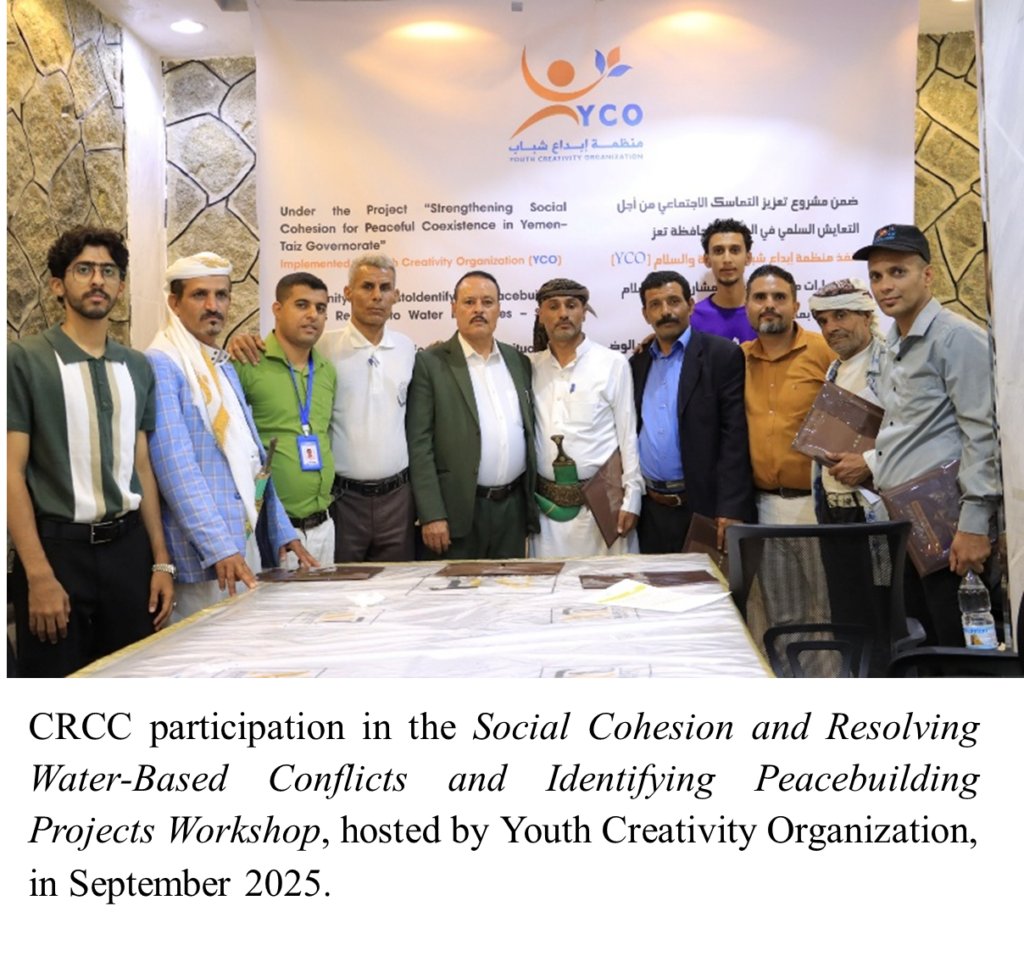
Within this workshop, prominent stakeholders directly involved in water and peacebuilding came together to assess Taiz’s urgent water needs. Among these stakeholders were the Director General of the Local Water and Sanitation Corporation in Taiz, the Director of Projects at the state water corporation, and the Director of the Public Works and Road Branch in Salah District. These key decisionmakers came together, along with community leaders and key informal stakeholders, such as prominent Sheikhs, to coordinate to coordinate comprehensive and sustainable solutions within the governorate between key actors.
The session resulted in the identification of dozens of existing conflicts in Salah district, which the CRCC was ready and primed to attend to. At the end of the workshop, the Youth Creativity Organization released a short video, documenting its impact. Within the video, the Youth Creativity Organization also thanked the CRCC for initiating the workshop by encouraging them to host and suggesting this initiative. From there, the CRCC took the workshop participants’ grievances and recommendations and utilized the discussion as a launching off point to coordinate urgent relief and sustainable efforts responding to community needs.
To combat the lack of access to clean water, the CRCC proposed the construction of three new surface wells, strategically located to alleviate the suffering of populations in governorate areas with the highest need. It shared this proposal with other civil society organizations and key actors during the workshop, successfully mobilizing charitable funding to finance project.
With this approval in hand, the CRCC is now working to engage local authorities to coordinate the search for suitable sites for the wells. In addition to local authorities, the CRCC is also leveraging the expertise of its members and their relevant networks by circulating a request for any relevant studies and well location proposals to be shared. Moreover, the CRCC is preparing to undertake their own assessments to determine the best sites for the wells according to strict criteria, prioritizing maximum benefit in meeting population needs.
In addition to establishing the wells, the CRCC also proposed the restoration of three damaged water collection tanks in Salah district, worth 50,000 USD. This was made possible by the CRCC’s efforts in meeting with and coordinating work amongst the Director General of the Directorate, Youth Creativity Organization, and other relevant stakeholders.
The purpose of the meeting, held at the local authorities’ headquarters in Salah, was to discuss a mechanism for restoration of the tanks. Within the meeting, the CRCC assisted the parties in working out the technical and administrative aspects of the project. As a result, procedures were agreed upon and an agreement was formed – with completion of the restoration expected by the end of January 2026.
Recognizing an urgent need within IDP camp sites and informal settlements, the CRCC also mobilized funding to provide seven tanks of safe drinking water to communities experiencing severe basic service shortages. The provision of these seven new water points, spaced out through the effected regions, enabled immediate relief for the affected population as the CRCC continues to coordinate long-term solutions. In doing so, the CRCC is following up with the local authorities at the state water corporation, which supplies basic services to the area, to open the water lines needed.
The CRCC has further addressed water disputes hindering local development projects and caused by deteriorated governance in Al-Shamaytayn. Disputes between tribal groups and politically backed factions led to the suspension of the Khubl Water Project, needed to sustain the livelihoods of community members in the area. The CRCC stepped in to resolve the suspension and resulting social tension that continued to deepen as community members’ pleas remained unanswered.
The CRCC stepped in to coordinate with the local authorities, the Rural Water Directorate, and Ministry of Social Affairs – pushing them to comply with their obligations. Through this coordination, the CRCC was able to organize fair and transparent elections to establish a legitimate management committee to oversee the project. This approach strengthened transparency and accountability, ensured community participation in decision-making, and restored trust in local institutions, enabling the project to resume effectively.
Similarly, while addressing the Al-Alaqmah Water Project, tensions between armed groups affiliated with political parties and the local community blocked progress. The committee supported the election of an impartial administrative body and coordinated closely with district authorities to implement solutions. This intervention reduced political interference, promoted impartial leadership, and strengthened the community’s confidence in local governance structures.
- Scaling the Impact
The urgent need for continued CRCC intervention is clear: good governance and accountability are severely fractured and challenged, not only within Taiz, but throughout all of Yemen. Ten years of harrowing conflict has left the country with fragmented governance structures, weak – and in some areas, nonexistent – rule of law, and a grave human rights landscape. State institutions are weak at best, while local institutions are often similarly powerless, lacking access to funding and resources. Among this backdrop, impunity is rampant as it spreads unchecked throughout rural and dense areas alike.
The CRCC’s work plays a critical role in easing local unrest, bridging social divides, and laying the groundwork for sustainable peace. Equally urgent is the broader need for transitional justice. After more than a decade of failed national peace talks, victim-centered approaches like restorative justice pilots represent a new path forward.
“The CRCC is not just an important entity – it is vital – needed in this context to bring these state actors, who should be answering to the people, together, so that they may coordinate and work in an organized manner to meet their obligations and objectives in addressing their communities’ grievances,” explained DT Institute’s Program Officer, Lynn Arbid. “This is incredibly important at the local level, but, at the national level, this is instrumental – as cohesion and coordination amongst all state-level institutions must be synchronized and responsive to community concerns and needs in order to actualize transitional justice.”
By demonstrating how good governance and accountability can be achieved at the community level, the CRCC operationalizes transitional justice principles, educating stakeholders, building trust, and fostering shared frameworks for conflict resolution. These pilots serve as blueprints for future transitional justice efforts and larger coordination efforts, rooted in local ownership, dignity, dialogue, and joint action.