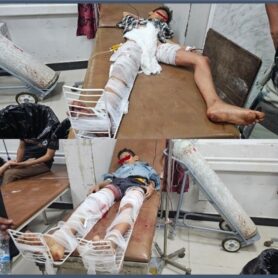
| Incident: | Two children injured by Houthi sniper fire |
| Date: | April 26, 2025 |
| Location: | Al-Dumaina area on 30th Street, near the old airport, northwest of Taiz city |
Introduction:
The moment two children, Suleiman Fahd, 13, and Mohammed Mansour, 12, arrived at Al-Thawra Hospital in Taiz on the afternoon of Saturday, April 26, 2025, covered in blood and screaming in pain, the phone of the young anesthesiologist, Rakan Mahyoub, rang. He had only been in the break room for a short nap. He was immediately summoned to the emergency room, and upon arrival, he found the situation chaotic, and a race against time had begun; he joined in immediately. After two hours, the problem was under control. He left the doctors’ room and sat in the crowded waiting area, wondering, How and where could two children be shot by such a perilous weapon that almost severed their legs?”
The two children live with their families in Al-Dumaina area on 30th Street, near the old airport, northwest of Taiz city. This area is close to the frontline between the Houthi forces and the legitimate government forces, where bloody battles took place between them before the truce that started in mid-2022. Earlier that day, the two children had headed to a nearby well on a water tanker to fetch water for their families. They were filling water cans when a Houthi sniper positioned on the hill overlooking the area shot them.
The sniper’s bullets struck the two children in the legs, causing serious fractures and nerve injuries. Some residents managed to reach the two children and pull them from near the well, and took them to Al-Thawra General Hospital, where they received first aid before being transferred to Al-Safwa Hospital for further treatment for the serious injuries they sustained.
According to a recent report by the American Center for Justice, the Houthi group “uses snipers as one of the most lethal weapons against civilians living on the outskirts of the besieged Taiz Governorate. Victims are often shot while leaving their homes to fetch water (…) or while students are going to or from school.”

Background:
Yemen is one of the most water-scarce countries in the world. The United Nations’ Humanitarian Response Report, issued two years ago, stated that 15.3 million Yemenis—more than half the population—do not have access to sufficient water, including for drinking, cooking, and sanitation. Taiz Governorate, particularly the city, is more affected than any other governorate. According to a public policy paper issued in October 2022 by the Develop Your Community organization, “Taiz Governorate suffers from a chronic water crisis that has worsened sharply since the 90s.”
Taiz lies on the front lines of conflict, and before the outbreak of war in September 2014, water reached homes every 40 days. The suffering of Taiz residents due to the water crisis had long been severe, but due to the war, which reached the city in April 2015, and the stifling siege imposed by the Houthi group since September 2015, the suffering has turned into a tragedy, even hell!
Taiz Children Between Death by Thirst or by Houthi Snipers:
A report by the American Center for Justice revealed that the water sector in Taiz has been severely damaged due to the war. According to the report, before the siege, the General Corporation for Water and Sanitation in Taiz city relied on 86 wells from five water fields for its water supply. As Human Rights Watch documented, four of these wells are under Houthi control or on the front lines of the conflict, “making them inaccessible to Taiz residents. Houthis have halted water flow to government-controlled areas, despite knowing that the city’s residents depend on this water.”
Pumping from 48 wells has been halted due to Houthi forces taking control of them or their location in areas of active conflict. During the second year of the war, a report by the Taiz Humanitarian Relief Coalition stated that the percentage of water outages reached 100%, and that 1.6 million people are in dire need of drinking water. The war and siege have caused massive human and material losses in the water sector, with 21 employees killed and most of them forcibly displaced from the city.
Before April 2015, the General Water Corporation operated with a staff of 823 male and female employees; today, it has only 80 employees. The damage to the water and sanitation infrastructure in Taiz city amounts to between 40% and 60%. Currently, 36% of GWC infrastructure is fully operating, 24% partially, and 40% completely non-functional. The total damage to the water sector in Taiz amounted to $35,041,723.
In response to this, and to mitigate the water scarcity, residents of the besieged city have begun to rely on water transported by tankers from Al-Dhabab area (a western suburb of Taiz city), which was the only source. They purchase it at exorbitant prices, reaching 15 times its previous price. Some have resorted to randomly drilling wells, which reached 70 wells, most of which quickly dried up, leaving only 22 wells. Most of the population relied on humanitarian aid from relief organizations and local initiatives supported by philanthropists to provide water. These organizations distributed water tankers in neighborhoods and refilled them regularly. However, these interventions cover only 15% of the total need.
Taiz’s age-old water crisis, which has turned into a tragedy due to war and siege, as well as cultural and economic reasons, has borne the brunt of the burden on vulnerable groups, especially women and children. Children have been severely affected. Not only has it hindered them from engaging in many activities, such as schooling and playing, but it has also put their lives at risk, as a large number have fallen victim and have been killed and wounded throughout the years of war while on their way to fetch water.

Advocating for the children of Gaza and Sniping at the Children of Taiz!!
In April 2022, the fighting in Yemen “partially” ceased following a truce brokered by the United Nations, which was announced to last until October of the same year. Fortunately, fighting did not resume in October, and the truce, albeit undeclared, has continued to date. Unfortunately, this was not enough, as the warring parties continued to commit serious violations of international human rights law and international humanitarian law. The siege of Taiz city also continued, and despite the limited opening of one road to civilians a year ago, the suffering of the residents due to the water crisis persists. Indeed, with the ceasefire, violations against civilians in Taiz while fetching water have increased, especially children, as they are targeted by Houthi snipers while traveling to fetch water from areas near the frontline. Days before a Houthi sniper targeted the two children, Suleiman and Mohammed, 16-year-old Mujahid Al-Kadhi was shot in the shoulder by a sniper while he was in the Al-Khadhra neighborhood in Sala district. Two weeks ago, four children were also shot by a Houthi sniper in Sala and Al-Dhabab areas. While Yemen Shabab TV reported that it had documented the killing and wounding of 53 civilians, including children and women, from the beginning of this year until the end of April, most of them in sniper and shelling operations carried out by the Houthi group on villages and neighborhoods in the Taiz districts under the authority of the legitimate government.
The Yemeni Coalition for Monitoring Human Rights Violations (Rasd Coalition) documented the killing and wounding of 366 people by Houthi sniper fire in Taiz alone between March 2015 and August 2020, including 130 children between the ages of 1 and 17, 88 males, and 42 females. According to the American Center for Justice report, sniping operations resulted in the deaths of 824 people, including 166 children, 87 women, and 571 men, and the injury of 1155 people, including 302 children, 182 women, and 671 men, among civilians, as a result of direct sniping by the Houthi militia in the city’s districts (Sala, Al-Qahirah, Al-Muzaffar) and the surrounding districts (Al-Ta’iziyah, Jabal Habashi, Sabir Al-Mawadim, and Maqbanah). A recent Human Rights Watch report stated: “Without lifting their siege on the civilian population of Taiz, the Houthis’ claims of demonstrating moral standing against the Israeli blockade of Gaza—which places Palestinian civilians at grave risk and constitutes a war crime—will ring hollow while they unlawfully besiege Yemen’s third-largest city.” It added: “Houthi military forces, like the Israeli military, violate the laws of war by denying water and other essential services to the entire civilian population, killing children.”
Conclusion:
Due to the stifling water crisis in Taiz, some of the city’s children are forced to leave their homes in the hope of helping their families bring water home. However, for dozens, if not hundreds, the journey turns deadly in the blink of an eye. Numerous stories and reports are confirming a systematic pattern of Houthi snipers being used as a weapon to terrorize and intimidate civilians, especially children who are forced to venture into dangerous areas near the front lines to fetch water, amid a deepening water crisis exacerbated by the militias’ control of wells and the cutting off supplies. These crimes not only take lives but also cause severe injuries, threatening the future of survivors.
The incident in which a Houthi sniper targeted children Suleiman and Fahd in April 2024 is neither the last nor the first. As the shocking figures show, hundreds of children have been killed or wounded, including 130 children killed by sniper fire between 2015 and 2020.
This crisis is not just a lack of resources, but also the transformation of water into a weapon of war and a flagrant violation of international law. While the Houthi group claims to support the Gaza cause, it imposes an inhumane siege on Taiz, turning the lives of children into a bet between thirst and bullets. For at least ten years, the Houthi group has been committing shocking war crimes. Ending this ongoing tragedy and crimes requires urgent international pressure to stop targeting children, open besieged wells, rebuild destroyed infrastructure, and ensure the unimpeded flow of humanitarian aid. Every day of delay is a new violation of a stolen childhood and trampled rights.