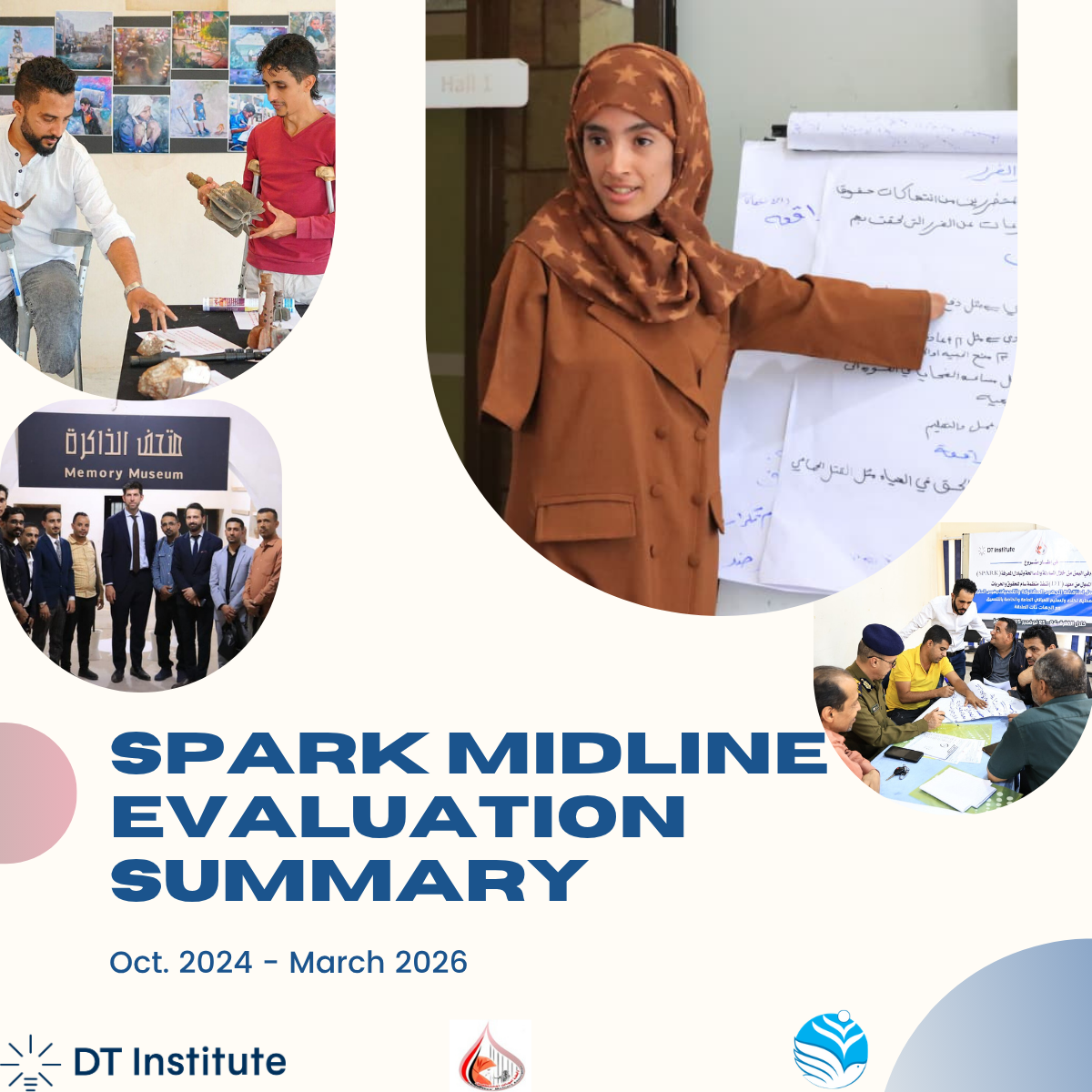
An independent midline evaluation (March 2026) finds that the SPARK project, led by DT Institute in partnership with SAM for Rights and Liberties and the Abductees’ Mothers Association, is demonstrating something rare in Yemen’s current context: transitional justice is not only possible—it can deliver tangible results even in the absence of functioning state institutions.
In a country where formal justice systems have largely failed, SPARK has moved transitional justice from theory into practice—producing concrete restitution for victims, measurable shifts in behavior, and new channels of engagement between communities and state actors.
A Model Built from the Ground Up
What distinguishes SPARK is not just what it achieved, but how it was designed. The project followed a layered approach that began with locally grounded research, moved into the creation of community-based mechanisms, and then piloted interventions that gradually connected to institutional actors.
This design was anchored in evidence from over 330 participants across six governorates, ensuring that interventions responded directly to Yemeni priorities—particularly the dual demand for accountability and reconciliation, alongside deep distrust in state institutions.
At its core, the approach combines:
- Evidence-led design grounded in local perspectives
- Community-owned mechanisms with real operational authority
- Gradual institutional engagement built on demonstrated results
Delivering Justice Where the State Could Not
The evaluation shows that SPARK’s impact is most visible in what it delivered—not what it intended.
Across interventions, the project achieved measurable outcomes:
- 60 looted homes returned to rightful owners out of 359 documented cases
- 125 cases documented, with over 40 disputes resolved through community mechanisms
- Legal files prepared and escalated to ministerial level after years of inaction
- Multiple long-standing cases resolved, including formal acknowledgment and reparations
These outcomes are particularly significant in a context where over 27,000 documented violations have occurred in Taiz alone since 2015, with limited accountability. Against this scale, even partial resolution represents meaningful progress.
Participation in these processes translated into measurable behavioral change:
- Willingness to collaborate with former conflict parties increased from 78.7% to 94.4%
- Confidence that the approach would benefit other communities rose from 72.8% to 89.4%
These are not marginal gains—they reflect a shift in how communities perceive both justice and each other.
The Power of Tangible Justice
One of the evaluation’s clearest findings is that results—not dialogue alone—drive transformation.
Where interventions produced visible outcomes, the impact was significantly stronger:
- In the Looted Homes initiative, collaboration willingness reached 97%
- Awareness of restorative justice increased by up to 38 percentage points in some interventions
- In the tanker initiative, awareness rose from 60.6% to 87.5%
These shifts are directly linked to tangible outcomes—homes returned, cases resolved, and official acknowledgment secured.
The lesson is clear:
- Dialogue creates opportunity
- Delivery creates trust and sustained change
Shifting the Role of Victims
The project also transformed how victims engage with justice processes.
Rather than remaining passive, participants became active agents—documenting cases, engaging in dialogue, and in some cases initiating formal claims.
This shift is reflected in participation trends:
- The proportion of participants reporting personal violations increased (e.g., from 29.6% to 37.5% in one pilot), indicating growing trust
- Female participation rose significantly, from 24% to 39% in awareness activities and up to 50% in some pilots
For marginalized communities, the most important outcome was not financial compensation, but recognition—being acknowledged and included in processes from which they had long been excluded.
Najla Fadl from AMA team stated that “As a feminist organization, women are as always considered victims. … [I]n this particular project, we were not only victims. We were the planners. We were planning how to do transitional justice and how the process could be implemented.”
Changing the Narrative of Transitional Justice
SPARK also addressed a critical barrier: the perception of transitional justice as externally imposed.
Through religious outreach and culturally grounded messaging:
- 20 preachers delivered 26 sermons, reaching over 10,300 community members
- Awareness campaigns led to 89% of participants reporting improved understanding of transitional justice
- Support for integrating transitional justice into peacebuilding increased to 90%
These efforts helped shift transitional justice from a contested concept into a socially accepted and publicly discussed issue.
Bridging Communities and Institutions
A defining strength of the project is its ability to connect grassroots processes with institutional actors.
This is reflected in both engagement and outcomes:
- Victim cases escalated to ministerial-level consideration
- Direct engagement with military actors enabled resolution in sensitive cases
- National-level actors expressed willingness to integrate project insights into broader processes
These developments indicate the emergence of a multi-level transitional justice ecosystem, linking communities, civil society, and state institutions.
Eshraq Al Maqtari, Minister of Legal Affairs and a board member of the Transitional Justice Ambassadors Forum, noted: “An impact observed through the Forum is that institutions are no longer afraid of discussing transitional justice issues… They believe that if they reform institutions like the judiciary and security sector, they can address justice issues effectively.”
The Unresolved Constraint: The Action Gap
Despite strong progress, the evaluation identifies a consistent structural challenge:
increased awareness does not consistently translate into action.
Across interventions:
- Up to 73% of victims in some pilots took no formal action despite documented harm
- In awareness components, non-reporting among victims increased from 39% to 46%
The barriers are clear:
- Fear of retaliation
- Lack of protection mechanisms
- Persistent distrust in institutions
This gap highlights a critical limitation. Awareness and willingness are necessary—but without safe and accessible pathways, they are not sufficient.
What This Means for Yemen
SPARK does not resolve Yemen’s conflict, but it changes what is possible within it.
It demonstrates that:
- Justice can be delivered incrementally, even in active conflict settings
- Communities are willing to reconcile when outcomes are tangible
- Institutions can be engaged through trusted intermediaries
- Locally grounded approaches can outperform externally driven models
Most importantly, it shows that peacebuilding does not need to wait for political agreements. It can begin at the community level and expand outward.
A Model Ready to Scale—With Conditions
The project has established a model that is both credible and adaptable—combining evidence, community legitimacy, and institutional engagement.
However, scaling requires addressing key constraints:
- Delivering on reparations commitments to sustain trust
- Expanding legal and protection mechanisms to enable victim action
- Replicating community-based structures in other high-need areas
- Converting informal engagement into formal institutional commitments