1. Overview of the SPARK Program
In July 2025, the SPARK team, composed of DT Institute and its local partners, the Abductees’ Mothers Association (AMA) and SAM for Rights and Liberties (SAM), launched the first restorative justice (RJ) pilot initiatives in Taiz. These initiatives aim to foster reconciliation and resolve community-level public disputes that have caused human rights violations.
The RJ model was designed in response to the findings of The Path Towards Peace, a research study published by SPARK in April 2025. This study captured local understandings of transitional justice (TJ) across Yemen, revealing that 64.3 percent of community members prioritize reconciliation and war-ending efforts over retributive accountability. Participants identified clear roles for civil society: initiating dialogue and reconciliation, offering legal and financial aid to victims, raising TJ awareness, and documenting violations.
Thus far, four restorative justice pilots have been achieved, demonstrating their critical role in easing local unrest, bridging social divides, and laying the groundwork for sustainable peace. AMA’s first pilot, the Al-Shamayatayn Reconciliation Initiative, illustrated this in resolving a five-year-long dispute between the Muhamasheen community (“the marginalized ones”) and local security forces.
Now, AMA’s second restorative justice pilot, the Al-Sarari Reconciliation Initiative, is mirroring the success of the first by addressing longstanding tensions with violent and debilitating impacts on the local community.
2. Initiative Spotlight: Al-Sarari Reconciliation
Under the Al-Sarari Reconciliation Initiative, AMA addressed deep-seated tensions between communities in Al-Sarari village. Captured by the Houthis (Ansar Allah) in 2015, communities in and around the village were gravely affected by the conflict. To protect themselves and in response to the occupation and broader war, community members aligned themselves with conflict parties. Some with the Houthis, while others supported the international recognized government of Yemen (IRG). Over time, these tensions grew and became pervasive throughout society, remaining even after the Houthi withdrawal.
Social tensions in Al-Sarari are not only pervasive; their critical community impacts are also widespread. Critical resources, such as land and water, are scarce in Al-Sarari. Thus, existing tensions have resulted in community members’ limited access to basic resources and services, such as water distribution.
At times, tensions were so widespread that they extended to the refusal of community members to gather in the same place as the other members with differing affiliations. This environment of mistrust and competition has posed significant challenges for community cohesion and post-occupation recovery – with further implications on the socio-economic abilities of the community as a whole.
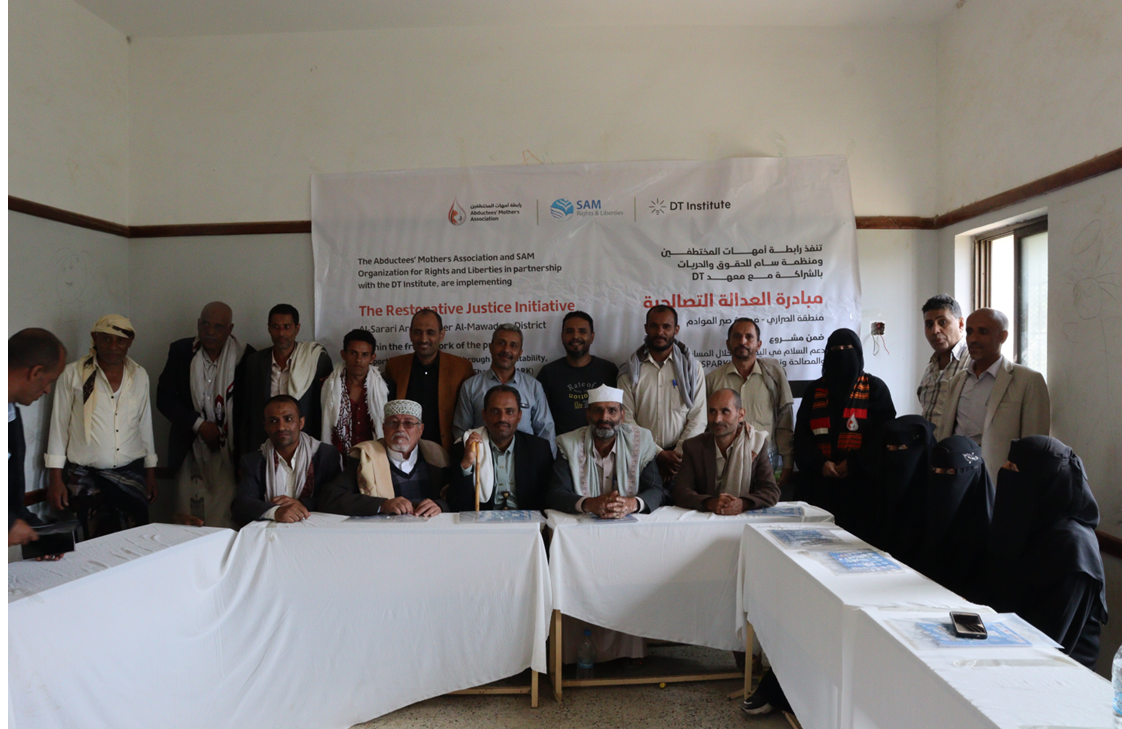
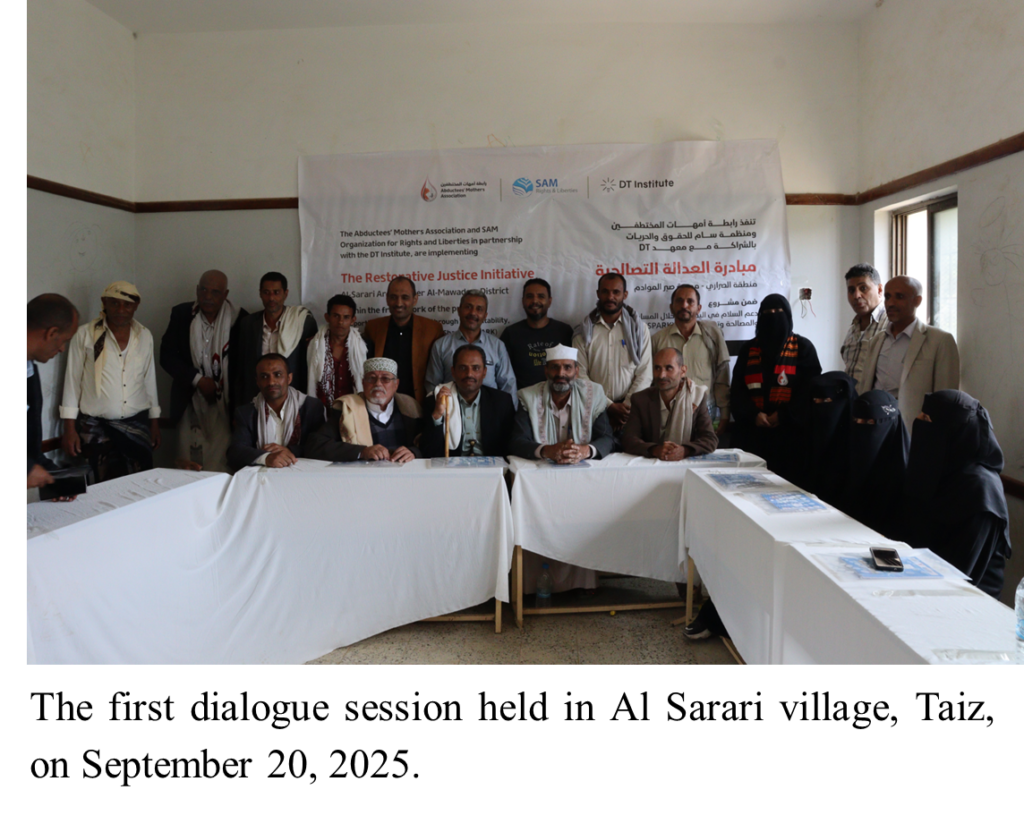
To resolve these social tensions and their resulting conflicts, AMA utilized a bottom-up approach, which began with careful field coordination efforts to overcome security challenges and rough terrain, preparing the community for productive dialogue sessions. AMA fostered dialogue aimed at rebuilding trust and understanding among 28 local community members and key stakeholders. The initiative included three dialogue sessions as well as engagement of individual stakeholders to ensure equal representation of community voices.
Session participants included key political party figures (such as members of the Islah party), local authority representatives, soldiers, religious leaders, and diverse community members. Social and community influencers, including doctors, teachers Sheikhs, school principals, and representatives of women and youths’ groups also attended. This varied group was intentionally and carefully selected by AMA to ensure balanced representation of all community components.
3. Agreement and Impact
Through sustainable engagement and encouragement, AMA successfully engaged multiple stakeholders — including military leaders, district directors, and social influencers — to strengthen social cohesion and ensure social protection. The initiative effectively enhanced the presence of the state in isolated villages like Al-Sarari.
Through structured dialogue spaces, all stakeholders participated alongside victims from both sides, creating a shared platform to exchange experiences and acknowledge the mutual pain caused by conflict-related violations. This interaction helped reduce hate speech and encouraged both parties to start thinking cooperatively, ultimately strengthening the role of local authorities and improving community services for everyone in the village.
The repeated dialogue sessions created positive momentum, pushing the participants from initial discussions focused on personal and legal disputes to address past violations and root causes of the conflict, fostering long-term understanding and trust. This momentum was critically and carefully fostered by AMA mediators, who focused on identifying conflict drivers and encouraging constructive communication within each session.
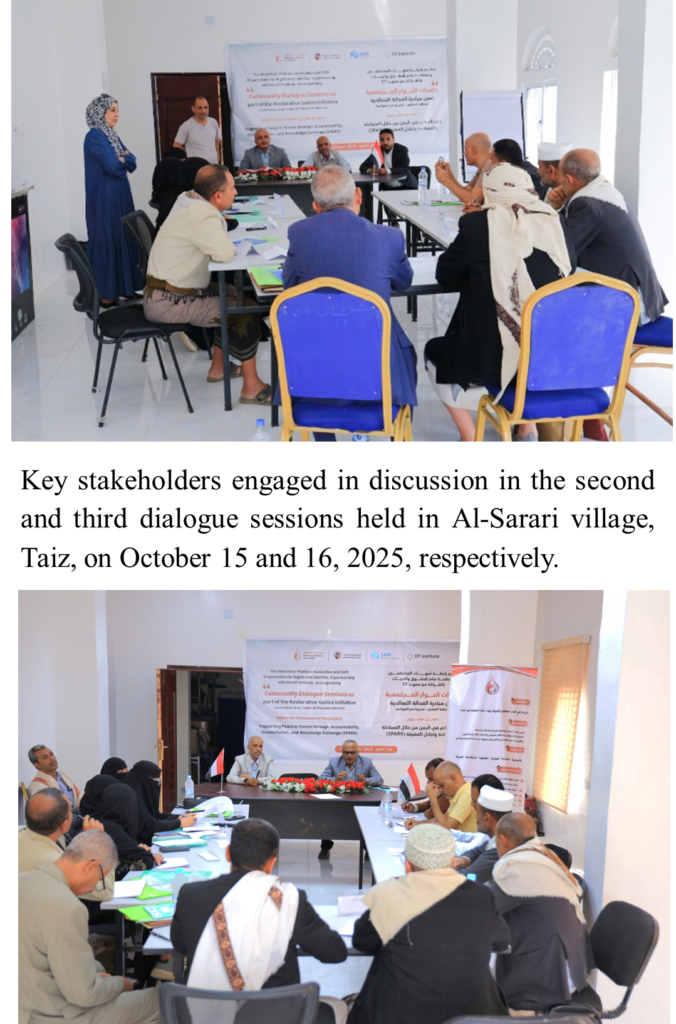
AMA’s critical research necessitated investigative discussion among the 28 dialogue session participants. This discussion technique was effective in addressing the social tensions and their grave implications. This insistence on diverse perspectives facilitated effective exploration of underlying causes of tension and broadened social relations and engagement between community members.
The first session, facilitated by the AMA researcher and mediator, focused on identifying conflict drivers and encouraging constructive communication. In this sense, the session also acted to raise awareness amongst the participants of the root causes of conflict, providing a path for productive discussion geared towards reconciliation.
Accordingly, during the first session, attendees participated in a lively discussion. They discussed how divisions have made the village feel unsafe and hindered humanitarian access. They also highlighted how tensions have begun to spread beyond the village and shared collective visions for rebuilding social cohesion.
Within the second and third sessions, participants turned identification into action – resulting in the development of action plans to improve the humanitarian and economic situation throughout the village. To ensure sustainable and actionable resolution of community tensions, participants agreed to establish a community committee to follow up on local economic needs and to advocate with non-governmental organizations (NGOs) and government authorities for better public services.
AMA session participants furthered these efforts by creating a needs matrix. The matrix identified the most urgent priorities, including land restoration and economic priorities to strengthen social harmony and enhance key public services. Another major priority identified by session participants was improving income opportunities for young people. Participants stressed the importance of doing so to reduce dependence of young people and to ensure they are not forced into combat to prove for themselves.
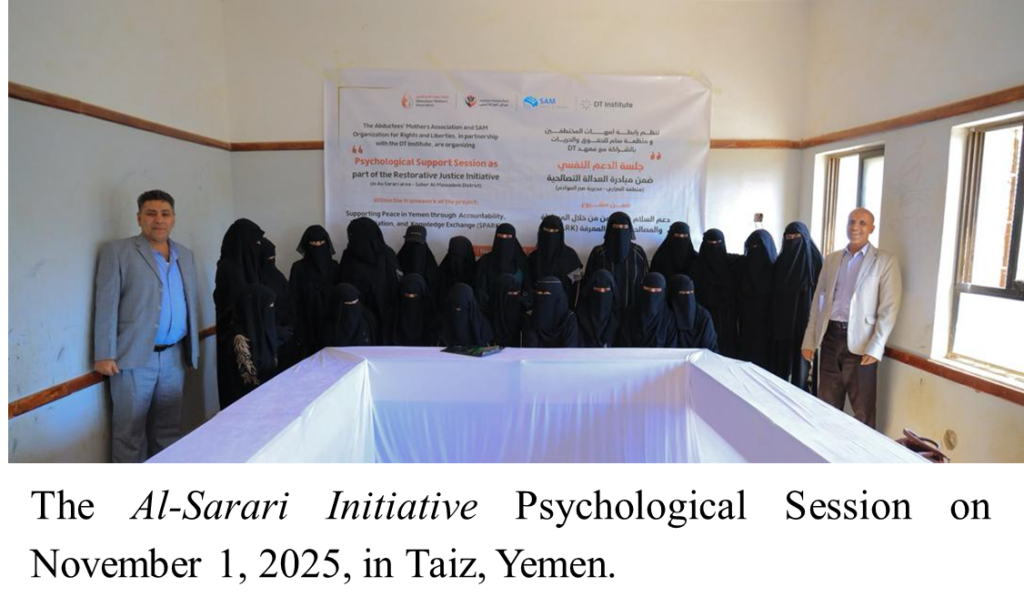
Recognizing a need within the village, AMA conducted one psychological support session for 20 female victims affected by the occupation and conflict in Al-Sarari. Victims included mothers, teachers, civil society activists, young women, and other community members. They reported first-hand experiences facing gunfire while doing errands to meet basic needs, land disputes due to unenforced court rulings, and children’s chronic fears over their unsafe routes to school.
The session focused on community healing and trauma therapy by acknowledging and addressing both the violations and their deep psychological impacts upon the session participants. Session participants engaged in robust discussion, coming to several significant historical agreements. Firstly, on the role of women as the center of societal recovery and reconciliation and the grave responsibility that this carries. “Women today are the pillar of the house – either you sow hatred or you sow peace,” remarked one participant.
Psychological session participants also agreed that achieving tolerance and social cohesion throughout the village does not require them to give up their rights. Importantly, this agreement was achieved after AMA outlined participants’ legal rights and offered avenues for redress in a manner which clearly illustrated the separation between social reconciliation and restoration of rights through law.
💬 “We want to reclaim out land but without inheriting hatred for our children.” – a psychological session participant, mother, and community member.
AMA’s effective engagement resulted in participants’ acquiescence to the formation of the community committee (as agreed upon by the dialogue session participants) and readiness to engage to resolve ongoing violations and disputes.
4. Learning, Documentation, and Replication
To document and ensure effective understanding of the complex disputes within Al-Sarari, AMA produced a policy paper examining the root causes of the conflict between the parties. The paper, entitled From Conflict to Recovery: Resolving Tensions in Al-Sarari Village, provides a comprehensive structural analysis of the complex conflict in Al-Sarari.
In doing so, it utilizes this initiative as a micro-case for understanding how local civil conflicts can evolve into devastating proxy wars within the broader Yemeni conflict and to demonstrate avenues for restorative justice and reconciliation.
To further build off the achievements of the Al-Sarari Initiative, the paper puts forth effective recommendations and an Integrated Solutions Model to heal social divisions among communities with differing doctrines.
The Integrated Solutions Model emphasizes the need for cohesive and coordination actions and solutions, addressing economic, security, and social cohesion concerns in tandem. This Model, as outlined within the paper, serves as a practical guide that can be applied in other contexts to achieve local reconciliation throughout Yemen.
AMA also prepared a presentation, outlining the initiative’s activities, objectives, and outcomes, to further enable duplication and potential trainings for similar initiatives across Yemen.
To assess the impact of the initiative, AMA also conducted pre- and post-surveys with Initiative participants. The surveys demonstrated clear progress in transforming participant attitudes from conflict towards reconciliation and restorative justice. Participants’ reported willingness to collaborate with groups they had previously been in conflict with increased from 77 percent in the pre-survey to 93 percent in the post-survey. A similar increase was observed in participants’ beliefs that other communities would benefit from such activities – with 77 percent of participants agreeing with this statement in the pre-survey to 90 percent reporting agreement in the post-survey.
💬 “The initiative has brought about a radical shift in the psychological and mental structure of the local community, it has shifted the dynamics of the relationship between the conflict parties from disconnection and denial…to a space of mutual recognition of pain…” – The AMA team, reporting on the Initiative’s observed impact on participants.
5. Scaling the Impact
Unfortunately, social tensions between community members, arising from the war, remain pervasive across Yemen. The ongoing conflict, now in its 11th year, has placed a significant strain on the general population’s ability to live safely and carry on normally.
Taiz alone has been under Houthi siege since the start of the conflict in 2015. Taiz’s occupation of over 10 years has led to repeated food insecurity, restricted access to aid and medicine, and significant constraints on community livelihoods due to road closures. In turn, this has deepened existing community tensions and fostered new disputes within the area, currently home to over 600,000 residents and 500,000 internally displaced persons (IDPs).
The urgent need for additional RJ pilots is clear: these initiatives play a critical role in easing local unrest, bridging social divides, and laying the groundwork for sustainable peace. Equally urgent is the broader need for transitional justice (TJ). After more than a decade of failed national peace talks, victim-centered approaches like RJ pilots represent a new path forward.
“Rooted in deep conflict analysis and community leadership, this bottom-up approach connects peacebuilding with livelihoods and basic services — offering a replicable model for sustainable coexistence across Yemen’s conflict-affected communities,” stated Sahar Mohammed, Program Assistant at DT Institute.
By demonstrating reconciliation at the community level, RJ initiatives operationalize transitional justice principles, educating stakeholders, building trust, and fostering shared frameworks for conflict resolution. These pilots serve as blueprints for future transitional justice efforts, rooted in local ownership, dignity, and dialogue.
💬 “These initiatives have provided a model that can be built on at the level of the whole of Yemen, because they depend on the community, are in line with its values, and help a lot in promoting the principle of tolerance and reconciliation, which leads to the achievement of the peace process permanently.” – Acting Secretary General of the Local Council in Saber Al-Mawadim District in the Al-Sarari dialogue sessions.
Although the Al Sarari Initiative has achieved primary success, further interventions are still needed based on AMA’s recommendations. Communities in Al-Sarari would greatly benefit from additional psychological support, legal assistance, and continued advocacy to strengthen public services, enhance the presence of local authorities, and build community trust, ultimately alleviating socio-economic struggles.
💬 “The fundamental impact of the initiative was to dismantle narratives of hatred and replace them with narratives of shared grievances, where participants realized, for the first time since 2015, that everyone, without exception, is a victim of the conflict…” – The AMA Team, reflecting on the impact of the initiative.
The Al Sarari Initiative marked a significant, but initial step, in bridging the gap between community members and bringing them together in face-to-face discussion. Further efforts focused on restoring community consensus and resolving disputes through restorative justice techniques are needed – in Al-Sirari and elsewhere – to build off this positive momentum and further empower community members throughout Yemen.