Overview
Advocacy stands as one of the most crucial pillars in advancing children’s rights and protecting them from various forms of violence and exploitation. It plays a pivotal role in influencing decision-makers and steering public opinion toward adopting more equitable and protective strategies.
Amid Yemen’s dire humanitarian crisis, characterized by the deterioration of state institutions and the continuity of armed conflict, advocacy has taken on heightened significance. This urgency stems from the escalating violations against children and the widening protection gap across the country.
Within the framework of the SAFE II project, implemented by DT Institute in partnership with local human rights organizations, Insaf Center for Rights and Development has emerged as a key actor in child protection in Yemen. The Center has actively delivered protection and awareness services while establishing effective government partnerships to ensure a sustainable and coordinated response to children’s issues.
Children’s Rights in Yemen and the Violations They Face
Children in Yemen continue to endure a range of grave violations resulting from ongoing armed conflict, economic collapse, and the deterioration of essential services. Humanitarian indicators consistently show that children are among the most severely affected by Yemen’s worsening political and economic conditions. A significant number have been exposed to incidents of violence and exploitation, including the recruitment and use of children by parties to the conflict, which is one of the most severe violations that not only strips them of their fundamental rights but also inflicts long-term psychological and physical harm.
Compounding these challenges, the destruction of schools, widespread insecurity, and deteriorating living conditions have driven up school dropout rates dramatically. Meanwhile, hundreds of thousands of children face acute risks due to severe malnutrition and a critical shortage of health services. Mass displacement has further disrupted family structures, increasing children’s vulnerability to neglect, violence, and exploitation.
In this context, advocacy is no longer a choice, it is an urgent necessity. Sustained advocacy efforts are essential to safeguard children’s rights and to establish robust legal and community-based frameworks that effectively protect them and respond to their immediate and long-term needs.
The Importance of Government Collaboration in Advocacy Efforts
Effective cooperation with governmental entities is among the most critical factors for achieving advocacy objectives. Advocacy efforts cannot succeed without genuine partnerships with government bodies. Through such collaboration, legal frameworks can be strengthened, government institutions’ capacities enhanced to manage child protection cases effectively, and public awareness raised to reject any practices that threaten children’s rights.
In this context, Insaf Center has prioritized building a complementary relationship with governmental agencies to ensure the sustainability of its efforts and to establish a comprehensive and effective child protection system.
Insaf Center’s Experience in Advocacy and Government Partnership
Insaf Center for Rights and Development has implemented a series of activities aimed at strengthening child protection through advocacy and effective partnerships with security, military, and civilian institutions. The Center has consistently combined direct fieldwork with policy-influencing initiatives to ensure practical and tangible protection for children.
One of the Center’s key activities was an awareness campaign targeting leaders and officers within security and military institutions, emphasizing the importance of respecting human rights and preventing child recruitment. The campaign was attended by high-level officials from the Military Police leadership, who reaffirmed their full commitment to prohibiting the recruitment of anyone under the age of 18. They further stressed that the Military Police serves as the supervisory authority responsible for monitoring recruitment processes within the armed forces and confirmed that official forms require applicants to submit a certified birth certificate to verify their legal age.
This campaign marked a significant step toward reinforcing respect for international humanitarian law within security and military institutions and overcome one of the gravest violations children face in armed conflicts.
Additionally, the Center collaborated with relevant stakeholders to develop child-related policies through producing studies and by contributing to the development of standardized case management guidelines. The Center also organized a series of meetings with activists and human rights defenders to integrate children’s issues into local development plans, ensuring a stable and institutionalized response to these concerns.
Mr. Abdullah Abbas, Monitoring and Evaluation expert at Insaf Center, emphasized that “government collaboration and advocacy are vital components in strengthening the child protection system, as they unify efforts across various entities and enhance coordination among concerned sectors.” He added, “Government partnership is not merely a coordination framework; rather, it is an integrated process that contributes to developing joint operational mechanisms, ensuring children receive timely, high-quality services.”
He also highlighted Insaf Center’s pivotal role in advocating for children’s issues in close coordination with governmental bodies.
Areas of Intervention
Insaf Center for Rights and Development has played a key role in monitoring and documenting numerous grave violations against children, in close coordination with relevant government institutions. The Center’s documentation methodology relied on field visits, direct interviews with victims, their families, and witnesses, as well as tracking case files with police and judicial authorities. The Center also maintained continuous coordination with national and international entities, including the Ministry of Human Rights, the National Commission to Investigate Alleged Violations of Human Rights, UNICEF, Save the Children, and Geneva Call.
Through these efforts, Insaf Center successfully documented 45 cases of grave violations against children from the most vulnerable groups, including:
- 22 children from marginalized communities.
- 23 displaced children.
- 5 children who belonged to both categories (marginalized and displaced).
- 4 children with disabilities.
The Center’s role extended beyond advocacy to include the provision of direct field-based services in partnership with the Social Affairs Office. These services included psychosocial support for child victims of violations and their caregivers, contributing significantly to strengthening the child protection system and mitigating the daily impacts of war on their lives.
These support programs included:
- Individual and group counseling sessions for the most affected children,
- Guidance and training for caregivers on how to provide psychological support to children.
- Baseline and follow-up assessments to evaluate and measure the impact of interventions on children’s psychological well-being, accompanied by ongoing monitoring for those requiring continued support.
In addition, the Center placed special emphasis on community engagement. It implemented awareness campaigns across various regions focusing on children’s rights and the dangers of child recruitment, while promoting protective practices to shield children from violence and exploitation. The Center also supported local community initiatives and produced advocacy materials that are grounded in Yemeni laws related to child rights.
The Impact
The joint efforts of government entities, civil society organizations, and Insaf Center for Rights and Development have yielded tangible results in improving child protection in Yemen. Awareness and media campaigns implemented through this collaboration have significantly raised community awareness about child protection issues and fostered a more supportive environment for preventing violations.
Among the most impactful activities have been the psychosocial support sessions provided to affected children and their caregivers. These programs included:
- Individual and group counseling sessions tailored for the most vulnerable children.
- Guidance and training for caregivers on how to offer psychological support.
- Pre- and post-intervention assessments to measure the impact on children’s psychological well-being, with continuous follow-up for those requiring ongoing care.
Ms. Shada Abdulrahman, who facilitated the psychosocial counseling sessions implemented by Insaf Center, stated:
“The baseline assessment of the psychosocial counseling sessions—conducted separately with children and women—revealed diverse psychological needs among participants. Children exhibited behaviors indicating an inability to express emotions, as well as fear, insecurity, difficulty concentrating, increased negative thoughts, social withdrawal, heightened irritability, and challenges adapting to their surroundings.”
She added:
“Following the counseling sessions, a marked improvement was observed among participating children. There was a noticeable reduction in distressing behaviors such as fear, withdrawal, and emotional outbursts. Children demonstrated a shift from negative to positive thinking, improved social interaction, and enhanced awareness of the risks associated with child recruitment. These outcomes clearly demonstrate the effectiveness of the counseling program in promoting beneficiaries’ mental health.”
On another front, Mr. Saleem Al-Aghbari, Projects Manager, confirmed that Insaf Center for Rights and Development is preparing a specialized activity:
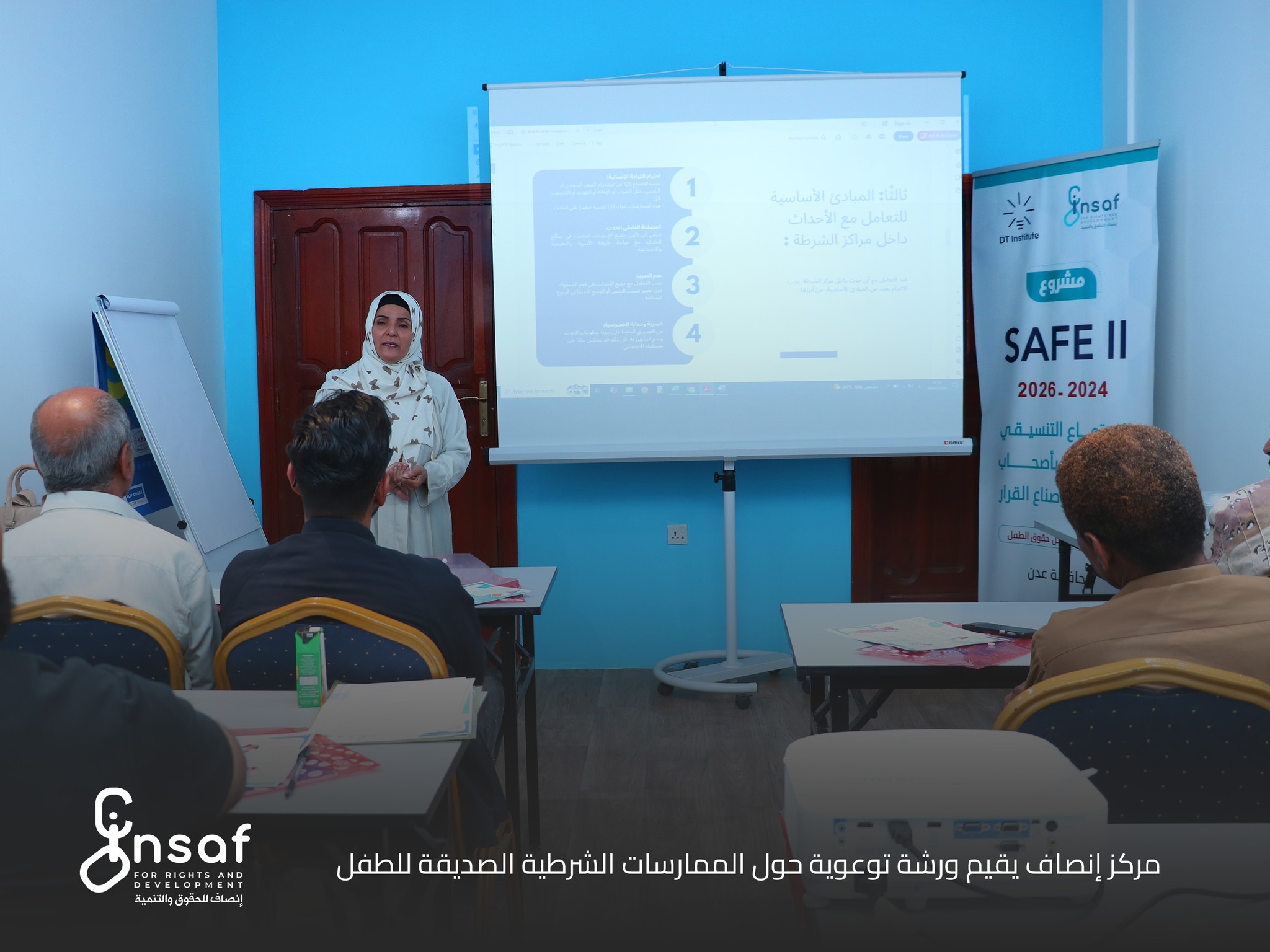
“We are organizing targeted awareness workshops for police personnel, in coordination with members of the SAFE II Project Coordination Committee and in partnership with relevant stakeholders. The activity was conducted on January 5–6 targeting 50 participants”
In a related development, multisectoral cooperation and enhanced coordination among government agencies have significantly strengthened the capacity to address child protection cases in a professional and systematic manner. This has elevated children’s issues on the public policy agenda and enabled more effective and sustainable advocacy.
In this context, Mr. Emad Sanan, Director General of Complaints and Reporting at the Ministry of Legal Affairs and Human Rights, emphasized:
“Government collaboration with civil society organizations is a cornerstone for ensuring coherent and integrated interventions in child protection.”
He explained that Yemen’s protection sector includes several specialized governmental bodies focused on children’s rights, such as the General Directorate of Complaints and Reporting under the Ministry of Legal Affairs and Human Rights, which continuously receives reports of violations against children.
Mr. Sanan also added that efforts are currently underway to launch a dedicated 24/7 Child Rights Operations Room, equipped with a hotline to receive complaints related to child recruitment and other violations. This mechanism aims to ensure rapid response and timely referral of cases to the relevant authorities.
Furthermore, he highlighted that the Ministry of Interior has a specialized Family Protection Department, and that units focused on women’s and children’s affairs operate within the Office of the Attorney General and the Ministry of Justice—all contributing to advancing justice and facilitating safe access to essential services.
He added that the Ministry of Social Affairs and Labor has recently developed a dedicated Child Rights Strategy, alongside implementing extensive media campaigns and awareness-raising activities across various events to promote child protection and community engagement.
Lastly, Mr. Sanan affirmed that cooperation between government entities and civil society organizations goes beyond information sharing—it also involves joint development of advocacy mechanisms and alignment of protection messaging, which has led to concrete, measurable outcomes.
Genuine and Effective Partnership
Insaf Center’s experience in advocacy and government collaboration demonstrates the critical importance of building effective partnerships with state institutions to deliver joint initiatives that ensure complementary roles and mutual trust.
This experience shows that reliable, verified data can form the foundation for successful, evidence-based advocacy efforts.
Insaf Center team emphasized that continuous coordination and regular meetings among government bodies, civil society organizations, and stakeholders is essential to: avoid duplication, align strategies, and channel efforts toward shared objectives.
Furthermore, Insaf Center for Rights and Development affirms that advocating for and protecting children’s rights cannot be achieved without genuine and effective partnerships with government entities.
Such collaboration not only strengthens the impact of interventions but also ensures the sustainability of positive change and fosters an enabling environment for child protection and community empowerment.