1. Overview of the SPARK Program
In June 2025, five members of the Justice4Yemen Pact (J4YP), a coalition of 10 Yemeni civil society organizations, joined the SPARK team, composed of DT Institute and its local partners, the Abductees’ Mothers Association (AMA) and SAM for Rights and Liberties (“SAM”), to launch advocacy campaigns to complement and expand the geographic scope of restorative justice pilots and raising awareness initiatives in Taiz and Marib.
The pilots aim to foster reconciliation and resolve community-level public disputes that have caused human rights violations. While the advocacy campaigns focus on raising community awareness of transitional justice – its mechanisms, opportunities for engagement, and importance for sustainable peace in Yemen – enabling replication of reconciliation mechanisms and community involvement in national transitional justice processes.
This model was designed in response to the findings of The Path Towards Peace, a research study published by SPARK in April 2025. This study captured local understandings of transitional justice (TJ) across Yemen, revealing that 64.3 percent of community members prioritize reconciliation and war-ending efforts over retributive accountability. Moreover, it further revealed that 51 percent of the research sample had no knowledge of transitional justice at all – identifying a crucial need for education. Participants identified clear roles for civil society: initiating dialogue and reconciliation, offering legal and financial aid to victims, raising TJ awareness, and documenting violations.
To address these gaps, SPARK works to strengthen locally owned mechanisms of reconciliation that respond to community demands for peace over retribution. At the same time, the program builds resilience within divided communities, creating sustainable pathways for dialogue and conflict resolution. Through inclusive approaches, such as victim-centered advocacy campaigns and innovative cultural initiatives, like music for reconciliation, SPARK ensures that women, youth, and marginalized groups are not only participants, but central drivers of Yemen’s transitional justice journey. With donor support, these efforts can be scaled to reach more communities, ensuring that reconciliation and peace take root from the group up.
2. Initiative Spotlight: The Role of Journalists in Transitional Justice
Human rights violations are being committed at rapid and widespread pace throughout all of Yemen. Journalists, in particular, are routinely subjected to severe and systematic violations at the hands of all warring parties, including the Houthi (Ansar Allah) group, the Southern Transitional Council (STC), the Internationally Recognized Government of Yemen (IRG), and external actors. Because of their status as agents of truth, journalists are increasingly and specifically targeted to stifle their voices and repress reporting of violations and bad actor behavior.
Violations by all warring parties against journalists include the killing of journalists as well as arbitrary detentions, enforced disappearances, torture, and inhumane treatment. The brutal treatment of journalists is compounded by the parties’ broader violations against freedom of speech and the press, which include intimidation and harassment of journalists and raids of media institutions.
Warring parties also utilize the law to target journalists, leveraging fabricated charges of “spreading false news,” “harming the public interest,” and “spying.” According to Human Rights Watch (HRW), some journalists report more brutal treatment than other detainees, believing it is used as a means to further scare and repress them and others in their position.
One journalist, Abdelkhaleq Emran, describes his time in Houthi detention, characterized by immense psychological and physical torture, including electric shocks, choking, and beatings with metal and wooden rods. He also stated that the judge, investigator, and prison authorities each stated, “journalists are the enemies of God and the nation;” “the only way to silence journalists is through death;” and “we pray to God by torturing journalists,” respectively.
Journalists also frequently face violations and restrictions in the operation of their work. In October 2025, J4YP partner, the Studies and Economic Media Center published a report in which 76.2 percent of surveyed journalists reported having had their electric devices searched, while 51.5 percent were subjected to direct financial extortion.
Generally, warring parties target journalists to further enable them to commit human rights violations with impunity and launch unopposed propaganda campaigns justifying their atrocities. The brutal treatment of journalists is compounded by the parties’ broader violations against freedom of speech and the press, which include intimidation and harassment of journalists and raids of media institutions.
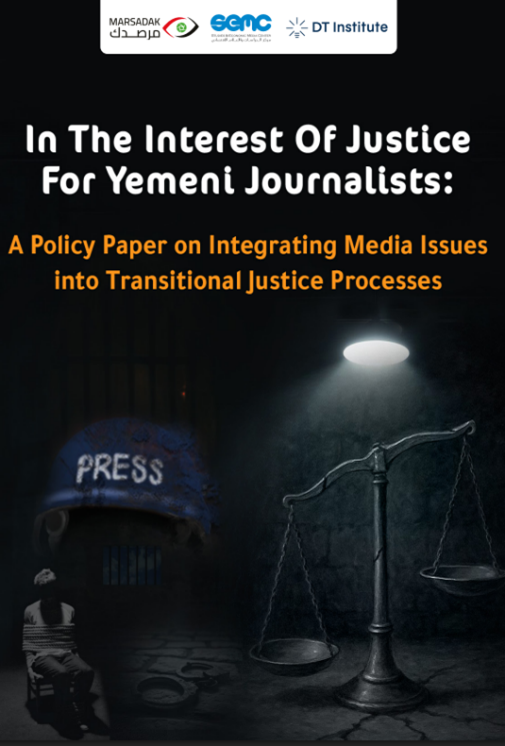
Journalists are also integral to transitional justice – the process by which countries, such as Yemen, confront mass atrocities, conflicts, and severe human rights violations to bring the country and society back together to rebuild trust and reestablish the rule of law after severe violence and repression. One pillar of transitional justice is truth-seeking – understanding the truth about past violations in a way that holds perpetrators accountable and acknowledges the impact of atrocities on victims. Truth-seeking is integral as a first step towards whole-of-society peacebuilding – transitional justice actors must understand the atrocities faced, the needs of victims, and perpetrator dynamics to assess how to provide reparations, conduct accountability measures, and re-institutionalize the country. Under The Role of Journalists in Transitional Justice , J4YP partner, The Studies and Economic Media Center (SEMC), seeks to demonstrate and integrate journalists into transitional justice, both as victims and key actors in truth-seeking and reconciliation efforts. In doing so, SEMC published In the Interest of Justice for Yemeni Journalists, an in-depth policy paper providing actionable recommendations to integrate journalists’ rights into Yemeni transitional justice processes.
Drawing from verified documentation of human rights violations against journalists, the report analyzes the impact of the conflict on Yemeni media and journalists, demonstrating the urgent need for integration of journalists’ rights. In proposing such integration, the paper illustrates their significance to each of the four pillars of transitional justice – truth-seeking, justice, reparation, and non-recurrence.
Accordingly, it establishes that journalists’ rights are crucial and integral, not only in truth-seeking, but also to justice, reparation, and non-recurrence. From there, SEMC proposes pathways to engage journalists in all phases of transitional justice, both as victims and key actors of change.
In actualizing transitional justice processes and bringing about change throughout Yemen, investigative journalism was proposed as effective in documenting violations, enabling the launch of effective awareness campaigns, preserving shared community memories of violations, and archiving past atrocities.
In detailing how transitional justice should be applied to journalists as victims, the report notes that reparations, guarantees of non-recurrence, and effective accountability procedures must be applied to cases of human rights violations against journalists. It acknowledges the particular sensitivity of perpetrators to journalists’ cases and utilizes examples from other contexts, including Rwanda and Guatemala, to illustrate effective models.
Finally, SEMC concludes with actionable recommendations direct towards various transitional justice stakeholders, including government authorities and institutions, civil society and the media, and the international community. These include recommendations to civil society to establish a unified database of human rights violations, which journalists can pull and report on, and to further develop the concept of “transitional journalism” – i.e., a post-conflict media framework focused on truth-seeking, accountability, and nation building.
Suggestions for governmental authorities also included amendment of press laws to align with international standards and establishment of an independent judicial mechanism to investigate media-related crimes.
4. Learning, Documentation, and Replication
In collecting qualitative data directly from stakeholders, SEMC implemented a virtual symposium, titled Crimes Against Journalists in Yemen: Prospects for Justice. The webinar, implemented in partnership with the Embassy of the Netherlands in Yemen, generated significant interest with over 80 attendees, including journalists, human rights defenders, experts, government representatives, political party actors, local civil society workers, and international organization staff. local civil society workers, and international organization staff.
The symposium provided a platform for comparative learning and national reflection. A Yemeni lawyer offered a detailed legal analysis of journalists’ rights violations, while a victim journalist shared a deeply moving testimony of his detention and torture by Houthi forces, highlighting the urgent need for justice and protection. The event’s discussions, together with key informant interviews (KIIs), informed SEMC’s policy paper, which is now finalized and currently under translation and design, with publication planned for October.
To further bolster the reach and effectiveness of the policy paper, SEMC shared it directly with national and international stakeholders, shared with over 5,000 journalists, and circulated by 32 local media outlets. Prominent local and international stakeholders engaged included HRW, the Committee to Project Journalists (CPJ), Gulf Centre for Human Rights, Internews Europe, and the Ministry of Human Rights and Legal Affairs.
Each of these organizations responded positively. The Undersecretary of the Ministry of Human Rights, Nabil Abdel Hafeez, stated that the work of the Ministry will greatly benefit from the policy paper due to the importance and significance of its proposals. HRW, CPJ, Internews Europe, and the Gulf Centre all reached out to SEMC via WhatsApp and email to praise the report’s significant impact.
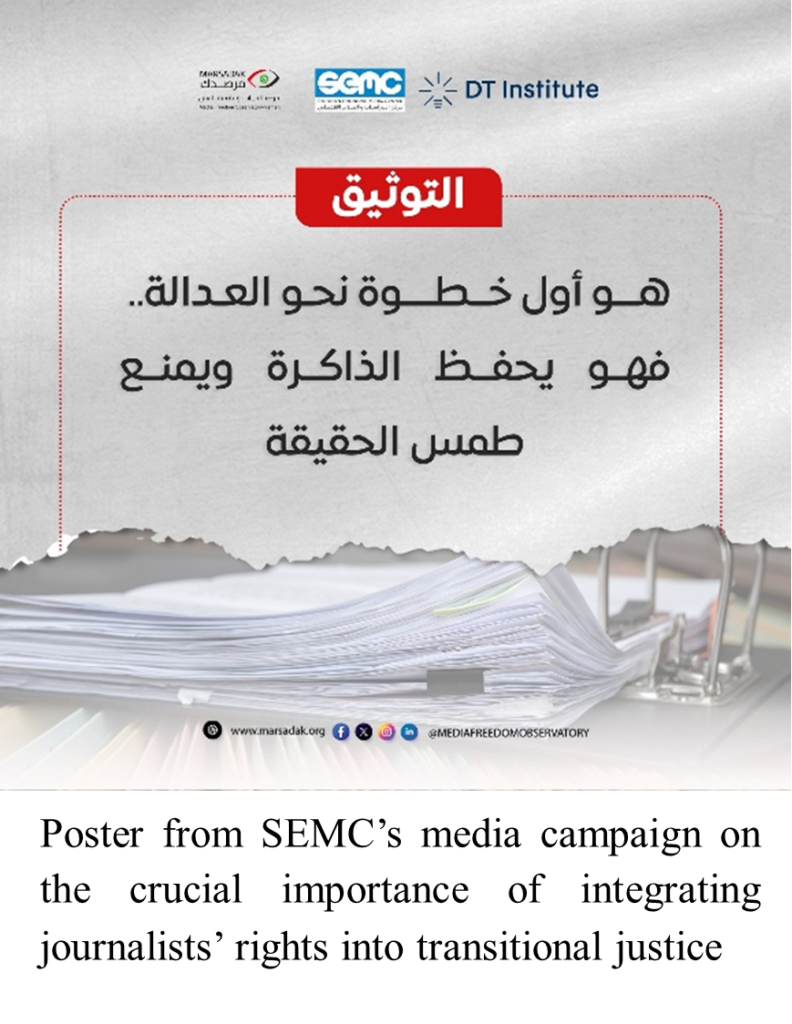
To engage local and international stakeholders, including journalists, victims, and community members, SEMC utilized their online presence to launch an illustrative digital advocacy campaign. The campaign included awareness-raising posters and a short video summarizing the policy paper’s key findings. Campaign materials were produced in engaging and easily digestible format to enable understanding across educational levels and societal sectors. The report was published via the J4YP’s and SEMC’s websites and reposted onto their social media. Social media coverage and posts received over 15,000 views with the video alone receiving over 3,800 views. Moreover, SEMC’s online followers increased by approximately 6.7 percent, resulting in over 1,000 new followers. Similarly, user interacti ons were observed at a rate of 176 percent as compared with the same period in years past. This reflects growing public and institutional interest in journalists’ rights, their significance, and the ways in which they can be prioritized and implemented into transitional justice processes throughout Yemen.
The paper also sparked new channels of communication and coordination with Erim , an international organization specializing in media development, freedom of opinion and expression, democracy and human rights. This led to a lengthy meeting between Erim and SEMC surrounding journalists’ rights, connecting media development and human rights, and opening new partnerships.
5. Scaling the Impact
The urgent need for transitional justice in Yemen is clear. Moreover, after over a decade of failed national peace talks in which victim and community needs were disregarded, the urgent need for victim- and community-led transitional justice is even more clear. The role of civil society and the goal of the SPARK program is to foster and provide the necessary skills, tools, and knowledge required by local communities to lead such transitional justice processes as part of Yemen’s national peacebuilding.
By raising awareness of transitional justice and engaging all transitional justice stakeholders, advocacy campaigns foster community responsibility to operationalize transitional justice principles. They envision transitional justice efforts, rooted in local ownership, dignity, and dialogue, serving as foundations for broader restorative justice pilots and raising awareness initiatives.
Circulation of the In the Interest of Justice for Yemeni Journalists policy paper is already contributing to increased shared understandings of transitional justice amongst journalists and the local public alike. Through engagements with local journalists on the ground in seminars, trainings, and discussion sessions, SEMC has received significant praise from journalists.
Journalists have noted that their understanding of transitional justice has increased, that the paper has raised awareness generally amongst the journalistic community, and that this was a very important step in educating the journalistic community.
💬 “This campaign has restored my understanding of the concept of transitional justice, and I will work on developing my skills to specialize in this aspect.” – Freelance Journalist Mohammed Al-Wadaei, provided within a session bringing together journalists in Taiz.
Yet the scale of the challenge far exceeds current resources. With greater donor investment, SPARK could expand restorative justice pilots to additional governorates, reaching thousands more Yemenis with awareness campaigns and victim-centered initiatives and strengthening the capacity of civil society to engage directly in national dialogues on reconciliation.
“Yemeni journalists have been on the frontlines of the conflict, risking their lives to document violations and amplify victims’ voices. Journalism is a core pillar of transitional justice, as truth-telling and public documentation are essential for accountability, reparations, and reconciliation,” stated Sahar Mohammed, DT Institute’s Program Assistant, “What has begun under the SPARK project is an important first step, but it must expand to strengthen journalists’ and civil society’s capacity to contribute to a unified transitional justice narrative that can influence decision-making.”