1. Overview of the SPARK Program
The SPARK program (Supporting Peace in Yemen through Accountability, Reconciliation, and Knowledge-Sharing) advances local and national reconciliation in Yemen by furthering initiatives to foster engagement with transitional justice. The program engages all segments of society in the transitional justice process, including local community members, civil society experts, high-level governmental stakeholders, and most recently political parties. This engagement enables these groups to come together as joint change makers and central drivers of Yemeni transitional justice.
Under the SPARK program, DT Institute and its local partners, the Abductees’ Mothers Association (AMA) and SAM for Rights and Liberties (“SAM”), launched raising awareness campaigns to educate community members on transitional justice mechanisms and engage experts and decision makers in thought provoking dialogues and initiatives. These awareness raising campaigns complemented restorative justice pilots in Taiz and Aden, which aim to foster reconciliation and resolve community-level disputes that have resulted in human rights violations.
2. Yemen’s Draft Transitional Justice and National Reconciliation Law
Transitional justice is not a new concept in Yemen. In 2012, a proposed Transitional Justice and National Reconciliation Law (hereafter the “Transitional Justice Law” or “draft law”) was introduced. The law was considered by the National Committee, and at the time, two committees focused on land and displaced persons were set up. However, the law has remained unenacted, stalled in a draft format since 2012.
The draft law maintained a heavy focus on transitional justice pillars, including restorative justice, preservation of national memory, intention to reveal truth, institutional reform, and provision of reparations to victims. In line with this, the law centered on mending societal divisions and promoting national reconciliation. It prioritized these concepts over criminal prosecutions or retributive justice.
Moreover, the focus of the law was strictly non-judicial, because it operated alongside a 2012 Immunity Law. This law, known as the Law No. 1 of 2012 on the Granting of Immunity from Legal and Judicial Prosecution (hereafter the “Immunity Law”), granted the former President and all civilian, military, and security officials within his regime from criminal prosecution for any “politically motivated acts” committed during his 33-year rule in exchange for his peaceful resignation.
Critics have condemned the draft law for its ties to the Immunity Law, which operated to shield former President Ali Abdullah Saleh and associated officials from accountability. The proposed Transitional Justice Law was structurally dependent upon and constrained by the Immunity Law. It forced the Transitional Justice Law to be designed purely around non-judicial mechanisms, since none of the former Presidents’ associates and officials could be tried within the courts.
As a result, perpetrators of grave human rights violations remained in power and integral to the political system. Critics, including the Middle East Institute, argued that this led to entrenchment of a culture of impunity and rendered Yemeni transitional justice as “without substance.” Amnesty International similarly put out a statement slamming the Transitional Justice law for its lack of provision of any concrete meaningful measures of redress and reparation and for its emphasis only the concept of forgiveness and for its lack of criminal accountability.
💬 “The draft transitional justice law, if enacted in its current form, together with the Immunity Law adopted in January 2012, will create a de facto amnesty for perpetrators of crimes under international law and grave human rights violations.” – Amnesty International.
The Immunity Law led to further consequences in 2014 when Houthi (Ansar Allah) forces seized control of the capital city of Sana’a with help from the former President’s regime. This was a direct result of the Immunity Law, which allowed the former regime to utilize their continued power in favor of the Houthis. This led to an eruption of political instability and forcing the country into a crushing civil war. This war is still ongoing. It continues to devastate Yemen as political forces and militant actors commit human rights violations with impunity, as many Transitional Justice Law critics predicted.
This has rendered the draft Transitional Justice and National Reconciliation Law futile. The law was designed primarily to address violations committed prior to 2014. It now requires substantial revision to reflect the scale and nature of violations that have occurred since the escalation of the conflict. Moreover, this presents lawmakers with an additional opportunity to address the 2012 draft law’s shortcomings, ensuring that impunity is effectively addressed and rooted out throughout Yemen.
💬 “The Transitional Justice Law is a work in progress, addressing the context in general terms without specifying a definitive phase or mechanism. There is now an opportunity to revisit and discuss the law, as the period from 2014 to the present remains a conflict, and the nature of the violations has changed; we have reached a different level of abuse, including mass killings and the bombing of homes.” – Eshraq Al Maqtari, Yemen’s Minister of Legal Affairs, at SPARK’s Reading Yemen’s Draft Transitional Justice Law Webinar.
The initiative demonstrated a positive impact on fostering political openness toward TJ and cross-group engagement among participating political actors. Pre- and post-survey findings showed an increase from 77 percent to 100 percent in the proportion of respondents willing to integrate TJ into the political discourse of their political parties or institutions.
In parallel, the percent of participants expressing willingness to collaborate with members of groups with whom they have political or social disagreements increased from 91 percent to 97 percent, reflecting strengthened readiness for dialogue, cooperation, and inclusive political engagement.
3. Initiative Spotlight: The Political Parties Initiative
Overall, Yemen’s past approaches emphasize stability over accountability, excluding key transitional justice elements like truth-seeking, victim redress, and institutional reform. Their repeated failures have highlighted a need for a new approach to peacebuilding and transitional justice. This approach requires prioritization of victims’ rights and victims’ voices, as represented by themselves and by civil society.
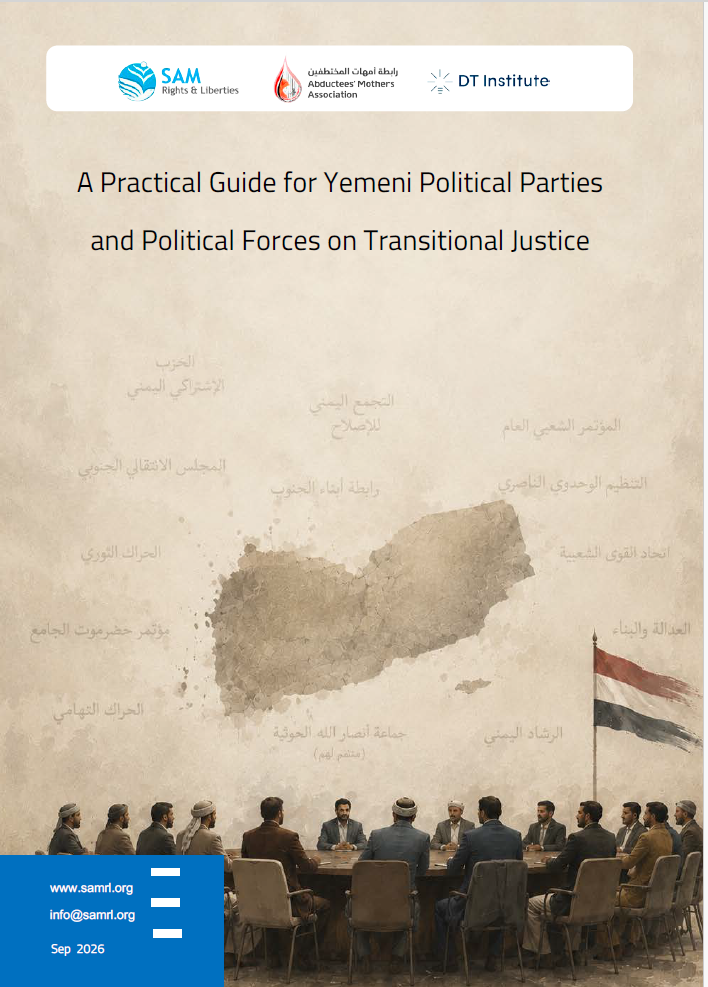
To promote this approach, SAM implemented the Political Parties Initiative, aimed at building actionable and effective transitional justice as agreed upon and understood by Yemen’s key political actors. In doing so, the initiative seeks to support the gradual formation of a common political narrative on key aspects of transitional justice, including truth-seeking, reparations, reconciliation, and, significantly, justice and accountability.
The initiative works towards this common political narrative by bringing political parties and components together in dialogue sessions to discuss these topics. It also operates via individual interviews, which aim to extract the political opinions of certain political entities on these topics as well. Subsequently, dialogue session and interview inputs were validated, synthesized, and utilized to identify common entry points to integrate this narrative into future political trajectories. These entry points, along with analysis synthesizing additional insights revealed through the interviews and sessions, are currently being developed into a guidebook to act as a reference tool supporting political parties in integrating transitional justice into future actions and discourse.
💬 “This initiative is very important. First, it aims to gather perspectives of political parties and forces on transitional justice. Second, it seeks to bridge the gap between political parties and forces, identify the fundamental needs for addressing the mechanisms and concepts of transitional justice, and establish common ground for dialogue on developments over the past ten years. Thirdly, it aims to raise awareness among political parties and forces regarding transitional justice processes and mechanisms.” – SAM
In total, the Political Parties Initiative featured five dialogue sessions and eight individual interviews with political party representatives as well as influencers and experts. The five dialogue sessions were attended by 49 participants in total. Dialogue session participants represented eight political parties, eight regional political forces, experts, and an official from the Office of the Special Envoy of the Secretary-General for Yemen (OSESGY), who is responsible for their transitional justice work.
Dialogue sessions were conducted both online and in-person (in Taiz and Hadramout). In-person session participants were drawn from formal, mainstream political parties and emerging political forces that further developed in the conflict context. Collectively, 13 political parties and political movements were represented within the in-person sessions across both governorates. Both sessions featured participation from core political parties, including the Yemeni Socialist Party, Nasserist Unionist People’s Organization, the Islah Party, the Justice and Construction Party, Al-Rashad Party, the Union of Popular Forces, and the General People’s Congress (GPC).
Online sessions engaged senior political stakeholders located outside Yemen, including party leaders and undersecretaries of political parties, alongside transitional justice experts. In total, these three sessions engaged 19 key figures representing six parties and five political forces. The political parties represented included the Yemeni Socialist Party, the Islah Party, the Nasserist Unionist People’s Organization, GPC, Al-Rashad Party, and the Justice and Construction Party.
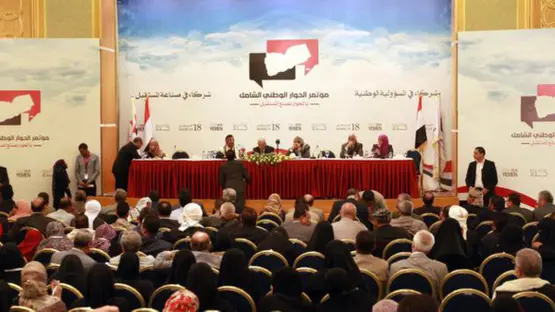
Importantly, online (as well as in-person) sessions also featured inputs from new and emerging political forces – many of which were left out of the discussion in 2012. The political forces represented included the Supreme Council of the Southern Revolutionary Movement, Tihama Movement, Hadramout Inclusive Conference, as well as representatives affiliated with the Houthis and the Southern Transitional Council (STC). The sessions also included one expert who participated in the National Dialogue Conference, one peace-building specialist, and a representative from OSESGY.
💬 “The Covenant and Agreement document and the outcomes of the National Dialogue were approved and ratified by all existing political forces at the time, including the Houthi movement. However, new political forces emerged later that do not recognize the outcomes of the National Dialogue, but I believe that reality will eventually bring them back into the mainstream national context.” – Mohamed Al Mekhlafi, Yemen’s Former Minister of Legal Affairs, at SPARK’s Reading Yemen’s Draft Transitional Justice Law Webinar.
The eight interviews were carried out in Taiz and Aden with representatives of major political parties and reconciliation actors. These included representatives from the Islah Party, the Nasserist Unionist People’s Organization, the Yemeni Socialist Party, STC, the Free South Arabia League Party, political experts in Aden and the Political Reconciliation Committee in Taiz.
4. Agreement and Impact
The dialogue sessions and interviews generated valuable insights into the perceptions, priorities, and concerns of Yemen’s political actors regarding transitional justice. Discussions revealed a growing recognition of transitional justice as a vital component of Yemen’s future peacebuilding and state-building processes. The engagement of representatives from major political parties, emerging political forces, de facto authorities, reconciliation actors, and peacebuilding experts provided a rare platform for discussing transitional justice across political divides.
The sessions identified several potential entry points for future transitional justice efforts and political discussions to actualize these efforts. Entry points are areas of emerging or key consensus amongst political actors, representing opportunities for effective and sustained discussion on transitional justice that can grow into further consensus on more controversial transitional justice topics.
Areas of consensus included the actors’ readiness to recognize victims’ suffering, their support for reparations and rehabilitation measures, and their recognition of the importance of documenting violations and preserving evidence. Political actors also agreed on the critical importance and need for institutional reform and for the prevention of the recurrence of future violations. Reparations emerged as the area with the strongest level of agreement among participants, while truth-seeking mechanisms also received considerable support across different political constituencies.
Simultaneously, participants expressed concerns regarding accountability mechanisms, which was a controversial topic in 2014 with Yemen’s draft Transitional Justice Law as well. Many of the political actors expressed fears that accountability measures could be politicized or used for political retaliation. To put such concerns to rest, political actors stressed the need for trusted institutions and a stable political environment. These concerns were shared across multiple political affiliations and reflected broader challenges facing transitional justice efforts in Yemen.
Generally, established parties with governance experience prioritized stability, state reconstruction, and gradual reform. In contrast, newer or less politically entrenched actors emphasized stronger accountability and broader justice mechanisms. However, this does not necessarily reflect a greater concern for victims. It may have been driven by political considerations, including efforts to weaken or marginalize more established actors and parties. Across all actors, there was a shared tension over whether state-building should precede justice or whether justice is a prerequisite for state-building.
Additionally, while most actors supported accountability in principle, they differed on its timing and scope. Newer political actors favored pursuing justice early in the transition, whereas more established actors argued that extensive accountability measures could undermine political stability. Many political parties also cautioned that accountability can only be effective and legitimate if supported by an independent and capable judiciary.
Overall, this revealed a need for further agreement and political consensus on the importance, effectiveness, and actual implementation of accountability measures. However, political actors also demonstrated a more productive and open stance on accountability, recognizing its importance to transitional justice. Importantly, disagreements were not over whether accountability should be pursued but rather how and when it should be implemented.
All party representatives justified their perspectives by noting that accountability should be linked to reparations and social repair, aiming not only to address wrongdoing but also to restore trust and heal the broader social damage caused by the conflict. Reparations emerged as a great area of consensus.
The Islah, Nasserist Unionist People’s Party, Yemeni Socialist Party, and Taiz Branch of the Socialist Party all clearly stated their support for both material and moral reparations. The STC held that the primary focus of reparations should be on psychological compensation for victims. However, GPC representatives argued that moral measures such as confessions, acknowledgments of responsibility, and public apologies may conflict with tribal traditions and Yemeni social norms.
Also contentious in the development of the draft Transitional Justice law was its temporal focus on violations that occurred starting from 1990. Similarly, this initiative involved disagreements on what the cut off should be for violations considered by future Yemeni transitional justice processes. Most political parties and forces favored limiting the scope of transitional justice to violations committed since 2014, arguing that this period is marked by extensive documentation and unprecedented levels of abuse.
However, this timeframe is unlikely to gain broad consensus. De facto authorities, particularly the Houthis and the STC, may resist a post-2014 focus, as it excludes violations they experienced before the conflict and overlooks their historical grievances. Experts also noted that regional actors, particularly the Arab-Led Coalition, may oppose transitional justice processes that could expose their involvement in violations.
Independent experts presented a productive path forward, a diplomatic form of transitional justice that did not undermine victims’ rights or threaten regional actors. They supported a comprehensive transitional justice framework that combines accountability, truth-telling, reparations, reconciliation, and institutional reform and works on each of these areas in tandem.
4. Learning, Documentation, and Replication
The interviews and dialogue sessions resulted in an insightful and significant mapping of transitional justice priorities of the many political parties and forces within Yemen. In short, there was a broad consensus among all political components on the importance of transitional justice, which will require an extensive system of victims’ reparations and institutional reform.
Key differences emerged in discussions on the sequencing of accountability and political settlement as well as on the timeframe that Yemeni transitional justice processes should seek to address. Although substantial, these differences, as well as the consensuses that emerged, demonstrated a productive path forward – both from the 2014 Transitional Justice Law and for future transitional justice processes.
Political consensuses not only provide entry points and a path forward, but they also reduce future implementation risks. Ultimately, transitional justice legislation is political as well as legal. Thus, dialogue before legislation can prevent future deadlocks. Moreover, consensus-building is itself a peacebuilding outcome.
To build on these peacebuilding outcomes and ensure their sustainability, SPARK partners are currently working on a guide. The guide will consolidate and analyze the political parties’ perspectives and translate their mapping of transitional justice priorities into an actionable and easily understandable path forward. It will illuminate areas of convergence, divergence, and entry points for further development in pushing forth Yemen’s transitional justice processes.
The guide will be distributed to all the political parties and published online, illuminating the path forward and acting as a living reference document within future political discussions on transitional justice. Additionally, it will be shared in a symposium, bringing together political actors, experts, and others in productive engagements focused on building on dialogue session outcomes and envisioning a path forward.
💬 “Building a shared understanding of transitional justice among political actors is not an end in itself. It is an investment in Yemen’s future. By creating spaces for dialogue today, documenting areas of consensus, and equipping political leaders with practical tools, we are helping lay the groundwork for a future transition that is more inclusive, victim-centered, and resilient.” – Feras Hamdouni,Program Director, DT Institute
5. Scaling the Impact
This initiative continues to build off previous research efforts, including the SPARK Path Towards Peace study, which emphasized the divergent views of transitional justice held by Yemen’s political parties, each of which has a different geographic area as its center of influence. By convening representatives of political components as well as civil society and political experts, the initiative is creating tangible opportunities to build a shared minimum framework that is both politically informed and locally rooted, increasing its chances of sustainability.
As emphasized by DT Institute’s Senior Program Manager, Feras Hamdouni, “transitional justice laws are among the most politically sensitive reforms any country can undertake. If designed without broad political ownership, they risk becoming another source of polarization and instability. But when developed through inclusive dialogue, they can become instruments of stabilization, building trust, strengthening institutions, and creating shared foundations for peace.”
He notes that the experience and process of discussing and designing future transitional justice processes can often be just as significant as the laws and means through which it is actualized. Thus, it is important to proceed with great caution and care, and to create opportunities for agreement and productive discussion on areas of disagreement.
💬 “Yemen’s experience demonstrates that the process of discussing transitional justice can be just as important as the law itself, offering valuable lessons for countries such as Syria, where a draft transitional justice law is now under discussion.” – Feras Hamdouni, Senior Program Manager, DT Institute Moreover, productive consensus-building dialogues are effective ways for civil society to contribute and shape Yemen’s transitional justice process, as SPARK partners are doing under the Political Parties Initiative. By increasing political actors’ awareness, revealing their concerns, and identifying points of convergence and divergence on transitional justice, civil society can successfully encourage and assist them in reaching shared understandings and agreements on transitional justice. Such understandings and agreements are both constructive and valuable for future legislation and implementation, leading to sustainable peacebuilding efforts for Yemen’s fut