1. Overview of the SPARK Program
Under the SPARK (Supporting Peace in Yemen through Accountability, Reconciliation, and Knowledge-Sharing) program, DT Institute and its local partners, the Abductees’ Mothers Association (AMA) and SAM for Rights and Liberties (“SAM”), launched raising awareness campaigns to complement restorative justice pilots and engage community members in Taiz and Aden.
The restorative justice pilots aim to foster reconciliation and resolve community-level public disputes that have caused human rights violations. While raising awareness campaigns educate community members on transitional justice mechanisms and engage experts and decision makers in thought provoking and effective dialogues and initiatives to advance Yemeni transitional justice.
This model was designed in response to the findings of The Path Towards Peace, a research study published by SPARK in April 2025. This study captured local understandings of transitional justice across Yemen, revealing that 64.3 percent of community members prioritize reconciliation and war-ending efforts over retributive accountability. Moreover, 79 percent of community member respondents reported that either they or a family member had been subjected to a human rights violation in Yemen. Among the violations, forced displacement was the most common, reported by approximately half of these respondents.
💬 “We are tired of displacement and homelessness, we want to go home, after we go home and settle down in our house then every perpetrator can be held to account.” – A woman from Taiz, as quoted inThe Path Towards Peace study.
Within the study, 79 percent of participants pointed to public reform, which includes restoration of public services, when asked about transitional justice pillars for prioritization in Yemen. In addressing these gaps, SPARK works to advance local and national reconciliation, by furthering initiatives to educate local stakeholders on transitional justice concepts. At the same time, the program builds resilience within divided communities through the pilots, which create sustainable pathways for dialogue and conflict resolution.
Through effective engagement, the program activates all segments of society – from the community level to civil society, experts, and high-level governmental stakeholders. This enables these groups to not only be participants, but central drivers of Yemen’s transitional justice journey. With donor support, these efforts can be scaled to reach more communities, ensuring that reconciliation and peace take root from the ground up.
2. Yemen’s Conflict Places Host Communities and IDPs in Tough and Dangerous Positions
According to the United Nations High Commissioner for Refugees (UNHCR), Yemen’s ongoing crisis remains “one of the world’s most complex and protracted humanitarian emergencies.” The UNHCR notes that due to this crisis over half of the population (an estimated 22.3 million people) will require humanitarian assistance, including 5.2 million internally displaced people (IDPs).
Relatedly, the Agency for Technical Cooperation and Development (ACTED) has held that over 1.6 million of those displaced have moved to the governorate of Marib. Marib recorded the highest number of newly displaced households in Yemen in 2025. According to the agency, this accounted for approximately 54 percent of all new displacement in 2025 nationwide.
Displacement has not slowed down in 2026. The International Organization for Migration (IOM) sounded alarm bells of displacement surges in January 2026. At this time, they also noted that Marib hosts some of Yemen’s largest displacement sites and that limited resources were being faced with increased pressure, heightening protection risks.
💬 “Families are once again fleeing with almost nothing, arriving exhausted and vulnerable…This surge in displacement is pushing already desperate communities to the brink. Without immediate and sustained aid, countless lives are at risk.” – IOM Director General Amy Pope discussing the January 2026 surge in migration.
Displacement is a serious and severe consequence of the overarching conflict, especially as the conflict has reduced the ability of governorates across the country to effectively address displacement. In the absence of suitable shelters, IDPs have been forced to seek shelter wherever they can find it. This has included buildings providing public services, such as university buildings and health, community, and gas centers.
Government facilities were intended for use as temporary accommodation for IDPs, which include families with young children, elderly individuals, and many marginalized populations. However, this desperate, temporary measure progressively evolved into a prolonged reality as the conflict raged on and the number of IDPs steadily increased. This has resulted in the inability of many public facilities to operate effectively and to provide essential services to both IDP and host communities.
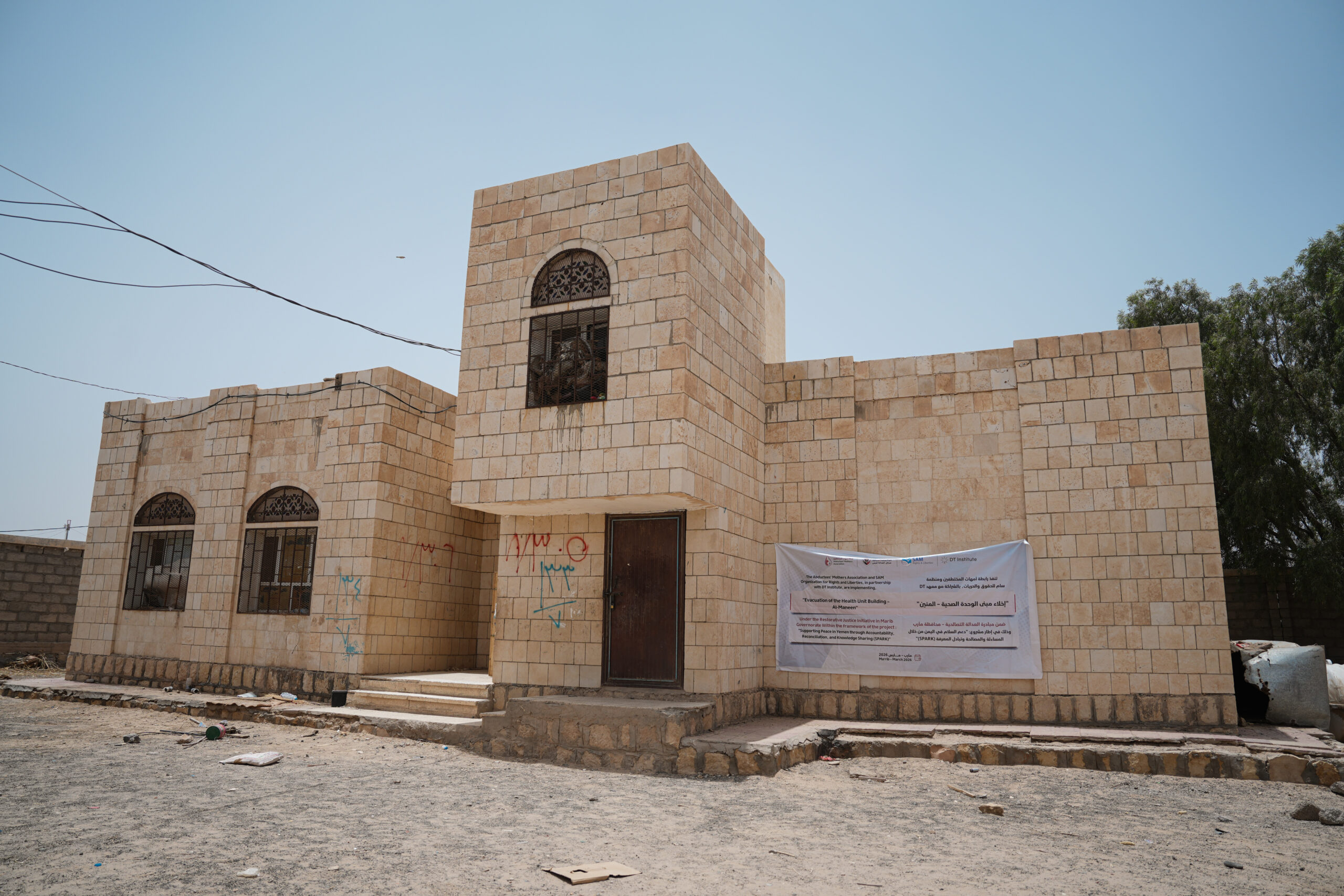
In Marib, this includes the Health Unit in Al-Maneen, Rural Women’s Community Center, Safer Gas Center, Technical Institute, and multiple Saba University buildings. Each of these facilities provides an important public function, including electricity and health, agricultural, educational, and career-building services. Moreover, each of these facilities has been prevented from performing their functions, leaving thousands in need.
Thus, comes the central predicament. Operational public facilities are needed to restore essential services, while thousands of displaced families depend on these same facilities for shelter, preventing them from becoming operational.
Clearly, this status quo cannot continue. Not only is the lack of public services injuring the public at large, but these governmental buildings were never intended to be shelters. Thus, their shelter capacities and facilities are inadequate at best, putting IDPs at further risk and requiring them to live in undignified conditions.
💬 “The use of government service buildings as shelters for displaced people in Marib Governorate poses a serious challenge, especially given the high population density and increasing pressure on basic services. These buildings were constructed to provide vital services to citizens, and converting them into residential areas disrupts education, health, administration, and other services, exacerbating the suffering of both the community and the displaced. We emphasize the necessity of providing safe and suitable alternative housing for displaced people, one that preserves their dignity and rights, while simultaneously ensuring the continued operation of government facilities and the provision of essential services needed by hundreds of thousands of residents in Marib.”– Sabah Sawied, Marib Restorative Justice Pilot Coordinator.
Forced eviction cannot be the answer as it would only serve to continue the violent cycle of repeated displacement that many IDPs have already continuously suffered. Moreover, without adequate housing solutions, this tactic would almost certainly result in even more vulnerable living conditions for IDPs. Forced eviction also raises the likelihood of fear and psychological distress, homelessness, and secondary (or in many cases tertiary or even further) displacement. It also increased the risk of violent confrontation as people are made desperate.
These severe consequences only cover the immediate impacts of forced eviction. In the long-term, forced eviction would likely also result in a loss of confidence in the local authority, deepened perceptions of injustice, and increased tensions between IDPs and host communities. Additionally, it would increase the potential for prolonged legal and social disputes, which – as we have witnessed time and time again in Yemen – can easily take on a life of their own with impacts on generations to come.
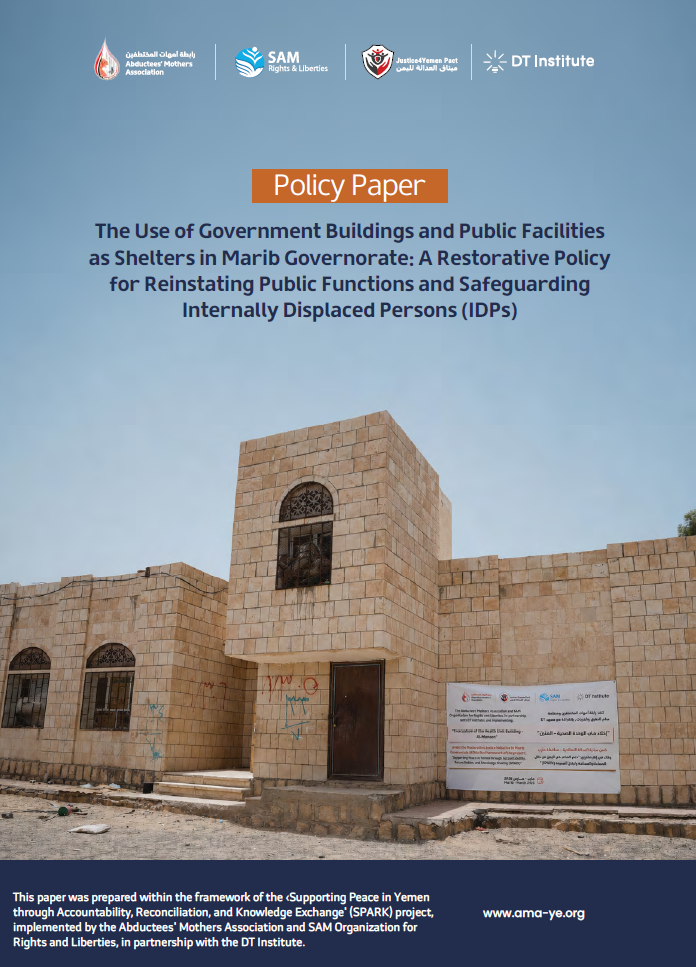
💬 “[Forced eviction’s] principal advantage lies in the rapid recovery of public facilities and the reinforcement of state authority and the rule of law. However, implementing this approach in the absence of appropriate alternative housing may lead to secondary displacement, worsen humanitarian conditions, increase tensions between internally displaced persons and the local authority, and conflict with the principles of protection and Do No Harm.” – SPARK’s policy paper,The Use of Government Buildings and Public Facilities as Shelters in Marib Governorate: A Restorative Policy for Reinstating Public Functions and Safeguarding Internally Displaced Persons
3. Initiative Spotlight: The Marib Restorative Justice Pilot
SPARK partners, SAM and AMA, who both maintain extensive experience as civil society organizations within Yemen, have a deep understanding of displacement and its consequences. Their teams include a community committee, which was formed under this pilot from local, influential community leaders in Marib to help address this crisis.
Leveraging their extensive experience and expertise in the area, these partners have come to many of the conclusions detailed above. Forced eviction is not an option, and neither is maintenance of the status quo. In fact, SPARK partners performed an extensive analysis of these options, including by examining the impact of this issue and these options on public services, governance, and social cohesion within their newly published policy paper, The Use of Government Buildings and Public Facilities as Shelters in Marib Governorate: A Restorative Policy for Reinstating Public Functions and Safeguarding Internally Displaced Persons.
The paper drew on stakeholder consultations, field research, and lessons from practical interventions to present the only viable solution – community-led cooperation and mediation between IDPs, host communities, local authorities, governmental entities, civil society organizations, and international non-profit organizations. Accordingly, it proposes a restorative justice-based policy that balances the restoration of public facilities with the protection of displaced families. In doing so, the paper offers a practical roadmap for local authorities, humanitarian actors, and policymakers to achieve sustainable solutions that safeguard both public interests and human dignity.
This roadmap was built based upon SPARK experiences under the Marib Restorative Justice Pilot, a multilateral response initiative to restore public services by relocating the IDPs currently inhabiting public buildings in Marib. The initiative utilized a participatory approach to acknowledge and address the complex interplay of humanitarian, legal, and social concerns tangled up within the tasks of relocation and restoration. Furthermore, it struck a balance between the rights of IDPs and the overarching public interest maintained by the local government in serving its people.
💬 “The policy paper included a comprehensive analysis of the root cause of the problem and then presented radical solutions instead of the temporary, patchwork solutions that had proven ineffective. It also served as a link between local authorities, supporting organizations, and civil society to develop a unified vision, outlining the role of each party in resolving this issue.” – AMA
4. Agreement and Impact
The initiative sought to address IDP sheltering within five facilities: the Health Center in Al-Maneen, the Rural Women’s Community Center, the Safer Gas Center, the Technical Institute, and the Saba University buildings. Of these five facilities, it has succeeded in the full or partial restoration of three thus far. Namely, these include the Health Center in Al-Maneen, the Rural Women’s Community Center, and the Saba University buildings.
With the local community committee overseeing implementation, efforts began with detailed documentation of the IDPs located within these facilities. Such efforts featured field visits and discussions with government officials, residents, and IDPs throughout the area. In under one month, documentation revealed the presence of approximately 1,144 displaced families, sheltering within nine public facilities. In addition to those mentioned above, these included the Youth and Sports House, a local community college, a local council, and a museum.
The five facilities mentioned above were selected as priority buildings due to their essential functions and in response to the community’s strong demands for their services. Prior to their occupation, these facilities served thousands of community members. The Health Unit in Al-Maneen provided essential and emergency medical services to approximately 20,000 displaced and host community members. The Rural Women’s Community Center benefited over 30,000 women across Marib by providing agricultural and livelihood services.
The Safer Gas Company serves as the primary source of electricity for Marib Governorate and is in need of urgent repairs, which are too dangerous to undertake while IDP families inhabit these spaces. The Technical Institute plays a critical role in community development, post-conflict recovery, and job creation by equipping youth and displaced individuals with practical skills like mechanics, electricity, and surveying. Similarly, Saba University afforded educational, and therefore career, opportunities to thousands of students throughout the region, who have no nearby alternative educational institutions of the same caliber.
To enable dignified, sustainable, and effective relocation, the pilot adopted a strategic approach based on mediation efforts and direct dialogue with IDPs. This involved continuous dialogue sessions where coordination between representatives of the facilities to be restored, local authorities, military actors, judiciary, the IDP Executive Management Unit (EMU), other governmental entities, and local and international civil society was organized and facilitation.
According to plans set out in each of these sessions, each entity maintained a complementary and valuable role in pushing the initiative forward. Local authorities, military actors, the judiciary, and other governmental agencies represented the state’s interests in restoring facilities and discussed previous unsuccessful attempts to enable learning and non-repetition of past mistakes. Facility representatives spoke to community needs for public services, restoration timelines, and provided details on IDP inhabitants.
Local and international civil society organizations, including the Norwegian Refugee Council (NRC) and ACTED, provided necessary funding and items (such as food baskets and shelter renovation materials) to enable dignified relocation. These organizations also assisted in coordination with governmental offices, including the Agricultural Office and the Housing, Land, and Property (HLP) Unit. Such offices provided necessities making relocation possible, including free land (for the shelter units to sit upon) and assistance in building extra facilities, including kitchens and bathrooms, to make shelter units suitable for family living.
Displaced persons were also in attendance. They spoke for themselves and their families, outlining their requirements for relocation, and a SPARK-recruited legal consultant, who ensured the process proceeded legally and with respect to IDPs legal rights. SPARK partners ensured further respect for IDP dignity and consent by recruiting the legal consultant to also provide necessary legal advice, conduct risk assessments, interpret applicable laws and regulations, and oversee pilot dialogue sessions and implementation. The consultant also conducted field visits to local authorities’ offices and public buildings to ensure that legal processes and permits were being respected.
This approach worked to ensure the fundamental human rights of all those involved, including the right to security of person for IDPs and the right to a standard of living adequate for health and well-being (which includes medical care and necessary social services) for all those involved. Both of these rights are promulgated within the Universal Declaration of Human Rights (UDHR), which sets out a common standard of achievement for all peoples and all nations.
Through direct dialogue, SPARK partners addressed the expressed concerns of IDPs. Moreover, the legal expert raised their understanding and awareness of their legal rights. Under the initiative, SPARK partners also coordinated efforts between government actors and civil society to provide essential services and support to IDPs. This approach proved highly effective, balanced, and contrasted local authorities’ previous failures to relocate IDPs without such considerations addressed.
Additionally, to facilitate a smooth transition of families, SPARK partners also conducted field visits to IDP families. The visits served to build trust, strengthen mutual understanding, and raise awareness of the importance of the facility, while clearly explaining the objectives and scope of the initiative. Within the visits, partners assessed the needs and concerns of IDP families. The visits allowed them to support a dignified relocation process and directly address families’ concerns, ensuring their consent to relocate. Partners practiced Do No Harm principles, ensuring respect of IDPs’ informed consent and rights.
Through this process, SPARK partners facilitated new homes for IDP families. The housing units were surveyed by the legal expert, who verified their compliance with legal criteria. The IDP families also gave her free and voluntary consent to relocate into the housing units by signing relocation agreements prepared by the legal expert. SPARK partners also divided responsibilities amongst the Shelter Cluster to ensure close monitoring of the relocation process, support to the IDPs, and to facilitate the provision of humanitarian assistance until families were safely settled into the new housing units.
4. Learning, Documentation, and Replication
To expand on the efforts completed under the Marib Restorative Justice Pilot, SPARK partner, AMA, also published a short documentary entitled, Between Two Rights. This film illustrates the real-life experiences of those displaced within the Marib governorate. It documents their stories – from being displaced with no where to go, to sheltering within government buildings as a temporary, emergency measure, to voluntarily agreeing to relocate thanks to the interventions of SPARK partners and SPARK-created community committee.
💬 “When we heard about the decision to evacuate, at first, we were very scared and lived through difficult days of anxiety. Our biggest concern was: where are we going to go? Will we be thrown on the street with our children and face displacement and homelessness again? …All these fears gradually began to fade when the [SPARK community committee, AMA representatives,] and SAM visited us. They did not come to us with the language of threats or coercion, but they sat with us in a transparent and direct dialogue and listened to all our challenges and fears with great listening. We felt, for the first time, that there was someone who took into account our human dimension and cared about our dignity.” – Displaced person from the film, Between Two Rights, (as translated from Arabic to English).
The film displayed how restorative justice and cooperation amongst different components of society can be leveraged to create sustainable solutions based on dialogue, trust, and partnership. It did so by utilizing the Marib Restorative Justice Pilot as a model that effectively balanced restoring public services with protecting the dignity of displaced families through reconciliation.
SPARK partners also convened a symposium in Marib. The symposium brought together 23 participants, including local authorities, civil society organizations, media professionals, religious leaders, community representatives, and members from community committee. During this event, AMA presented the policy paper.
Speakers utilized the paper’s findings to demonstrate the pilot model’s feasibility compared to alternative solutions, including forced evacuations and maintenance of the status quo, which were each dismissed because of the dangers they present to IDPs and host communities. Participants issued several recommendations, including allocating space in the government’s budget to support evacuation necessities (e.g., transportation allowances, food baskets, and caravans) and issuing a decision requiring government offices to work on alternative housing for IDPs and facilitate their relocation.
AMA, SAM, and the community committee also partnered with preachers and religious guides to conduct sermons and lectures throughout Marib. These initiatives furthered the messaging and purpose of the Marib Restorative Justice Pilot by highlighting the intersection between transitional justice and religion. Sermons and lectures preached justice, coexistence, tolerance, and reconciliation to over 1,920 attendees (over 1,810 sermon attendees and 110 lecture attendees).
5. Scaling the Impact
Building on the positive outcomes achieved in Marib, the initiative demonstrates a viable model for resolving displacement-related challenges through structured dialogue, mediation, and community-led approaches. The intervention has contributed to the restoration of one public building and the provision of dignified relocation solutions for displaced families, reinforcing the effectiveness of non-coercive, consensus-based processes supported by civil society engagement.
The model has also highlighted the value of coordinated action between humanitarian and human rights actors in facilitating sustainable and dignified solutions to complex displacement cases. Through this approach, community participation has been strengthened, dialogue between affected families, including IDPs and host communities, and local authorities has been improved, and legal facilitation has supported the formalization of agreements.
💬 “What makes the Marib experience particularly meaningful is that it shows restorative justice can move beyond dialogue and become a practical tool for addressing the everyday consequences of conflict. By bringing displaced families, local authorities, civil society, and humanitarian actors together, the initiative created a pathway to restore essential public services while protecting the dignity and rights of affected communities. For us, this is what locally led transitional justice looks like in practice.” – Feras Hamdouni, Senior Program Manager
Locally led restorative justice processes can contribute to transitional justice objectives in practice. By addressing the consequences of conflict-induced displacement, restoring access to essential public services, and rebuilding trust between affected communities and public authorities, the initiative represents a form of collective redress and institutional recovery for harms experienced during the conflict.
Given the continued scale of need, with over 5 million IDPs throughout Yemen and the conflict still raging, there is a clear opportunity and need for expansion and replication. Similar challenges to those in Marib are present in various other conflict-affected areas under the internally recognized government of Yemen (IRG). This is particularly true in Taiz, where public buildings continue to be used as IDP shelters and essential services are disrupted. Such initiatives would be the first step in tackling Yemen’s severe internal displacement issue and providing IDPs with effective reparations.