1. Overview of the SPARK Program
The SPARK program (Supporting Peace in Yemen through Accountability, Reconciliation, and Knowledge-Sharing) advances local and national reconciliation in Yemen by furthering initiatives to foster engagement with transitional justice. The program engages all segments of society in the transitional justice process, including local community members, civil society experts, high-level governmental stakeholders, and most recently political parties. This engagement enables these groups to come together as joint change makers and central drivers of Yemeni transitional justice.
Under the SPARK program, DT Institute and its local partners, the Abductees’ Mothers Association (AMA) and SAM for Rights and Liberties (“SAM”), launched raising awareness campaigns to educate community members on transitional justice mechanisms and engage experts and decision makers in thought provoking dialogues and initiatives. These awareness raising campaigns complemented restorative justice pilots in Taiz and Aden, which aim to foster reconciliation and resolve community-level disputes that have resulted in human rights violations.
2. Yemen’s Political Parties and Transitional Justice
This model was designed in response to the findings of The Path Towards Peace, a research study published by SPARK in April 2025. This study captured local understandings of transitional justice by interviewing victims affected by the conflict, transitional justice experts, and political party members. Most victim- and expert-respondents (64 percent) prioritized reconciliation and war-ending efforts over retributive accountability. Participants in the research identified clear roles for civil society in the transitional justice process, including initiating dialogue and reconciliation, raising awareness, and documenting violations.
Political party member-participants in the study, of which there were 13, included representatives from the General People’s Congress (GPC), Southern Transitional Council (STC), Islah Party, and the Yemeni Socialist Party. The study featured analysis on the divergent perspectives and positions of Yemeni political parties towards transitional justice based on their responses, provided in focus group sessions. Analysis revealed alternative approaches to transitional justice. The Yemeni Socialist Party held that transitional justice was an important step in building Yemen’s future and desired civil state. The STC focused on utilizing transitional justice processes to address the historical impacts of political and armed conflicts on southern communities.
Both the GPC and the Islah Party have expressed multiple approaches and opinions on transitional justice. The GPC has two wings – one which supports the internationally recognized government of Yemen (IRG) and its focus on national reconciliation, and another that cooperates with the Houthi Movement and agrees with their position on transitional justice, which holds external powers responsible for Yemen’s conflict. The Islah Party’s stance varies depending on the time period. They fear application of transitional justice mechanisms to the 1994 war due to their involvement. However, they are supportive of its application to violations following 2014 due to the heavy impact the war has had on them.
These divergences in political parties’ approach to transitional justice emphasize the ways in which they have viewed transitional justice processes in the past – as selective and interest-driven rather than as a consistent commitment to accountability. Their positions are shaped by their roles in past conflicts: parties tend to support justice when they are victims and resist it when they may be held responsible. As a result, transitional justice is treated as a political instrument shaped by power considerations and fear of accountability, rather than a neutral process for achieving justice. These realities emphasize the need for this initiative.
💬 “First of all, we need to distance transitional justice from the parties, because their justice only applies to their party, they have no real interest in supporting transitional justice and their inclusion will be useless.” – A respondent from Sana’a in The Path Towards Peace Study.
The International Center for Transitional Justice (ICTJ) emphasizes that peace processes and their accompanying political negotiations working towards ending violent conflict must always deal with past human rights violations. In Yemen specifically, the ICTJ has advocated for significant victim involvement in peacebuilding. SPARK partners continue to champion victim-led transitional justice as a necessary element of sustainable Yemeni peace processes. However, Yemen has typically dealt with conflict through informal reconciliation and political deals, not transitional justice. At the local level, tribal mediation settles disputes through compensation and ceasefire agreements, focusing on ending violence rather than addressing rights violations. At the national level, political settlements, such as the 2011 Yemeni Revolution and the Gulf Initiative, prioritized stability by granting immunity to the regime at the time, including President Ali Abdullah Saleh.
💬 “Across the region, we are seeing countries grapple with how to address the legacy of conflict during political transitions. Syria’s transition has once again highlighted that sustainable peace requires early conversations about accountability, victims’ rights, and institutional reform. Yemen has an opportunity to prepare for that moment now, before a political settlement is reached, by building dialogue and common ground among political actors rather than waiting until the transition begins.” – Feras Hamdouni, Program Director at DT Institute.
3. Initiative Spotlight: The Political Parties Initiative
Overall, Yemen’s past approaches emphasize stability over accountability, excluding key transitional justice elements like truth-seeking, victim redress, and institutional reform. Their repeated failures have highlighted a need for a new approach to peacebuilding and transitional justice. This approach requires prioritization of victims’ rights and victims’ voices, as represented by themselves and by civil society.
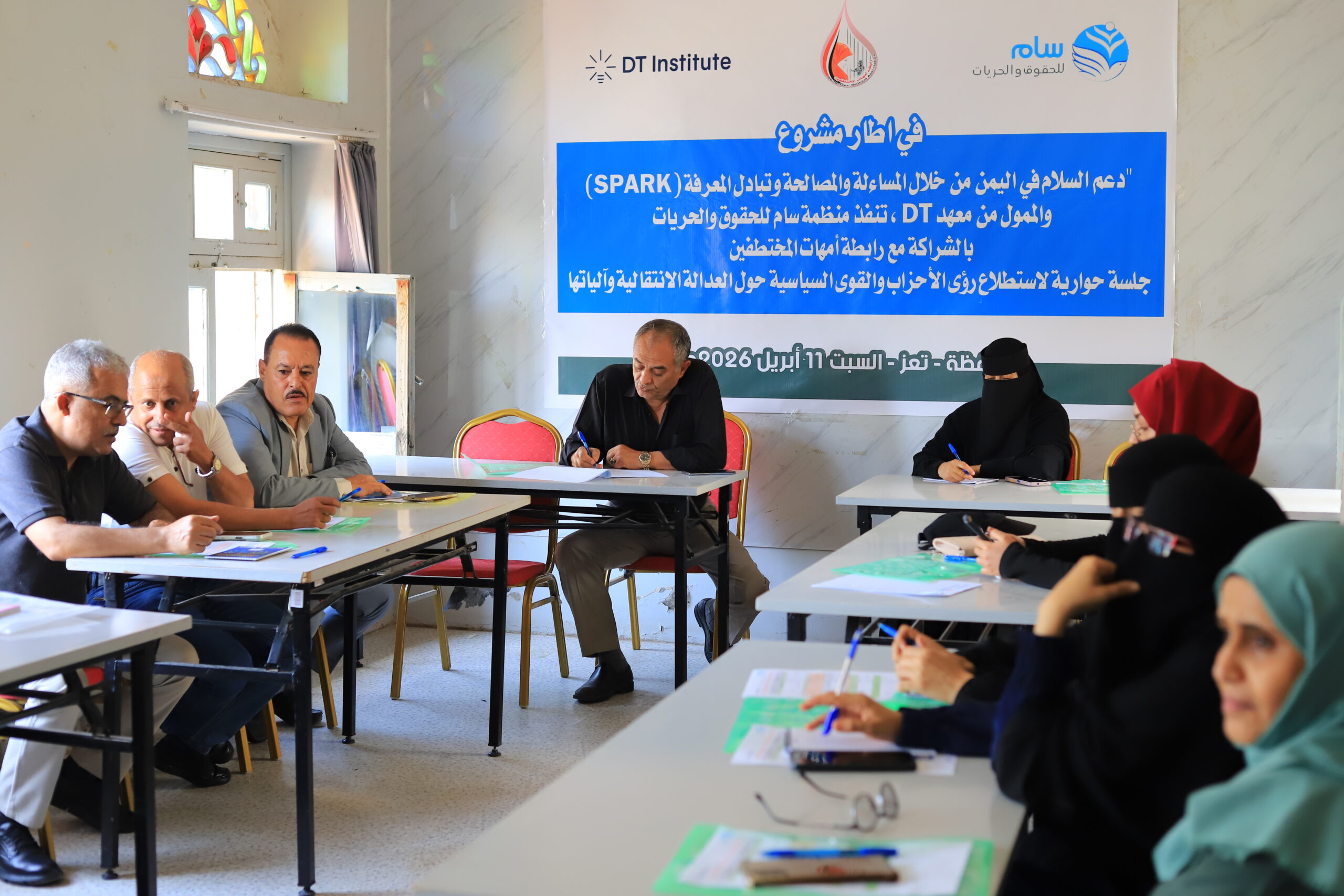
In working towards this approach, SAM implemented the Political Parties Initiative. This initiative aims to build an actionable understanding of transitional justice among Yemen’s key political actors through structured political engagement. In doing so, it seeks to support the gradual formation of a common political narrative on justice, accountability, truth-seeking, reconciliation, and other aspects of transitional justice.
The pilot is working towards these aims through a sequence of dialogue sessions and individual interviews of representatives of influential political parties and forces throughout Yemen. Dialogue session and interview inputs will be validated, synthesized, and utilized to identify common entry points to integrate this narrative into future political trajectories. These entry points, along with analysis synthesizing additional insights revealed through the interviews and sessions, will then be developed into a guidebook to act as a reference tool supporting political parties in integrating transitional justice into future actions and discourse.
💬 “Transitional justice cannot succeed if it remains solely a civil society conversation. Political parties will ultimately shape the policies, institutions, and decisions that determine whether victims receive justice. This initiative creates a rare space where political actors can move beyond political differences to identify practical areas of consensus, laying the foundation for a more inclusive and nationally owned approach to transitional justice.” – Feras Hamdouni, Program Director at DT Institute
4. Agreement and Impact
The Political Parties Initiative featured both dialogue sessions and individual interviews with political party representatives as well as influencers and experts. In total, there were five dialogue sessions and eight individual interviews conducted. The interviews were conducted with representatives of the following political parties: the Islah (or “Reform”) Party, the Nasserist Unionist People’s Party, the Yemeni Socialist Party, the Taiz Branch of the Socialist Party, the Southern Transitional Council (STC), The Free South Arabian League Party, and the Taiz Political Reconciliation Committee. Additionally, one interview was conducted with an expert on the Aden Branch of the Socialist Party.
The dialogue sessions were conducted with representatives of the following political parties and components: Yemeni Socialist Party, Islah Party, the Union of Popular Forces, the Justice and Construction Party, GPC, the Supreme Council of Popular Resistance, the Nasserist Unionist People’s Organization, the Political Bureau, and Al Rasahd Party. Political forces represented included the Hadramout National Council, the Tahima Movement, the Houthi (Ansar Allah) Movement, the Hadramout Inclusive Conference, and the Supreme Council of the Revolutionary Movement.
In total dialogue sessions featured inputs from 48 participants, including political party members and representatives as well as community influencers, journalists, political analysts, human rights defenders, experts, and the former official of the Office of the Special Envoy of the Secretary-General for Yemen (OSESGY). Inputs from each of the sessions and interviews are currently being analyzed to identify areas of consensus, divergence, and strategic entry points for deeper discussions and collaboration on effective priorities to move Yemeni transitional justice forward.
💬 “This initiative is very important. First, it aims to gather perspectives of political parties and forces on transitional justice. Second, it seeks to bridge the gap between political parties and forces, identify the fundamental needs for addressing the mechanisms and concepts of transitional justice, and establish common ground for dialogue on developments over the past ten years. Thirdly, it aims to raise awareness among political parties and forces regarding transitional justice processes and mechanisms.” – SAM
While all political entities expressed support for transitional justice and emphasized the inclusion of victims, few offered detailed or practical proposals for implementation. Most parties lacked a written vision or policy framework for transitional justice, suggesting that it has yet to become a fully developed policy priority among Yemen’s political actors. However, all participants expressed consensus that transitional justice is a necessary pathway for breaking the cycle of conflict and moving toward long-term stability.
Generally, established parties with governance experience prioritized stability, state reconstruction, and gradual reform. In contrast, newer or less politically entrenched actors emphasized stronger accountability and broader justice mechanisms. However, this does not necessarily reflect a greater concern for victims; it may also be driven by political considerations, including efforts to weaken or marginalize more established actors and parties. Across all actors, there was a shared tension over whether state-building should precede justice or whether justice is a prerequisite for state-building.
Additionally, while most actors supported accountability in principle, they differed on its timing and scope. Newer political actors favored pursuing justice early in the transition, whereas more established actors argued that extensive accountability measures could undermine political stability. Many political parties also cautioned that accountability can only be effective and legitimate if supported by an independent and capable judiciary. The Houthi Movement prioritized political settlement followed by judicial reform as the pathway to achieving transitional justice.
All party representatives justified their perspectives by noting that accountability should be linked to reparations and social repair, aiming not only to address wrongdoing but also to restore trust and heal the broader social damage caused by the conflict. Reparations emerged as a great area of consensus. The Islah, Nasserist Unionist People’s Party, Yemeni Socialist Party, and Taiz Branch of the Socialist Party all clearly stated their support for both material and moral reparations. The STC held that the primary focus of reparations should be on psychological compensation for victims. However, GPC representatives argued that moral measures such as confessions, acknowledgments of responsibility, and public apologies may conflict with tribal traditions and Yemeni social norms.
Most political parties and forces favored limiting the scope of transitional justice to violations committed since 2014, arguing that this period is marked by extensive documentation and unprecedented levels of abuse. However, this timeframe is unlikely to gain broad consensus. De facto authorities, particularly the Houthis and the STC, may resist a post-2014 focus, as it excludes violations they experienced before the conflict and overlooks their historical grievances. Experts also noted that regional actors, particularly the Arab-Led Coalition, may oppose transitional justice processes that could expose their involvement in violations. At the same time, some experts pointed out that Saudi Arabia has sought to provide reparations or compensation in certain cases involving mass civilian casualties resulting from mistaken airstrikes.
💬 “ The initiative addresses a significant gap in the Yemeni landscape and targets decision-makers. It could be a significant and influential event that contributes to shaping the features of transitional justice in Yemen, with dialogue and meetings being among its primary tasks.” – SAM
4. Learning, Documentation, and Replication
The interviews and dialogue sessions resulted in an insightful and significant mapping of transitional justice priorities of the many political parties and forces within Yemen. In short, there was a broad consensus among all political components on the importance of transitional justice, which will require an extensive system of victims’ reparations and institutional reform. Key differences emerged in discussions on the sequencing of accountability and political settlement as well as on the timeframe that Yemeni transitional justice processes should seek to address.
In doing so, SAM explained, that the initiative revealed a research gap by illuminating political actors’ positions as defined by members of the political forces and parties themselves and explained by civil society and experts. Further, “it revealed how political forces perceive the international and regional community’s reaction to transitional justice processes in Yemen,” and compared parties state positions on transitional justice mechanisms with their actions and material challenges.
💬 “The initiative is considered crucial for working towards [and] encouraging engagement in open discussions [that] build the capacities of political parties and forces, leading to convergent viewpoints, and granting parties the confidence to interact with the SAM Organization’s initiative on transitional justice issues and bridge differing perspectives.” – SAM
SPARK partners are currently working to consolidate and analyze the political parties’ perspectives and to translate their mapping of transitional justice priorities into a guide. This guide will illuminate areas of convergence, divergence, and entry points for further development in pushing forth Yemen’s transitional justice processes. It will be distributed to all the political parties and published online, illuminating the path forward and acting as a living reference document within future political discussions on transitional justice.
5. Scaling the Impact
This initiative continues to build off previous research efforts, including the SPARK Path Towards Peace study, which emphasized the divergent views of transitional justice held by Yemen’s political parties, each of which has a different geographic area as its center of influence. By convening representatives of political components as well as civil society and political experts, the initiative is creating tangible opportunities to build a shared minimum framework that is both politically informed and locally rooted, increasing its chances of sustainability.
This framework will be summarized within the initiative’s planned transitional justice guide, which will identify national-level challenges and potential avenues for cooperation on the transitional justice process. Moreover, it will supplement future discussions jumping off from the Political Parties Initiative’s dialogue sessions and interviews.
“Building a shared understanding of transitional justice among political actors is not an end in itself,” explained Feras Hamdouni, DT Institute’s Program Director. “It is an investment in Yemen’s future. By creating spaces for dialogue today, documenting areas of consensus, and equipping political leaders with practical tools, we are helping lay the groundwork for a future transition that is more inclusive, victim-centered, and resilient.”
There is a continuous need for further dialogue that is focused on and includes de-facto authorities and political forces that emerged after the war, in conjunction with established Yemeni political parties. Only through these discussions will civil society encourage and assist such parties in reaching a shared agreement on transitional justice by increasing their awareness, revealing their concerns, and identifying points of convergence and divergence.
Moreover, the added perspectives and involvement of civil society will ensure that the Yemeni form of transitional justice that emerges from such discussions will prioritize victims and be conducted in a manner that encourages participation from political actors rather than dissuading them. Productive discussions in which influential political components embrace and own transitional justice are the first steps towards sustainable peacebuilding in Yemen. As demonstrated by the Political Parties Initiative and the consensuses already identified, they are effective ways for civil society to engage political actors in Yemen and to work towards building political will.