1. Overview of the SPARK Program
Under the SPARK (Supporting Peace in Yemen through Accountability, Reconciliation, and Knowledge-Sharing) program, DT Institute and its local partners, the Abductees’ Mothers Association (AMA) and SAM for Rights and Liberties (“SAM”), promote transitional justice throughout Yemen. In doing so, SPARK sets the stage for peacebuilding processes that prioritize locals and victims, address social divisions and human rights violations, and halt cycles of violence bolstered by impunity.
Previous peace negotiations have sustained Yemen’s bloody and vicious loop of human rights atrocities by allowing conflict parties and perpetrator affiliates to avoid accountability and conduct dialogues at the expense of victims and local communities, rather than in their interest. To counteract this trend, local partners emphasize that any sustainable ceasefire requires such nationwide reconciliation and transitional justice. Transitional justice must feature victim and local participation and leadership to ensure their voices are effectively and sustainably considered.
SPARK partners’ recent study, Peace Engineering in Yemen: A Critical Review of Historical Reconciliation Experiences and Lessons for Constructing a Sustainable National Reconciliation Framework, examines Yemen’s turbulent history, which has been shaped by recurrent cycles of conflict, fragmented reconciliation efforts, and incomplete political settlements. The study puts forth 18 strategic lessons as a compass for future, sustainable peacebuilding in Yemen. Within these lessons, it highlights the importance of “rejecting victor’s justice in favor of consensual justice” and ensuring that peace is based on consensual non-retributive frameworks, rather then a singular or several parties’ interests to the detriment of other parties.
Other lessons, discussed within the analytical paper, work in tandem with this one. They emphasize the critical need to recruit civil society, local communities, international partners, and all other stakeholders as partners in transitional justice, ensuring that all these diverse segments collaborate for lasting solutions. This is the basis of consensus-based dialogue as a methodology to advance transitional justice in Yemen.
The consensus-based dialogue methodology is defined as one that fosters widespread agreement amongst all Yemeni transitional justice stakeholders so that the peacebuilding outcome will represent a collective judgment or shared opinion which most, if not all, individuals can support. This collective judgment will enable Yemeni society to collectively move forward together, representing a marked deviation from Yemen’s previous peacebuilding attempts.
By promoting transitional justice, SPARK seeks to stabilize Yemen’s volatile and fractured political and human rights environment. The program creates pathways for community healing, reconciliation, and inclusive peacebuilding through which it brings together various sectors of Yemeni society, including civil society, local communities, and governmental entities. In doing so, SPARK bridges the gaps between these sectors of Yemeni society, enabling trust-building between locals and governmental institutions, community healing and resolutions between deeply divided community groups, and fostering political will and proper understanding of transitional justice.
SPARK activities include restorative justice pilots, which foster reconciliation and resolve community-level public disputes causing and sustaining human rights violations and societal unrest. SPARK awareness campaigns educate community members on transitional justice mechanisms and engage experts and decision makers in thought provoking and effective dialogues and initiatives to advance Yemeni transitional justice. Campaigns are critical in enabling Yemeni locals and victims to take part in future transitional justice processes.
This model was designed in response to the findings of The Path Towards Peace, a research study published by SPARK in April 2025. This study captured local understandings of transitional justice across Yemen, revealing that 64.3 percent of community members prioritize reconciliation and war-ending efforts over retributive accountability. Participants identified clear roles for civil society, including initiating dialogue and reconciliation, raising TJ awareness, and documenting violations. Moreover, female participants emphasized the challenges and difficulties faced by Yemeni women, including fear of shame and scandal resulting from disclosure of human rights violations and discriminatory treatment by authorities.
SPARK’s methodology intentionally integrates bottom-up community reconciliation initiatives with top-down political dialogue processes. By linking localized restorative justice efforts with national-level political engagement, the program seeks to build broad-based consensus on transitional justice across both institutions and communities. This dual-track approach helps ensure that future transitional justice mechanisms are not only politically viable, but also socially legitimate and locally grounded.
2. The Critical Value of Consensus-Based Dialogue to Transitional Justice
The global debate on inclusive peacebuilding and consensus-based transitional justice processes focuses on how societies emerging from conflict can balance peace, justice, political stability, and legitimacy. Supporters argue that broad inclusion of victims, civil society, women, minorities, and local actors creates more sustainable and legitimate outcomes, while critics warn that overly inclusive or consensus-driven processes can slow negotiations, empower spoilers, and weaken accountability. The debate also questions whether transitional justice should prioritize universal legal accountability and reconciliation or adapt to political realities and locally negotiated approaches that may manage disagreement rather than produce full national consensus.
Under SPARK, partners operate on the basis that active understanding, support, and participation of local populations is integral to any transitional justice process. Their contributions and engagement in transitional justice are required to carry out critical processes and aspects, such as truth commissions, reparations mechanisms, and trials. Victim and local participation are similarly required for truth-seeking and memory keeping as factual histories of abuse cannot be recorded without their input and consent.
Furthermore, community buy-in provides legitimacy, transforming justice processes from being externally imposed to locally owned. This decreases the risk of the process and its outcomes being ignored or rejected by the public at large. Buy-in also ensures that mechanisms aiming to address societal traumas and needs actually do so.
Popular engagement further empowers citizens and victims, turning them into functional stakeholders, rather than passive, ancillary subjects of the process. With victims as stakeholders in democratic processes that prioritize their voices, processes can be structured to ensure that the conditions that led to violence in the first place are disrupted, ensuring non-repetition.
Yemen’s history is marred with repeated violent cycles of abuse and trauma, shaped by political discussions and “peacebuilding” at the expense of victims and locals. This could be done, because victims and locals were not taken into account – their voices were ignored as they were not offered a seat at the decision-makers’ table.
Moreover, true, thoughtful consensuses between decision-makers remained limited and fragmented. Instead, individual political parties and forces were able to manipulate peacebuilding discussions to ensure continued impunity, by avoiding accountability and corroborating to maintain pre-existing power distributions. This was done, not only at the expense of victims and locals, but at the expense of fostering a true understanding among all active political players for the betterment of Yemen’s governing structures.
💬 “[P]revious approaches [to peacebuilding in Yemen] suffered from fundamental flaws: reliance on elite bargaining, centered on power- and resource-sharing (quota-based arrangements) among conflict parties and tribal and political leaders, alongside the systematic marginalization of the political, economic, and social roots of the conflict. This approach formed a fragile peace that temporarily served elite interests while leaving the drivers of war dormant beneath the surface.” – SPARK Partners within the study, Peace Engineering in Yemen.
The solution to all of this is well-known, and, as noted previously and within Peace Engineering in Yemen, it is an essential building block of any transitional justice process anywhere in the world. Active engagement and participation of not only locals and victims, but all players – political, governmental, de-facto, international, and civil society, among any others – working towards shared understandings and agreements.
Pointing to the statistic that 60 percent of armed conflicts recurred between 1946 and 2016, the United Nations Educational, Scientific and Cultural Organization (UNESCO) holds intercultural dialogue as “a necessary complement to legal accountability, not an optional add-on.” They hold that dialogue is required for “survivor-centered, transformative approaches that connect judicial and non-judicial mechanisms with lived experience, cultural practice, and plural memories of violence and its aftermath.”
Within the same publication entitled, Dialogue for Transitional Justice, UNESCO further notes that dialogue strengthens the four pillars of transitional justice – truth, justice, reparation, and guarantees of non-recurrence – when it is participatory and anchored in lived experiences. This is true preciously because consensus-oriented dialogue helps create shared ownership of justice processes among political actors, victims, and local communities. In turn, this increases both implementation feasibility and long-term durability.
💬 “Transitional justice frameworks, while crucial for addressing past atrocities, at times underestimate the importance of human connection, empathy, and dialogue in fostering healing and rebuilding fractured societies.” – Lida Brito, Assistant Director-General of Social and Human Sciences at UNESCO, in their publication, Dialogue for Transitional Justice.
Yemen has certainly had its fair share of recurring conflict throughout its storied history. SPARK aims to ensure that future peacebuilding endeavors deliver lasting and sustainable peace, ending this cycle of violence and impunity. Therefore, a need for consensus-focused dialogue, aimed at reconciliation and bringing diverse perspectives towards common understandings, is necessary.
3. SPARK Implementation of Consensus-Based Dialogue Via Restorative Justice Pilots and Raising Awareness Initiatives
SPARK works to implement consensus-based dialogues among diverse groups via three primary methods. Firstly, by bringing together diverse, and often opposing, parties to reconcile their viewpoints into shared narratives, fostering real time understanding and allowing such parties to build off such shared understandings in future transitional justice processes. Secondly, by reconciling disputing parties, which have maintained deeply embedded and longstanding distaste for one another that has translated into greater community unrest and disputes. Thirdly and finally, by fostering understanding and awareness of different segments of society, for example, victims and survivors, by consolidating their high-level perspectives into cohesive narratives to inform future reconciliation and consensus-based dialogues.
💬 “SPARK’s experience in Yemen demonstrates that transitional justice cannot succeed through elite political agreements alone, nor solely through isolated community reconciliation efforts. Sustainable justice requires consensus-building across both levels simultaneously. By combining grassroots restorative justice initiatives with structured political dialogue among national actors, SPARK helps create a shared foundation for accountability, reconciliation, and institutional trust. This integrated approach increases the likelihood that future transitional justice mechanisms will be both politically feasible and socially legitimate.” – Feras Hamdouni, Senior Program Manager, DT Institute.
Bridging Understanding Amongst Segments of Yemeni Society
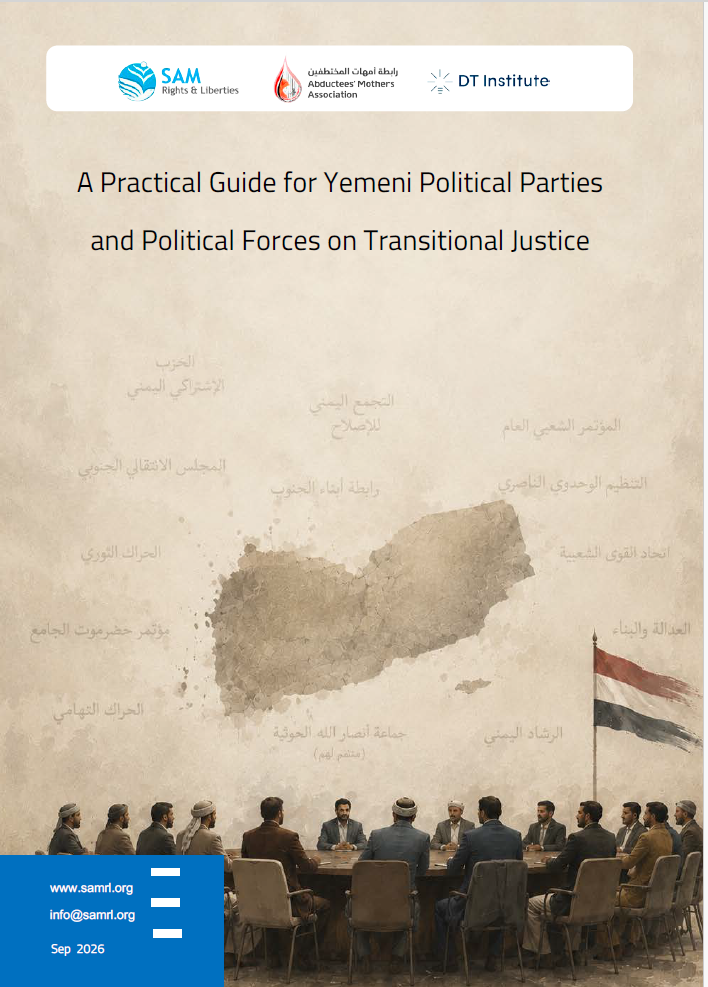
Under SPARK’s Political Parties Initiative, SPARK partners are working to build a joint political narrative on transitional justice and to find common entry points to integrate this narrative into future political discussions, trajectories, and peacebuilding efforts. In doing so, this initiative brings together diverse political actors in robust dialogue sessions, empowering them to build a joint transitional justice narrative together. Such political actors include not only traditional political parties, but also others who maintain strong influences throughout Yemen, including de-facto authorities and emerging political forces.
As a key output, the initiative also seeks to produce a practical guide, which will outline the shared visions, narrative, and perspectives of the political parties and forces. This guide will lay the foundation for unified political discourse on transitional justice. Not only will this guide ensure that transitional justice is included on the political agenda as a critical component of peacebuilding among such decisionmakers, but it will also ensure that political parties and forces can start this discussion by building upon common understanding and shared visions for transitional justice, rather than on opposing sides. This will foster further reconciliation and consensus among parties, ensuring that the cycle of consensus-building continues, replacing past cycles of misunderstanding and self-serving, opportunist foci.
Thus far, the initiative has brought together seven political parties and five political forces in four structured dialogue sessions conducted both in-person and online. Political parties included the Yemeni Socialist Party, Islah Party, the Union of Popular Forces, the Justice and Construction Party, the General People’s Congress, the Nasserist Unionist People’s Organization, and Al Rashad Party. Political forces represented included the Hadramout National Council, Hadramout Inclusive Conference, the Supreme Council of Popular Resistance, the Political Bureau, and the Supreme Council of the Revolutionary Movement.
The sessions were held in April and May in the Taiz and Hadramout governorates, as well as online. Future sessions will be held in other governorates and online as well to optimize attendance from various political actors and diversity. The sessions were successful in fostering healthy discussion amongst the parties and forces, in which participants examined different political perspectives. Through the dialogue, several points of both convergence and divergence emerged on critical transitional justice topics, including victims’ rights, accountability, truth-seeking, and reconciliation. Key sensitivities related to terminology and the sequencing of peace and justice were also exposed.
Dialogue sessions demonstrated broad consensus among the participants regarding the importance of transitional justice as a foundation for peacebuilding and addressing conflict-related violations, while reflecting different political dynamics and approaches. In Taiz, discussions were more polarized, particularly regarding accountability and reconciliation. The Yemeni Congregation for Reform, Yemeni Socialist Party, and Nasserist Unionist People’s Organization emphasized accountability and institutional reform, whereas the General People’s Congress and the Political Bureau prioritized reconciliation and political compromise. This reflects the continued politicization of transitional justice within a highly contested political environment.
In contrast, discussions in Hadramout were comparatively more pragmatic and consensus oriented. Although differences remained regarding the scope and sequencing of accountability, most actors approached transitional justice as a framework for restoring stability, rebuilding trust, and strengthening social cohesion. Hadramout therefore reflected greater openness toward institutional consensus and gradual implementation approaches, while both contexts continued to reveal the absence of clear and operational party-based transitional justice frameworks.
The initiative demonstrated a positive impact on fostering political openness toward transitional justice and cross-group engagement among participating political actors. Pre- and post-survey findings showed an increase from 89 percent to 100 percent in the proportion of respondents willing to integrate transitional justice into the political discourse of their political parties or institutions. In parallel, the percent of participants expressing willingness to collaborate with members of groups with whom they have political or social disagreements increased from 96 percent to 100 percent, reflecting strengthened readiness for dialogue, cooperation, and inclusive political engagement.
💬 “The themes of today’s session were important for understanding the parties’ perspectives and their future vision regarding transitional justice, whether in relation to the concept of justice, victims, or forms of reparation. These themes are important, and we need more dialogue and discussion sessions, especially since the nature of the topics discussed requires more sessions because they are important. One of the most important outcomes is understanding the perspectives of the parties’ branches on transitional justice issues. This is an important step in formulating the parties’ visions as they are part of civil society organizations.” – Yasser Al-Salawi, Head of the Thought and Culture Department of the Socialist Party in Yemen.
The cross-party dialogue promoted by this initiative is not only significant in bridging gaps and creating understandings between differing parties, but also it is significant in and of itself. Yemen maintains an extremely fragmented political environment. The initiative therefore contributes not only to transitional justice awareness, but also to the development of shared political understandings necessary for future reconciliation efforts.
Fostering Community Coexistence and Reconciliation Via Dispute Resolution
Under the Al-Shamayatayn Restorative Justice Pilot, SPARK partners addressed longstanding tensions between diverse community members and societal segments, which have spiraled into greater community disputes, inhibiting locals’ conditions and ability to live in harmony.
The Al-Shamayatayn Restorative Justice Pilot addressed deeply seeded tensions between the Muhamasheen (“the marginalized ones”) community and local security forces in the Al-Shamayatayn district. In doing so, this pilot demonstrated how localized dialogue and restorative justice mechanisms can generate practical consensus even in highly polarized settings where formal judicial processes have stalled. Moreover, it is representative of SPARK’s bottom-up approach to transitional justice, centered on trust-building, facilitated dialogue, and negotiated reconciliation.
The hostilities originated approximately five years prior to the start of the pilot when a Muhamasheen man was killed by the local security forces. His body remained unburied throughout these five years, against Yemeni religious and cultural norms. This deepened community trauma and distaste, fostering distrust and resentment amongst the Muhamasheen community and the local security forces.
To resolve the conflict, the SPARK Community and Consensus Committee (CRCC) engaged the victim’s family and local security actors. Through discussions with each of these parties, the CRCC worked to understand each of their perspectives. Discussions with local security forces included the Director of Al-Shamayatayn District and involved extensive outreach utilizing the CRCC’s local networks. Engagement with the victim’s family required use of the trauma-informed care (TIC) protocol and listening to their demands.
Finally, the CRCC engaged both parties jointly in four facilitated dialogue sessions. Over the course of these discussions, both parties were guided toward understanding, compromise, and resolution. After five years of stalemate and judicial inaction, both parties signed a formal reconciliation agreement, resulting in a peaceful resolution based on joint understanding of each side.
On July 29, 2025, the victim was finally laid to rest with a dignified funeral. Moreover, the security forces publicly acknowledged the harm caused and agreed to reparative measure directed towards the victim’s family. Parties viewed the pilot as an opportunity to rebuild societal trust and understanding and to move forward. They expressed that the pilot was much needed, especially after so many years of ill-feelings and standstill.
💬 “Initially, the victim’s tribe approached the situation with the intent of retaliation rather than resolution. However, through the initiative’s inclusive engagement with all stakeholders and sustained communication with the various parties, a shared conviction gradually emerged around the value of the reconciliation pathway.” – Abdal Azzaz Al-Shaibani, Director General of Al-Shamayatayn District.
Fostering National-Level Understanding of Critical Segments of Society
Under the Transitional Justice from the Survivor’s Perspective Initiative, SPARK partners fostered understanding of Yemeni victims and survivors, who had experienced past abuse and human rights violations. As victims and survivors of such abuses, these individuals demonstrated a critical need to be included in transitional justice processes, including in reparations, truth-seeking, and recovery pathway initiatives.
The initiative had a dual aim and impact. It enabled survivors and victims to gain proper knowledge of transitional justice, their rights, and the potential recovery pathways utilizing TIC. However, it also ensured that once this understanding was formed it operated to inform others on survivors’ needs and their collective memory of abuses and human rights violations suffered. In this sense, the initiative provided a foundation for future consensus-based dialogue that takes into account these victims and survivors’ perspectives, memories, and needs.
The initiative operated by bringing together victims and survivors in two awareness sessions in Taiz, attended by 50 participants in total. Such awareness sessions gave way for impactful dialogue and significant breakthroughs among victims as it fostered understanding and educated them on TJ principles. Participants indicated that the session was a key driver in encouraging them to document evidence of their human rights violation cases and to seek justice. Moreover, during the sessions, participants experiences, needs, and perspectives were recorded to inform a future booklet summarizing their joint narrative.
A third session was held for 20 journalists, including several affiliated with political parties. This session explored the role of the media in transitional justice and peacebuilding. Throughout the session, speakers highlighted how media coverage can support accountability by preserving a historical memory and documenting violations.
From these sessions, SPARK partners published a booklet entitled, The Voice of Survivors: Stories of Victims in Taiz. The booklet focuses on five moving testimonies, capturing how the war has reshaped ordinary lives and impacted Yemeni locals and victims. It discusses displacement, injury, loss, and disappeared loved ones with no answers. It emphasizes these experiences by contextualizing them within Yemen’s dire environment, highlighting how these experiences are not isolated incidents, but part of a broader pattern of violations that continue to impact individuals and communities long after the initial harm.
By centering victims’ voices, The Voice of Survivors highlights a critical truth: justice begins with listening, and meaningful peace depends on acknowledging those who have borne the cost of war.
💬 “In deeply fragmented societies such as Yemen and Syria, transitional justice processes risk reinforcing division if they are perceived as exclusionary or politically imposed. Consensus-based dialogue provides an alternative pathway by enabling victims, communities, civil society actors, and political stakeholders to gradually develop shared understandings around accountability, reconciliation, and non-repetition. SPARK’s model demonstrates that dialogue itself can become a mechanism of transitional justice by rebuilding relationships, restoring trust, and generating inclusive ownership over future peacebuilding processes.” – Feras Hamdouni, Senior Program Manager, DT Institute.
4. Scaling the Impact
The above sampling of SPARK activities, including awareness-raising initiatives and restorative justice pilots, represents a small number of those contributing to consensus-based dialogue for transitional justice in Yemen. To enable national consensus-based dialogue, SPARK operates to foster understanding, unity, and reconciliation of all segments of Yemeni society, not limited to those above.
This includes female human rights defenders and influential religious preachers through the Peace Dialogue Restorative Justice Pilot; sectarian groups, including locals divided amongst sectarian lines, in the Al-Sarari Restorative Justice Pilot; and tribal leaders, local civil society, and international non-governmental organizations (NGOs) in an initiative enhancing social and political agreement on utilizing traditional and customary practices in transitional justice processes.
💬 “Women have been engaged in envisioning the process of transitional justice. They were not only present as victims but were involved as agents and actors in shaping the process. … There was a certain smartness from the project administration, especially in including political leadership and also including the National Commission for Reconciliation. When we included them, we started to see a positive impact. It almost became a trend, and we saw how this influenced the political elite as well. Because of this, transitional justice became a subject that is discussed with the presence of marginalized women victims together with the political elite. …Some years ago, we could never witness something like this. I also noticed that ordinary people and emerging activists started discussing transitional justice. …Another point is that we started a dialogue between authorities and victims. For example, in the Al-Shamayatayn Initiative…” – Najla Fadhel, Member, Abductees’ Mothers Association.
In fostering such understandings amongst local, national, and international stakeholders, SPARK operates through a bottom-up approach under the methodology that these often-localized consensus-based dialogues are the foundation for national, whole-of-society consensuses down the line. As described at the outset of this case study, such dialogue is critical to the successful, lasting implementation of transitional justice and peacebuilding efforts throughout Yemen.
The fostering of broad agreement amongst all transitional justice stakeholders and an accurate representation of their perspectives in Yemen’s peacebuilding outcomes will enable it to represent a participatory, collective judgement of Yemeni society as a whole. This, in turn, will enable stakeholder buy-in, joint ownership, and empowerment within the transitional justice process, reducing risks of rejection and enabling further sustainability.
💬 “The experiences of both Yemen and Syria demonstrate the limitations of peace processes that prioritize elite negotiations while marginalizing local communities and victims. in both contexts’ emerging consensus-based dialogue initiatives suggest a potential alternative approach: one that combines community-level reconciliation with national political engagement, the evolving transitional justice discussions increasingly recognize that sustainable peace requires both top-down political agreements and bottom-up social consensus.” – Feras Hamdouni, Senior Program Manager, DT Institute.