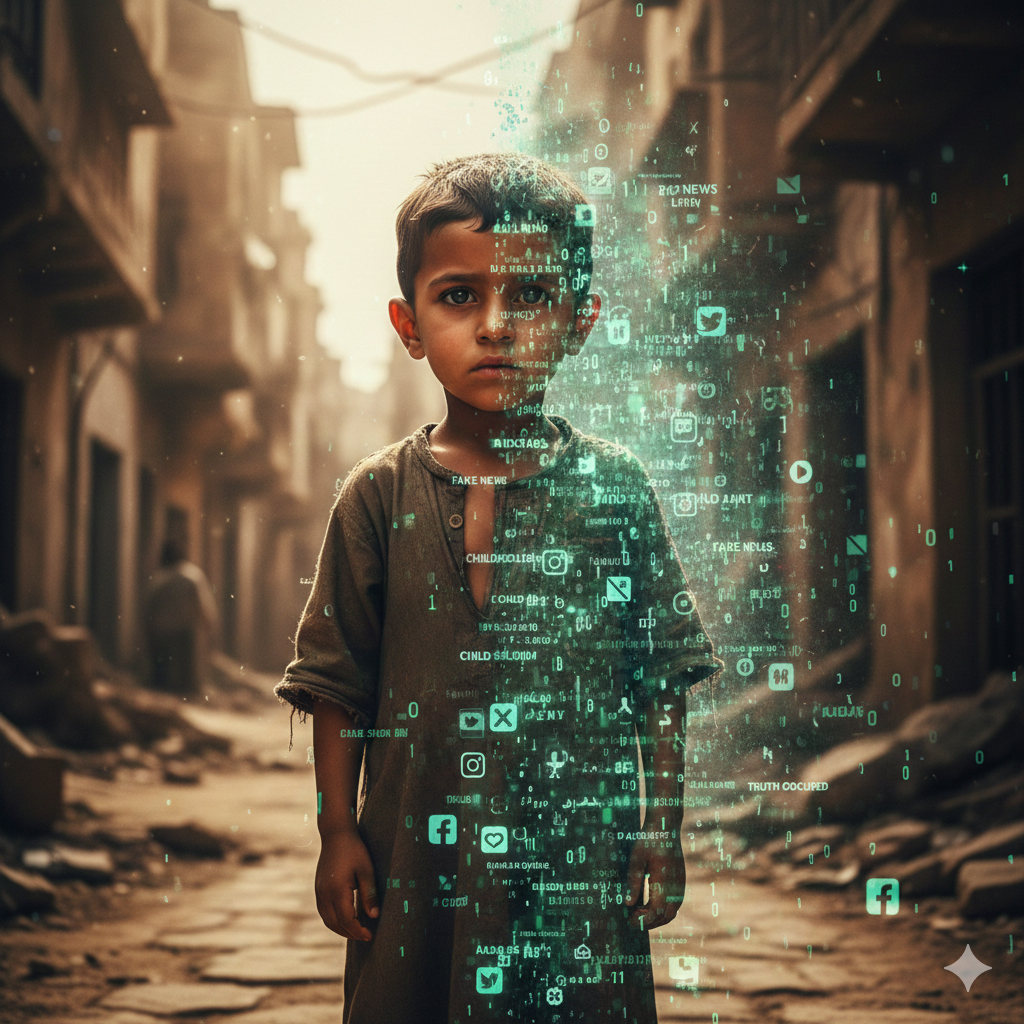
The proliferation of disinformation in Yemen does not only undermine children’s rights, it contributes directly to instability, extremist recruitment pipelines, and regional insecurity. By countering disinformation that fuels child recruitment, shields perpetrators, and distorts accountability, SAFE supports broader counterterrorism and stabilization priorities. Reducing impunity and limiting propaganda infrastructure helps prevent armed actors from consolidating power, radicalizing youth, and expanding threats that destabilize the Red Sea corridor and surrounding region.
Disinformation and Children’s Rights in Yemen
Since the outbreak of the Yemeni conflict in 2014, children remain one of its most severe causalities. In 2025, the United Nations (UN) Secretary-General on children and armed conflict reported over 5,539 grave violations committed against children in Yemen. These included all six of the grave violations of children in times of war, the most prevalent of which were the killing and maiming of children (1,941 violations) and child recruitment (564).
Since then, over the life of Supporting Awareness, Facilitating Enforcement of Children’s Rights in the Yemeni Conflict (SAFE) program, from 2022 to 2025, SAFE partners documented over 428 additional grave violations. These violations reflected a similar pattern with killing and maiming (126 violations) and child recruitment (112) being the most frequent.
Complementing and underpinning these violations are rampant media disinformation campaigns launched by conflict parties, particularly the Houthis (Ansar Allah), to justify and deflect responsibility for such atrocities. Through such campaigns, these actors have launched a “soft war,” utilizing the media as their weapon to spread disinformation and propaganda that reframe violations as acts of national defense, or absolve push blame onto the children’s family.
As reflected within the 18 disinformation reports published under SAFE, the Houthi “soft war” entails sophisticated strategies and political maneuvers, intended to transform the war raging on the ground into the digital space. These campaigns not only justify atrocities, for example, by claiming murdered children as Houthi martyrs. Significantly, they also serve to enhance their public image and shift blame onto external actors, such as the Saudi-Led Coalition and the United States.
These tactics frame the Houthis’ plight as a struggle, not just against local but also against global forces. This can be seen most blatantly in the Houthi slogan, which translates to “God is great; death to America; death to Israel; a curse on the Jews; victory for Islam,” and reflects both Hezbollah’s motto and that of the Iranian Revolution.
Such media weaponization serves a dual purpose – vilifying external actors like the United States, while simultaneously mobilizing public opinion and generating support for their propagandized agenda. International media reports that the Houthis control approximately 30 local media outlets, alongside a digital army of hundreds of Houthi-affiliated social media accounts.
Moreover, as a proxy of Iran, the Houthis receive, not only military training from Hezbollah, but also support in hosting media networks and trainings of media personnel in “military media” – a term originating in Tehran. This strategy has created an atmosphere of intimidation, as media outlets frame Houthi actions as ‘national’ causes while concealing the true objective of consolidating control over Yemen. This includes weaponizing the situation in Gaza to recruit children to fight on the frontlines in Yemen.
💬 “Disinformation functions like a landmine in people’s minds, causing damage long after it is planted. … The overarching goal [of such disinformation] is to reshape public consciousness using traditional and digital media.” – Farouk Al-Kamali, Editor-in-Chief of the YobYob Fact Checking Platform, at the webinar launching the investigative report, Media Disinformation and Violations Against Children in Yemen: Between Evasion of Responsibility and the Right of Victims to Truth.
SAFE’s Role in Enhancing Digital Accountability
The prevalence of the Houthis’ “soft war” cannot be understated, and neither can its impact on the greater narrative surrounding the Yemeni conflict. As continuously emphasized by SAFE and Justice4Yemen Pact (J4YP) partners, through media manipulation, disinformation, and propaganda, conflict parties sew their own narratives of the conflict and its humanitarian toll. These narratives not only serve to absolve them from responsibility, but also to effectively rewrite history.
However, unlike the Houthis coordinated “soft war,” the internationally recognized government’s (IRG) media apparatus has historically been fragile, fragmented, and prone to internal competition, reflecting both weaknesses and tensions among the IRG’s various units. In fragile environments, unchecked narrative manipulation entrenches instability by obstructing justice processes, eroding public trust, and undermining prospects for durable peace. Addressing these information threats is therefore a stabilization measure as much as a human rights intervention.
As stated within J4YP’s story highlighting DT Institute’s engagement in the SAFE program, “the manipulation of media must also be monitored and addressed, because it is through these narratives that crimes are concealed and repeated.” Emphasizing the call of YCMHRV’s CEO, Muthar Al Bathaji, the story continued, “Without counter-narratives, the truth is lost — and with it, the possibility of accountability.”
💬 “Media no longer functions merely as an information intermediary; it has become an actor in conflict management, narrative control, and public opinion shaping.” – Safa Nasser, Researcher and Human Rights Activist, at the webinar launching the investigative report, Media Disinformation and Violations Against Children in Yemen: Between Evasion of Responsibility and the Right of Victims to Truth.
Moreover, SAFE work has demonstrated, the ways in which these narratives are often carefully and strategically crafted, rather than random or one-off. Under SAFE, local partners, the Yemen Coalition for Monitoring Human Rights Violations (YCMHRV, also known as “Rasd”) and the INSAF Center for Human Rights, has brought attention to conflict party ties to Hezbollah and Iran, and the ways in which their tactics are being leveraged to influence Yemeni public opinion.
These narratives and their grave impacts are documented in 18 disinformation stories, published over the lifetime of SAFE and featuring the intentional use of media manipulation. This manipulation, which featured disinformation and propaganda, was used to justify violations against children. Such violations include child recruitment, torture, and killing and maiming of children, among other grave violations of children’s rights.
💬 “Disinformation is not simply a distortion of facts — it is a destabilizing force that erodes the rule of law, obstructs credible documentation, and weakens accountability systems. By transforming clear crimes into politicized narratives, it protects armed actors, entrenches impunity, and fuels cycles of violence. When truth is manipulated, governance is undermined, instability deepens, and the conditions that allow extremist recruitment and conflict expansion to persist are reinforced. Protecting factual integrity is therefore not only a matter of justice for victims, but a necessary safeguard for stability and security.” – Feras Hamdouni, DT Institute’s Senior Program Manager.
These stories culminated with YCMHRV’s investigative report entitled, Media Disinformation and Violations Against Children in Yemen: Between Evasion of Responsibility and the Right of Victims to Truth. The study – the first of its kind in Yemen – analyzes disinformation and its role in undermining children’s rights throughout Yemen. Moreover, it includes a field survey, featuring the informed opinions and experienced reflections of 62 journalists, researchers, and child-rights activists.
SAFE Documentation Uncovers Organized and Entrenched Patterns of Media Manipulation
The patterns identified by SAFE demonstrate that media manipulation in Yemen, particularly the brand promoted by the Houthis, is not incidental but structured and strategic. These tactics mirror broader information warfare approaches used by armed non-state actors globally. When left unchecked, such tactics create permissive environments for extremism, prolong conflict, and obstruct governance — outcomes directly contrary to stabilization and counterterrorism objectives.
Over time, SAFE partners noticed four emerging patterns of narrative manipulation, as documented in the comprehensive investigative report. The four main patterns of disinformation in conducting such narrative manipulation included: (1) shifting responsibility and exchanging accusations, (2) smearing victims and protecting perpetrators, (3) reframing and distorting violations, and (4) concealment and information blackout.
Each of these patterns has further been illustrated by the SAFE disinformation reports, which focus on individual instances of media manipulation and grave abuse. Each of the reports provides an effective and detailed perspective into specific patterns of abuse.
For instance, Summer Centers: How the Houthis Turn Children’s Pens into Rifles, doesan effective job illustrating the tactic of reframing and distorting. In this case, YCMHRV’s thorough investigation reals – contrary to Houthi-affiliated media reports – Houthi summer camp activities are not “educational.” Rather, they are violent, economically exploitative, and psychologically manipulative.
Similarly, another SAFE report, entitled Militarizing Summer: Houthi Use of Summer Camps for Child Recruitment and Indoctrination in Yemen, points to Houthi distortion of the current situation in Gaza. The report documents the experiences of 14-year-old Ghamdan Yahya Al-Ahwas, who was told he would be fighting to defend the people of Gaza, and instead sent to the frontlines in Hajjah, Yemen. This resulted in his immediate and imminent death.
In the disinformation report, Children of the Hantous Family: Victims of Abduction and Deception, YCMHRV effectively documents the smearing of victims to protect perpetrators. In this case, the Houthis falsely accused five children, aged 10 to 14, of belonging to a terrorist cell, using this as an excuse to justify their kidnapping and torture of the children based on their father’s affiliations.
Disinformation reports also illustrate patterns of shifting responsibility and concealment and information blackout in conducting narrative manipulation. Both of these can be observed in the report, entitled Sa’da’s Landmines: Nameless Children, Unaccountable Perpetrators, and a Truth Buried Beneath Propaganda. This reportdid an effective job illustrating the tactic of shifting responsibility. In this case, three children were killed by an unknown explosive object.
Subsequently, Houthi- and government-aligned media outlets began exchanging accusations – either on the Saudi-Led Coalition or Houthis – depending on their loyalties. Such accusations were accompanied by the blocking of investigations by conflict parties. These were attempts to ensure no further information is collected on these violations, effectively an attempted information blackout.
Similarly, in the SAFE report entitled, Al-Bumiyah Market Massacre: Houthi Drone Attacks in Reality, and the Media Kills Twice, the Houthis took their tactics one step further, accusing not only local actors, but also the United States. The Houthis claimed the US was responsible for inciting a conspiracy against the group. Their accusations took the form of a sophisticated and organized social media campaign under the hashtag #United_States_is_Terrorist. A central component of this campaign included redirection of the conversation about the drone attack in Yemen to the wholly unrelated events in Gaza.
Initiative Spotlight: Media Disinformation and Violations Against Children in Yemen
A comprehensive analysis of these patterns is provided within the investigative report, Media Disinformation and Violations Against Children in Yemen: Between Evasion of Responsibility and the Right of Victims to Truth, represents an in-depth analysis into the impact of media disinformation among children’s rights violations in Yemen.
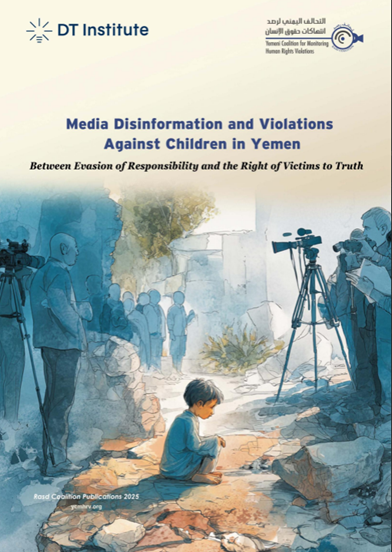
According to the study, approximately 80 percent of respondents believe that media disinformation has a “very significant impact” on uncovering the truth and documenting violations against children. The report notes that the media’s actions in “obstructing the course of justice and concealing crimes, the suffering of victims is deepened, and accountability efforts are undermined.”
Moreover, 63 percent of respondents indicated that all conflict parties engage in media manipulation and disinformation. Respondents identified Houthi-aligned media as the most frequent disseminator of harmful disinformation impacting children’s rights, followed by anonymous and unverified sources and partisan media outlets.
Respondents also gave information on central drivers of disinformation, which underpin these crimes, allowing media manipulation to thrive. These include weak media independence, which was cited by 69 percent of participants. Such participants indicated that reliance on conflict-linked funding continues to expose media outlets to political influence. This, compounded with low media literacy among the public, increased susceptibility to misleading content.
Personal Stories and Documented Testimonials of Media Manipulation
“Media deception around child recruitment is a crime no less horrific than the recruitment itself,” noted YCMHRV in the disinformation report, Summer Centers: How the Houthis Turn Children’s Pens into Rifles. In the most “positive” light, conflict party disinformation in Yemen often serves to (as further stated by YCMHRV) “turn the crime into a ‘virtue,’ and the victim into a ‘false hero.’”
Disinformation is not merely a byproduct of armed conflict, it is a violation in its own right that directly undermines children’s rights, truth, and justice. When false narratives are deliberately constructed to deny, reframe, or justify grave violations – just as the patterns have illustrated – the harm does not end with the physical act itself.
DT Institute’s Senior Program Manager, Feras Hamdouni, stresses, “This dynamic is not unique to Yemen. I witnessed it firsthand during the Daraya massacre in August 2012, where Assad-affiliated forces killed tens of children and their families. Almost immediately after the massacre, a coordinated disinformation campaign was launched through state-aligned television, online platforms, and controlled offline channels. When UN and ICRC missions conducted brief visits to meet families, survivors were pressured and intimidated into repeating a fabricated narrative, that “unknown militias” were responsible.”
Hamdouni’s experience represents a further illustration of intentional, organized media manipulation, with a focused purpose in mind – to ensure erasure of the truth of the violations. As Hamdouni explained, this manipulation did not only erase accountability; it actively harmed children. It denied their suffering, corrupted documentation efforts, and embedded impunity into the international response.
What happened in Daraya mirrors what SAFE has documented in Yemen: disinformation extending the violation beyond the moment of violence and into the realm of justice itself.
Translating Documentation into Accountability Via International Justice Mechanisms
Under the SAFE project’s methodology, partners seek to continuously link documentation efforts to international accountability mechanisms. Over the life of SAFE II, partners have submitted 12 individual legal case files to international justice mechanisms, including the Special Procedures of the United Nations and the Committee on the Rights of Persons with Disabilities (CRPD).
These cases advocate for accountability for individual victims, while drawing attention to crimes that are repeatedly committed against children throughout Yemen. In doing so, they make certain the truth of these crimes is documented and preserved in a manner aligning with international legal standards, ensuring that public disinformation does not impact international justice and accountability.
Moving forward, SAFE partners are committed to pursuing local strategic litigation to address not only documented violations against children, but also the media disinformation that accompanies and extends such violations. “Integrating documentation with legal analysis and accountability pathways would enhance the impact of our work and create clearer avenues for redress and justice,” holds Hamdouni.
Going Forward
In looking forward to a media environment free from harmful narratives and tainted with rampant disinformation, SAFE partners continue to uncover the truth and draw attention to conflict parties’ propagandized narratives. In doing so, YCMHRV hosted a webinar to launch the investigative report.
The webinar featured 56 attendees, including activists, experts, and a representative from the European Union. Throughout the webinar, speakers and participants alike highlighted the study as uniquely valuable. As noted by YCMHRV’s CEO, Mutahar Al-Bathiji, during the webinar, “this is the first study in Yemen to systematically examine the relationship between children’s rights and media disinformation.”
In doing so, the study provided effective insights into the relationship between the two – discussed extensively throughout the webinar. Speakers drew attention to the usage of disinformation as a “direct continuation of violation[s]” and as a transforming factor that alters crimes requiring accountability into disputed or politicized narratives, stripping them of their human rights components.
“From my experience in Daraya and through our work in Yemen under the SAFE program, I have learned that the violation does not end when a child is killed, recruited, or injured. It continues through the narrative imposed afterward,” explained Hamdouni. He continued, “Disinformation turns crimes into confusion, silences families, obstructs documentation, and protects perpetrators. In this sense, misinformation is not just biased media — it is an extension of the violation itself and a powerful tool for sustaining impunity.”
As pointed out by webinar participants, namely Muna Saleh, member of the Joint Technical Committee for Preventing Recruitment of Children, in combatting such disinformation awareness raising is key and should start by providing education on violations against children. Their suggestions further aligned with the investigative report’s recommendations, which included establishing an independent national mechanism to monitor and combat disinformation and creating monitoring units within media institutions to support field documentation.
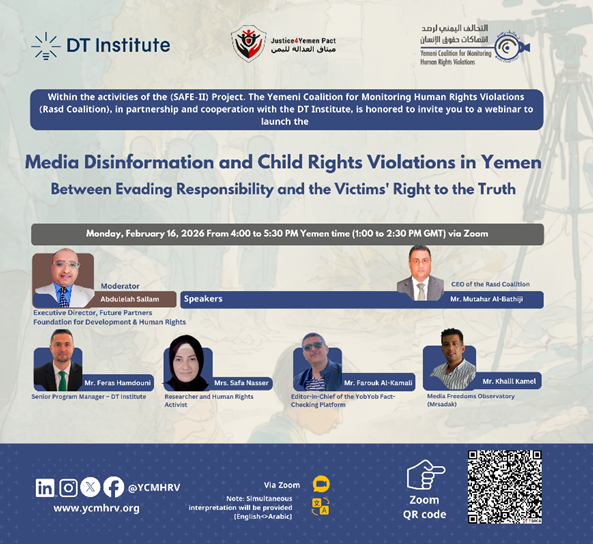
💬 “Disinformation is a threat to safety. Protecting children and creating safe environments requires pressuring conflict parties and allowing organizations to operate freely. … [O]rganizations must be protected, perpetrators held accountable, and no tolerance [for disinformation] allowed.” – Khalil Kamel, Monitoring and Documentation Officer at Media Freedom Observatory (Marsadak), at the webinar launching the investigative report, Media Disinformation and Violations Against Children in Yemen: Between Evasion of Responsibility and the Right of Victims to Truth.
By countering disinformation that fuels child recruitment, shields armed actors, and spreads anti-U.S. narratives, SAFE contributes to reducing drivers of instability in Yemen. Supporting digital accountability and narrative transparency strengthens governance resilience, disrupts extremist messaging ecosystems, and advances both humanitarian protection and regional stability.