Yemen — February 18, 2026
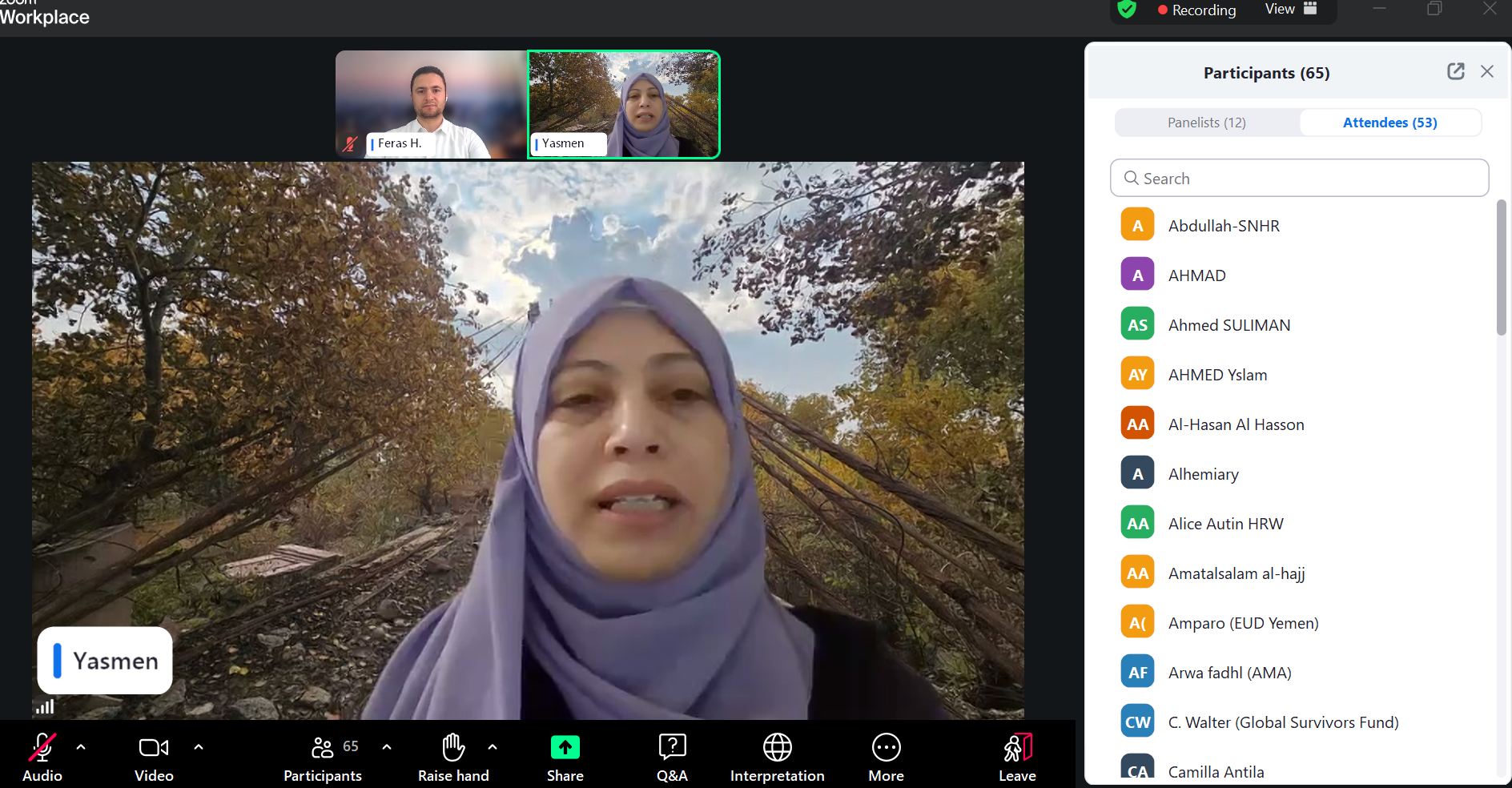
A regional webinar convened this week to discuss transitional justice in Yemen and Syria, highlighting the central role of civil society and victims in promoting sustainable peace. The event brought together 64 participants from organizations including the European Union, the Netherlands Embassy, FCDO, DRL, Mediators Beyond Borders, and CCDP. Speakers emphasized that transitional justice is not a political luxury, but a necessary step for societal and political transformation.
Feras Hamdoni, Senior Program Manager at DT Institute, offered comparative insights between Yemen and Syria. “In both contexts, reparations are a major challenge due to limited resources and the absence of sustainable national funds to compensate victims,” he said, adding that while Syria benefits from the International, Impartial, and Independent Mechanism (IIIM), Yemen lacks such an international investigative body. He also stressed the urgent need for institutional reform in security and judicial sectors to prevent recurrence of violations.
Ishraq Al-Maqtari, Minister of Legal Affairs in Yemen, emphasized the importance of preparation and civil society engagement. “Preparing and laying the groundwork for transitional justice is urgent and must be based on clear political and legal will. Civil society has sometimes advanced ahead of the state, elevating victims’ voices and strengthening the legitimacy of documentation,” he said.
Yasmen Almeshan, Commissioner at the National Commission for Transitional Justice in Syria, highlighted transparency and institutional memory as central to sustainable reforms. “There is a commemorative path aimed at avoiding repetition, preserving memory, and promoting institutional reform. Citizenship is our guiding principle,” she said, noting the challenges posed by economic constraints and the complexity of violations across different regions.
Dr. Fadl Abdulgani, Director of the Syrian Network for Human Rights and UNDP Consultant, addressed the link between transitional justice and political transitions. “Settlements have occurred under certain conditions, but mismanagement risks the failure of relevant bodies. Both Yemen and Syria face a significant legacy of violations requiring societal-level transition,” he said.
Maysaa Shujaa Al-Deen, Senior Researcher at Sanaa Center, spoke on civil society’s emerging role in Yemen. “Discussion of transitional justice is still in its infancy in Yemen, emerging from cumulative civil society efforts. Previously, political agreements ignored violations or rights, but civil forces began demanding accountability from 2011 onwards,” she explained.
Mohammed Al Mekhlafi, former Minister of Legal Affairs in Yemen, discussed Yemen’s legal and institutional foundations. “Draft laws and committees addressing land, displacement, and reparations provide a basis for transitional justice, but continuity and enforcement are crucial to ensure victims receive their rights,” he said, pointing to stalled implementation due to ongoing conflict.
The webinar concluded that transitional justice must be multi-faceted, inclusive, and sustained, combining legal frameworks, civil society engagement, and political will. Participants agreed that justice is only meaningful when victims see tangible outcomes and remain at the center of the process.