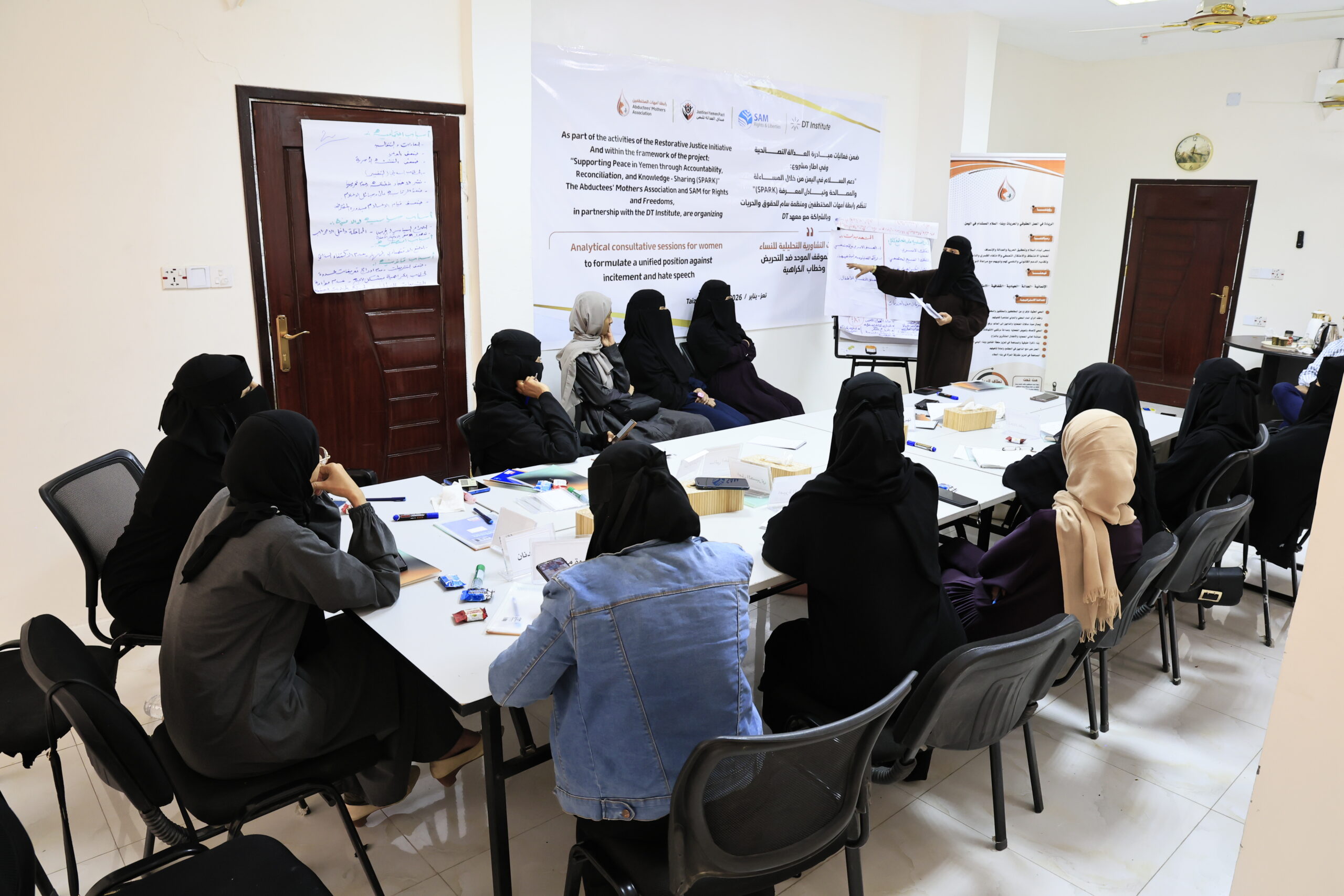
1. Overview of the SPARK Program
Under the SPARK (Supporting Peace in Yemen through Accountability, Reconciliation, and Knowledge-Sharing) program, DT Institute and its local partners, the Abductees’ Mothers Association (AMA) and SAM for Rights and Liberties (“SAM”), launched raising awareness campaigns to complement restorative justice pilots and engage community members in Taiz and Aden.
The restorative justice pilots aim to foster reconciliation and resolve community-level public disputes that have caused human rights violations. While raising awareness campaigns educate community members on transitional justice mechanisms and engage experts and decision makers in thought provoking and effective dialogues and initiatives to advance Yemeni transitional justice.
This model was designed in response to the findings of The Path Towards Peace, a research study published by SPARK in April 2025. This study captured local understandings of transitional justice (TJ) across Yemen, revealing that 64.3 percent of community members prioritize reconciliation and war-ending efforts over retributive accountability. Participants identified clear roles for civil society, including initiating dialogue and reconciliation, raising TJ awareness, and documenting violations. Moreover, female participants emphasized the challenges and difficulties faced by Yemeni women, including fear of shame and scandal resulting from disclosure of human rights violations and discriminatory treatment by authorities.
Participants in focus sessions also expressed ideas for the inclusion and involvement of women in transitional justice processes. The most prominent suggestion, cited by 48 percent of respondents, was to include women in bodies and committees tasked with designing and implementing transitional justice. Many female participants emphasized that this was important given that women are more likely to be subject to violations and because of their important role in society. However, there was also much discussion on ensuring women’s involvement in transitional justice aligns with Yemeni culture, customs, and traditions.
💬 “Women are the ones most exposed to violations and harm. They were the main group being attacked. They need to be involved in exposing the scope and damage of these violations, as they have paid the highest price for this war. The nature of their participation needs to suit our culture.” – An interviewee from Marib, participating in the Path Towards Peace Study.
In addressing these gaps, SPARK works to advance local and national reconciliation, by furthering initiatives to educate local stakeholders on transitional justice concepts. At the same time, the program builds resilience within divided communities through the pilots, which create sustainable pathways for dialogue and conflict resolution.
Through effective engagement, the program activates all segments of society – from the community level to civil society, experts, and high-level governmental stakeholders. This enables these groups to not only be participants, but central drivers of Yemen’s transitional justice journey. With donor support, these efforts can be scaled to reach more communities, ensuring that reconciliation and peace take root from the ground up.
2. The Impact of the Conflict on Women
After over a decade of conflict, Yemen’s dire environment presents increasing challenges and restricts amongst all civilians, but especially women. Yemeni women are disproportionately affected by the greater conflict as millions continue to face dire humanitarian conditions and struggle to meet basic needs and access essential services amid protracted crises, conflict-induced economic deterioration, mass displacement, and climate-related shocks. According to the United Nations (UN) Office for the Coordination of Humanitarian Affairs (OCHA), over 22 million people will require humanitarian assistance and protection services across Yemen. Of these 22 million, approximately 50 percent or 10.95 million are women and girls.
In addition to risks related to hunger, WASH (water, sanitation and hygiene), and preventable diseases, which Yemeni households are increasingly exposed to, women face additional challenges and victimization at the hands of the conflict parties. Their mobility is seriously restricted by the Houthi (Ansar Allah) forces, which maintain control in the North, and by the internationally recognized government of Yemen (IRG) and the Southern Transitional Council (STC) in their areas of control throughout the South. At the same time, Yemeni women are central to families’ economic survival and to community resilience throughout the country.
In December of 2025, the Georgetown Institute for Women, Peace and Security’s (GIWPS) ranked Yemen as the lowest performing country in the Middle East and North Africa (MENA) and as the second worst overall on their Women, Peace, and Security Index (WPS Index). The index ranks 181 countries on 13 indicators of women’s inclusion, justice, and security. Amongst all inclusion indicators – women’s mean years of schooling, employment, financial inclusion, cellphone use, and share of parliament seats – Yemen ranked the lowest in the MENA region. Women ranked near worst or worst in the group amongst justice indicators as well, including in access to justice and absence of legal discrimination against women (at 0.8 and 26.9 compared to the worst scores of 0.7 and 26.3, respectively).
Yemen’s low rankings paint a bleak picture for women’s rights and participation in society. Despite these numbers, Yemeni women remain resilient and persistent. Throughout the country, women play vital roles in sustaining their communities as key actors shaping household and community stability. Moreover, women are often critical players in fostering dialogue and community resilience amongst continuous hardship.
Female civil society leaders emphasize that technology, economic necessity, and evolving norms have expanded women’s participation in society. As shared by Gabool Al Mutawakel, co-founder of the Youth Leadership Development Foundation, “Gender gaps persist mainly due to poverty, limited education, and conservative norms, not outright insecurity. With more resources, women’s conditions would improve significantly.” Moreover, the new government’s inclusion of three female ministers among its 35 members has garnered attention. Some see it as an overdue signal of inclusivity and recognition, while others remain skeptical on whether their appointments will translate into meaningful influence and policy changes.
However, there is still a long road ahead. Overall, as reflected by female peacebuilders, civil society actors, and the Sana’a Center for Strategic Studies in their recently released policy brief, meaningful female participation in peacebuilding and transitional justice requires sustainable prioritization of their roles and voices. This includes investment in female political leadership and collective power and intentional shifts from symbolic inclusion to true meaningful influence in decision-making.
💬 “Being a peacebuilder in Yemen is incredibly challenging, especially as a woman. Society does not accept women as peacebuilders. Many believe this is not our role – that we were born to stay in the kitchen, to remain at home. They don’t recognize the capacities of women, and that is a big mistake. Women are not just caretakers; we are part of our communities, fighting for rights and for a better future.” – Olla Al-Sakkaf, female Yemeni activist and researcher, in an interview with The Global Partnership for Prevention of Armed Conflict (GPPAC).
3. SPARK’s Restorative Justice Pilots Place Women on the Forefront of Successful, Reproducible Transitional Justice Processes
Under DT Institute’s previous programs, Yemen Human Rights Forensic Lab Plus (YHRFL+) and Supporting Awareness, Facilitating Enforcement of Children’s Rights in the Yemeni Conflict (SAFE), Yemeni civil society partners documented 143 human rights violations committed against women and girls throughout Yemen. Such violations included sexual and gender-based violence as well as grave violations against children in times of war and other types of abuse. Under SPARK, DT Institute in partnership with AMA and SAM (both previous YHRFL+ partners) seek to actualize key components of transitional justice – reparations, reconciliation, and victims’ empowerment – focusing on the most vulnerable in Yemen, including women and girls.
SPARK’s restorative justice pilots equip Yemeni locals with the tools necessary to actualize transitional justice principles in their own communities by enabling them to repair community ties, overcome obstacles fostering societal unrest, and resolve challenges interfering with their livelihoods. They do so by creating sustainable avenues for dialogue and reconciliation, which prioritize community members’ needs, and are actioned by diverse community participation, representative of those they seek to serve. As such, a key demographic of these initiatives – and indeed, throughout Yemeni society – is women.
In Yemen, women are often at the center of communal society. As key actors in their own households and families, women are vital players enabling familial and community stability. Thus, empowerment of women has broad implications, going beyond empowerment of a singular person or gender group. Empowering women empowers whole families, communities, and future generations. SPARK capitalizes upon women’s critical roles in society by elevating their voices and creating opportunities for their participation via the pilots.
💬 “Women are the pillars of peace…It is they who plant the seeds – whether of hatred or of peace – within their sons, their husbands, and their brothers.” – Psychosocial support specialist under SPARK’s Al-Sarari Restorative Justice Pilot.
Psychological Support for Female Victims Uniquely Affected by Community Disputes / at the Heart of Community Healing
Building on the findings of the YHFRL+ program, which focused on human rights documentation of violations and systematic collection of victim testimonies, the SPARK program represents a strategic shift from evidence generation to transitional justice–oriented intervention. The documentation phase had clearly revealed widespread psychosocial distress among victims, particularly women, alongside limited access to appropriate mental health and psychosocial support services.
In response, SPARK was designed as a strategic transitional justice intervention that places victims at the center of recovery and empowerment processes. It moved beyond documentation to directly address the consequences of harm by integrating structured psychosocial support as a core component of its approach. This reflects an understanding that transitional justice is not only about recording violations, but also about restoring dignity, agency, and resilience among affected populations.
Through individual and group counseling sessions, SPARK provided targeted psychological support to women victims from communities such as Al Shamaytain and Al-Sarari, as well as those affected by incidents including oil tank damage and looted property. These interventions were designed to empower women to process trauma, regain emotional stability, and strengthen coping mechanisms in contexts of prolonged conflict and social disruption.
Thus, under the Al-Sarari, Looted Homes, Al-Shamaytain, and Oil Tanker Massacre Restorative Justice Pilots, a particular emphasis was placed upon female victims and their need for psychological and psychosocial support.
💬 “Psychological support made us feel – for the very first time – that there is someone who hears our pain without judgement.” – Community member, daughter of a victim, and participant in SPARK’s Al-Shamayteen Restorative Justice Pilot.
Al-Sarari Restorative Justice Pilot
The Al-Sarari Restorative Justice Pilot focused on strengthening social cohesion in Al-Sarari village, which was captured by the Houthi (Ansar Allah) group in 2015. The occupation fostered deep divisions among residents as some aligned with the Houthis and others with the IRG. These tensions persisted after Houthi withdrawal, manifesting in various ways and often culminating in resource disputes, such as over land and water distribution. Tensions were so pervasive that, at times, they also culminated in refusal of community members to gather in the same place as or be associated with other community members with differing affiliations. Such disputes were affecting residents’ daily lives, their societal cohesion, and access to basic resources, creating unrest and unsustainable ways of living throughout the area.
To address these pervasive and deeply embedded divisions, the pilot used a multi-faceted strategy with the ultimate aim of fostering dialogue and rebuilding trust among local stakeholders. An integral component of this strategy was psychological and social support, which focused on the female community members. This support brought together 20 women from both sides of the conflict, creating a rare and safe space for honest and emotional release. Through shared storytelling, mutual recognition of pain, and open communication the women were permitted to air their grievances and have them heard. This openness helped reduce tension, rebuild broken bonds of trust, and increase social harmony – not only between the open within the session, but also between the two disputing sides.
The session’s key focus on women as vital actors shaping familial and community stability are effective. Within the sessions, participants voiced their actionable priorities. As central changemakers in their communities, the women advocated for economic and public service reforms to address community needs and benefit everyone regardless of political or other affiliations. Moreover, the female participants also came together to advocate for community rights and reparations for losses and looting of property experienced during the conflict. In doing so, the women collectively acknowledged the deep injustice of these violations and emphasized that restitution must take place through legal channels.
The women also emphasized their intent to ensure that anger and hatred were not passed down to future generations, marking a seismic shift in community practices and attitudes. Overall, psychological and social support strengthened social cohesion, encouraged accountability, and laid the groundwork for healing and productive community dialogue. Prior to and after support was provided, pre- and post-assessments were distributed to participants. Post-assessment findings demonstrated clear progress in shifting participant attitudes of cooperation and the value of restorative dialogue. Participants’ willingness to collaborate with groups they had previously been in conflict with increased from 77 percent in the pre-assessment to 93 percent after the intervention. This improvement reflects a meaningful strengthening of openness and trust-building among participants, particularly given the sensitive ethnic and political diversity within the group.
💬 “If we truly love our children, then we must strive to preserve peace among ourselves.” – Community member and participant in SPARK’s Al-Sarari Restorative Justice Pilot.
Looted Homes Restorative Justice Pilot
Under the Looted Homes Restorative Justice Pilot, SPARK aimed to restore ownership of looted homes throughout Taiz. SPARK efforts culminated in documentation of 359 homes, over 72 percent of which were committed by military and security affiliates, and restored ownership of 63 homes. Accompanying and supplementing this restoration were psychosocial and legal support sessions provided to owners and community members based on demonstrated need. In total, SAM held 40 psychosocial and 44 legal support sessions for 110 women. The majority of the psychosocial sessions, which were conducted both jointly and individually, were provided to women (39 women in total).
The psychologist reported observed improvements. For example, one participant, who cried hysterically at the first session, was calmer, more focused, and less anxious by the final fourth session in which she participated. Legal support sessions were also provided to a significant number of women, including 71 female victims. Sessions providing legal support due to high demand displayed by victims and their families to guide them through the appropriate legal channels to restore their home ownership. The support also featured preparation of select legal complaints and assistance in submitting 12 cases.
The psychological sessions provided integral support to female victims of displacement and looting, who displayed psychological stress related to social and living conditions. One female victim had fled from Sana’a after experiencing domestic violence to her home in Taiz only to find that her house had been looted and was currently occupied. Without shelter, she was forced to find an alternative solution, taking refuge in her neighbor’s temporary shelter, where she stayed for four months until SPARK intervention. SPARK conducted initiated mediation and dialogue with the perpetrators occupying her home, applying pressure upon them to restore her right to her home. This tactic was successful in facilitating the restoration of her home ownership and allowing her to return.
In another case, an apartment building belonging to a female owner was looted, stripping her from realizing their ownership rights to several apartments within the building. The occupying perpetrators were military personnel from Brigade 22 and her building was located along the frontlines of fighting. The perpetrators claimed to be guarding the properties backed by military command. Thus, restoration of the building was largely considered to be impossible by all those who were aware of the situation. SPARK partners recognized these challenges but also understood the importance of restoration to the owner. To address this complex situation, SPARK activated the Community and Reconciliation Consensus Committee (CRCC), formed of local leaders and influential figures in Taiz. The CRCC leveraged their extensive influential to exert social pressure, initiate intensive dialogue, and coordinate with others with influence, including the Presidential Leadership Council (PLC) Committee. Through CRCC diplomacy, concentrated dialogue, social pressure, and coordination with the PLC Committee, SPARK succeeded in restoring the building to its rightful female owner.
💬 “It was impossible to restore my building through traditional legal procedures. I could not imagine returning to our house without conflict, but the dialogue conducted by [the] CRCC achieved what the courts failed to do in 10 years!” – Female building owner, whose home was restored under SPARK’s Looted Homes Restorative Justice Pilot.
💬 “I would like to thank [SPARK’s CRCC] for returning my father’s home and handing over all the furnishing intact, as well as for the assistance and food basket they provided to me. This is a humanitarian act that will not be forgotten.” – A female victim, whose family was displaced from her father’s home, and who was assisted under SPARK’s Looted Homes Restorative Justice Pilot.
Restorative Justice Pilots Aimed at Amplifying Female Voices
Restorative justice pilots, building on SPARK’s transitional justice framework, focused on victim empowerment as a strategic pillar of transitional justice and future peacebuilding. In particular, emphasis was placed on empowerment of the most vulnerable and those disproportionately affected, including women. Through direct participation in transitional justice mechanisms and restorative justice pilots aimed at actualizing transitional justice principles, female victims and locals were empowered and their voices amplified. This was operationalized through several initiatives, including the Transitional Justice Ambassadors’ Forum and the Peace Dialogue Restorative Justice Pilot.
Transitional Justice Ambassadors’ Forum
The Transitional Justice Ambassadors’ Forum (TJAF) served as a structured, victim-led platform and multi-lateral space, bringing together approximately 230 victims, community members, civil society actors, and human rights defenders – all adamantly committed to promoting transitional justice and peacebuilding throughout Yemen. Participants are diverse, representing 15 governorates throughout Yemen. An integral portion of this membership, approximately 50 percent, are women, recognized as central changemakers and influential figures within their respective communities.
Within this space, SPARK moved beyond consultation of victims toward genuine participation and leadership, enabling victims to actively shape transitional justice discussions, priorities, and approaches. Female victims were not positioned as passive beneficiaries but as key actors in defining and advancing the justice process through collective engagement in the Forum.
As Eshraq Al-Muqtari, board member of the Forum and Yemen’s Minister of Legal Affairs, described, the Forum functioned as a genuinely victim-led space — one in which victims transitioned from silence to agency. She highlighted significant cases of victim empowerment, such as that of Sara,[1] a landmine survivor who had never previously spoken publicly about her experience. Through engagement in the Forum, Sara gradually moved from silence to active participation. She now speaks openly within her community, illustrating a tangible shift in voice, confidence, and social presence – and shaping others in her endeavors.
This empowerment process was further reinforced through awareness-raising and training initiatives, which supported female victims in reframing their experiences. Empowerment allowed female victims to reframe violations from causes of suffering to also be seen as sources of resilience, legitimacy, and advocacy. This shift contributed to transforming victim identity from passive grievance to active engagement in justice processes.
Najla Fadel from AMA emphasized this transformation directly, noting that women in the project were not merely victims of violence, but active contributors who participated in planning how transitional justice should be designed and implemented. This reflects a structural shift in power dynamics within the Forum, where women influenced both agenda-setting and implementation pathways.
💬 “The peace that begins within the family has the power to shield an entire community from the perpetuation of pain.” – Community member and participant in SPARK’s Al-Shamayteen Restorative Justice Pilot.
The Peace Dialogue Restorative Justice Pilot
The Peace Dialogue Restorative Justice Pilot remains solely focused on women and their ability to initiated and foster change as human rights defenders and civil society activists throughout Yemen. The initiative aims to combat incitement, hate speech, and attacks upon female actors conducting public-facing work. Such incitement, which includes slander, harassment, online bullying, blackmail, and even physical attacks, is rampant throughout Yemen and in the online space as targeted towards Yemeni women. The goal of such campaigns is to prevent female human rights defenders and activists from continuing their public facing work, and ofttimes, they do unfortunately affect such activists.
This was the case with Iftihan Al-Mashhari, the Director of Hygiene and the Improvement Fund in Taiz, who was assassinated in September 2025. News outlets and social media users have called attention to the fact that this assassination was not an isolated incident. It was the result of an ongoing online hate campaign, conducted for months primarily through fake social media accounts and utilized by political entities to bolster their political agendas.
The Peace Dialogue Restorative Justice Pilot, which is currently being implemented,operates to transform the negative incitement and pervasive narrative currently promoted by some Yemeni religious and influential figures. It aims to do so through a gradual dialogue methodology, rooted in unifying female human rights defender perspectives and building bridges between female activists and key religious leaders. In doing so, the initiative has launched the first phase, in which SPARK partners are working to bring together Yemeni female human rights defenders and activists. Thus far, 56 female human rights defenders and activists representing six governorates throughout Yemen have been brought together in robust dialogue sessions.
The sessions focused on investigating the root causes of incitement against public-facing women. They also explored the specific challenges and difficulties faced by these women as related to smear campaigns, hate, and incitement. Additionally, and most importantly, the sessions provided a collaborative space for the unification of rights-based narratives amongst the women. In doing so, they strengthened strategic coordination and gave the women strength in numbers by building a shared approach to counter incitement, stigma, and social exclusion.
At the closing of this phase, their diverse perspectives will be consolidated and captured within an influential position paper. The paper, which is currently being drafted, will take pulse of the current state of hate speech, incitement, and harassment of female human rights defenders and activists and offer the female perspective on such hate and their implications upon their work, reputation, and lives. Moreso, the position paper proposes a roadmap for practical and strategic solutions on the legal, institutional, and societal levels. These solutions are drafted to alleviate such incitement and promote the effective engagement and work of female activists.
Additionally, at the end of this initiative, the paper will be published via the websites of the Justice4Yemen Pact (J4YP), AMA, and SAM. In this sense, it will also raise awareness among the public. It will stand as a living reminder of the continuous incitement against female activists and human rights defenders in Yemeni society. Furthermore, it will foster understanding of female perspectives amongst the greater public.
💬 “It is anticipated that this position paper will contribute to unifying the narrative of feminist activism, establishing a methodological reference point upon which future initiatives can be built—not only within the scope of this specific project but across the broader spectrum of advocacy efforts dedicated to women’s issues.” – Dr. Amat Al-Salam Al-Hajj, President, founder, and CEO of AMA.
In addition to the joining of female human rights defenders and activists, their perspectives, their voices, and their calls for justice, this pilot will also engage key religious figures and influencers, who often fuel incitement against these women. Once the female dialogue sessions are completed and the policy paper is prepared, the initiative will move to advance positive engagement with key religious leaders and influencers. Through this engagement, the pilot will work to dismantle stereotypes and build sustainable bridges for long-term understanding between these figures and the female human rights defenders and activists.
Moreover, by clearly illustrating the unified position of female human rights defenders and activists and reflecting their perspectives comprehensively, the paper will foster additional understanding amongst society, bridging the gap between these groups and others determined to hinder the public-facing work of female actors. These efforts will culminate in joint workshops and a local conference, bringing together these groups and government bodies related to women’s rights, including representatives from the National Women’s Committee, along with a representative from the recently established Ministry of Women Affairs, the Ministry of Legal Affairs, and local authorities.
Expected results of the conference include establishing binding protection commitments, and the purpose of including governmental representatives is to foster development of these protection commitments. To complement the understandings bridged amongst participants, AMA will push for concrete policies and legal reforms to be implemented as well.
A widespread digital advocacy and awareness campaign, expressing solidarity between the groups and highlighting the results of this initiative, will also be conducted. The SPARK campaign will illustrate the experience and opinions of female human rights defenders and activists. It will utilize these perspectives and the strides made by the initiative to advocate for Yemeni women.
💬 “The ultimate objective [of this initiative] is to foster greater acceptance of women’s roles and to facilitate their access to positions of influence, particularly after their capabilities regarding integrity and professionalism have been clearly demonstrated, as well as to raise awareness among official bodies, including religious institutions, regarding the importance of women’s participation.” – Dr. Amat Al-Salam Al-Hajj, President, founder, and CEO of AMA.
6. Scaling the Impact
As highlighted by participants in The Path Towards Peace study, the participation of women in public life and in transitional justice is essential as they have and continue to be more regularly and frequently victimized than their male counterparts. Their victimization is not only a feature of the greater conflict raging within Yemen but also by other factors, including religious, cultural, and social incitement against them. After over a decade of ongoing conflict contributing to further displacement of families, civilians, and disproportionately affecting women all throughout Yemen, the necessity of similar pilots and initiatives is clear.
By raising awareness of transitional justice and engaging all transitional justice stakeholders, raising awareness campaigns foster community responsibility to operationalize transitional justice principles. They envision transitional justice efforts, rooted in local ownership, dignity, and dialogue, serving as foundations for broader restorative justice pilots and raising awareness initiatives.
“As a Yemeni woman and survivor of conflict, I firmly believe that the meaningful inclusion of women in transitional justice processes is essential to achieving sustainable peace in Yemen,” stated Sahar Mohammed, Program Assistant at DT Institute. “Women have been disproportionately affected by years of conflict, displacement, and social marginalization, yet their role in transitional justice must extend beyond recognition as victims. Through the SPARK project, we continue to support women’s participation as leaders, advocates, and changemakers in advancing accountability, reconciliation, and community-centered peacebuilding efforts.”
Through restorative justice pilots, Yemeni transitional justice continues to be explored, facilitated, and actualized for all members of society, including women as integral changemakers in their community. This implementation of transitional justice on the local level in thoughtful and innovative ways continues to build toward effective whole-of-society peacebuilding efforts.
By raising awareness of transitional justice and engaging all transitional justice stakeholders, raising awareness campaigns foster community responsibility to operationalize transitional justice principles. They envision transitional justice efforts, rooted in local ownership, dignity, and dialogue, serving as foundations for broader restorative justice pilots and raising awareness initiatives.