1. Overview of the SPARK Program
Under the SPARK (Supporting Peace in Yemen through Accountability, Reconciliation, and Knowledge-Sharing) program, DT Institute and its local partners, the Abductees’ Mothers Association (AMA) and SAM for Rights and Liberties (“SAM”), launched raising awareness campaigns to complement restorative justice pilots and engage community members in Taiz and Aden.
The restorative justice pilots aim to foster reconciliation and resolve community-level public disputes that have caused human rights violations. While raising awareness campaigns educate community members on transitional justice mechanisms and engage experts and decision makers in thought provoking and effective dialogues and initiatives to advance Yemeni transitional justice.
This model was designed in response to the findings of The Path Towards Peace, a research study published by SPARK in April 2025. This study captured local understandings of transitional justice (TJ) across Yemen, revealing that 64.3 percent of community members prioritize reconciliation and war-ending efforts over retributive accountability. Participants identified clear roles for civil society, including initiating dialogue and reconciliation, raising TJ awareness, and documenting violations. Moreover, female participants emphasized the challenges and difficulties faced by Yemeni women, including fear of shame and scandal (which is related to customs and traditions) and discriminatory treatment by authorities.
Participants in focus sessions also expressed ideas for the inclusion and involvement of women in transitional justice processes. The most prominent suggestion, cited by 48 percent of respondents, was to include women in bodies and committees tasked with designing and implementing transitional justice. Many female participants emphasized that this was important given that women are more likely to be subject to violations and because of their important role in society. However, there was also much discussion on ensuring women’s involvement in transitional justice aligns with Yemeni culture, customs, and traditions.
💬 “Women are the ones most exposed to violations and harm. They were the main group being attacked. They need to be involved in exposing the scope and damage of these violations, as they have paid the highest price for this war. The nature of their participation needs to suit our culture.” – An interviewee from Marib, participating in the Path Towards Peace Study.
In addressing these gaps, SPARK works to advance local and national reconciliation, by furthering initiatives to educate local stakeholders on transitional justice concepts. At the same time, the program builds resilience within divided communities through the pilots, which create sustainable pathways for dialogue and conflict resolution.
Through effective engagement, the program activates all segments of society – from the community level to civil society, experts, and high-level governmental stakeholders. This enables these groups to not only be participants, but central drivers of Yemen’s transitional justice journey. With donor support, these efforts can be scaled to reach more communities, ensuring that reconciliation and peace take root from the groud up.
2. Incitement Against Female Human Rights Defenders and Activists in Yemen
Female human rights defenders and activists in Yemen face intense incitement, including libel, slander, hate speech, and harassment, both online and in-person. This incitement is often part of structured smear campaigns aimed at targeting and discrediting their reputation. The goal of such campaigns is to prevent female human rights defenders and activists from continuing their public facing work, and ofttimes, they do unfortunately affect such activists.
This was the case with Iftihan Al-Mashhari, the Director of Hygiene and the Improvement Fund in Taiz, who was assassinated in September 2025. News outlets and social media users have called attention to the fact that this assassination was not an isolated incident. It was the result of an ongoing online hate campaign, conducted for months primarily through fake social media accounts and utilized by political entities to bolster their political agendas.
💬 “In the aftermath of the assassination, it became evident that such inflammatory posts were not mere criticisms, but rather a systematic process of stripping the victim of her moral and social legitimacy… In a society acutely sensitive regarding the role of women, such accusations effectively serve as a social verdict. In the eyes of her detractors, al-Mashhari ceased to be merely a public servant; instead, she was portrayed as a moral adversary and a source of provocation—thereby fostering a hostile environment that paved the way for this crime.” – A Special Report, entitled Systematic Incitement: How did smear campaigns pave the way for the assassination of Iftihan Al-Mashari, published by Al-Majhar news station.
Smear campaigns and other organized incitement are often committed by prominent conservative religious figures and hardline clerics. These figures frequently accuse female human rights defenders and activists of being immodest and of pervasive moral corruption. Sometimes it is the content of their activism that is attacked, while in other instances it is related to the way in which the women dress or their appearance.
Additionally, such figures often leverage their respective influences to drive further hatred and tangible consequences for the women they are attacking. Frequently, such religious figures engage or are associated with other influential figures, including institutional actors and political party affiliates, who may back up or amplify attacks against female activists and human rights defenders. They do so by translating online hate into tangible, real-life consequences, including by threating women and pushing for their prosecution.
As an example, in November 2025, a female journalist, television presenter for Al-Jumhuriya TV, and political commentator, Ahed Yassin, took to Facebook to reveal an incitement campaign against her. In her post, Yassin detailed the campaign, which she noted was organized by “hardline clerics and several members of parliament” based on her appearance and clothing.
In a statement to the Gulf Centre for Human Rights (GCHR), Yassin detailed how this campaign put her in a dangerous and precarious situation. She explained that a member of parliament demanded that the owner of the Al-Jumhuriya TV channel force her to wear the hijab and fire her if she refused. She also noted that she may be persecuted in Egypt, where she resides, because of the power and influence of those behind this campaign, who accused her of apostasy because of how she dresses as a television presenter.
💬 “I say clearly: exploiting the parliamentary or religious platform to incite hatred and denigrate women is a dangerous behavior that reflects a crisis of thought and a crisis of morality, not a ‘defense of virtue.’ … I am not in conflict with religion, nor with values, nor with society. I am in conflict with extremism, and with those who believe that the path to fame and power lies in the humiliation of women.” – Ahed Yassin via a Facebook post calling out an organized campaign against her.
In addition to religious figures, figures in other spheres including institutional actors, political party affiliates, and other influential figures also participate in hate speech and incitement against women. As highlighted by the President, Founder, and CEO of AMA, “The Iftihan incident was not the result of religious incitement, as is commonly rumored; rather, it stemmed from interest-driven incitement orchestrated by influential figures whose interests were undermined by her integrity — a situation that escalated until it culminated in an assassination.”
AMA’s CEO, female human rights defenders and activists participating in this initiative, and women all throughout women participating in The Path Towards Peace study, emphasized hate speech and incitement as not only confined to the religious sphere. They noted that this harm pervades the social, traditional, and cultural spheres within Yemen as well and are often particularly targeted at public-facing women, who do not confine themselves to the home life.
💬 “[Yemeni] society is violent towards women, whether through physical harm or crude language.” – An interviewee from al-Hudayah, participating in the Path Towards Peace Study.
3. Initiative Spotlight: The Peace Dialogue Restorative Justice Pilot
To effectively and sustainably respond to such incitement, SPARK partners, SAM and AMA, launched the Peace Dialogue Restorative Justice Pilot. The Pilot seeks to transform the negative incitement and pervasive narrative currently promoted by some Yemeni religious and influential figures. It aims to do so through a gradual dialogue methodology, rooted in unifying female human rights defender perspectives and building bridges between female activists and key religious leaders.
To foster sustainability, trust-building, and understanding, the initiative will proceed through several phases. The first phase involves unification of the Yemeni feminist human rights narrative. This will be achieved through open dialogue, fostered through safe spaces bringing together diverse female human rights representatives representing varied experiences and perspectives. Such activists will be brought together in online and in-person workshops and dialogue sessions, wherein they will share their experiences and insights related to incitement against them and against female human rights defenders and activists, generally.
At the closing of this phase, their diverse perspectives will be consolidated and captured within an influential position paper. The paper takes pulse of the current state of hate speech, incitement, and harassment of female human rights defenders and activists. It offers the female perspective on such hate and their implications upon their work, reputation, and lives. Moreso, the position paper proposes a roadmap for practical and strategic solutions on the legal, institutional, and societal levels. These solutions are drafted to alleviate such incitement and promote the effective engagement and work of female activists.
💬 “The significance of this position paper lies in the fact that it is grounded in the voices and lived experiences of women and female activists. It precisely delineates existing gaps and challenges while offering a clear vision for potential remedial pathways, thereby serving as a vital tool for guiding future policies and efforts.” – Dr. Amat Al-Salam Al-Hajj, President, founder, and CEO of AMA.
The aim of the position paper is to stand as a strong tool, complementing and furthering dialogue sessions between female human rights defenders and activists, on one hand, and key religious figures and influencers (who often fuel incitement), on the other hand. By clearly illustrating the unified position of female human rights defenders and activists and reflecting their perspectives comprehensively, it will foster understanding in bridging the gap between these groups.
Additionally, at the end of this initiative, the paper will be published via the websites of the Justice4Yemen Pact (J4YP), AMA, and SAM. In this sense, it will also raise awareness among the public. It will stand as a living reminder of the continuous incitement against female activists and human rights defenders in Yemeni society. Furthermore, it will foster understanding of female perspectives amongst the greater public.
💬 “It is anticipated that this position paper will contribute to unifying the narrative of feminist activism, establishing a methodological reference point upon which future initiatives can be built—not only within the scope of this specific project but across the broader spectrum of advocacy efforts dedicated to women’s issues.” – Dr. Amat Al-Salam Al-Hajj, President, founder, and CEO of AMA.
Once the female dialogue sessions are completed and the policy paper is prepared, the initiative will move to advance positive engagement with key religious leaders and influencers. Through this engagement, the pilot will work to dismantle stereotypes and build sustainable bridges for long-term understanding between these figures and the female human rights defenders and activists.
These efforts will culminate in joint workshops and a local conference, bringing together these groups and government bodies related to women’s rights, including representatives from the National Women’s Committee, along with a representative from the recently established Ministry of Women Affairs.
, the Ministry of Legal Affairs, and local authorities. Expected results of the conference include establishing binding protection commitments, and the purpose of including governmental representatives is to foster development of these protection commitments. To complement the understandings bridged amongst participants, AMA will push for concrete policies and legal reforms to be implemented as well.
AMA will also direct a widespread digital advocacy and awareness campaign expressing solidarity between the groups and highlighting the results of this initiative. The campaign will illustrate the experience and opinions of female human rights defenders and activists. It will utilize these perspectives and the strides made by the initiative to advocate for Yemeni women.
💬 “We aspire for the outcomes of this initiative, including its reference papers, to serve as a foundation upon which future advocacy efforts for women’s causes can be built, thereby strengthening their presence in both the political and social spheres.” – Dr. Amat Al-Salam Al-Hajj, President, founder, and CEO of AMA.
4. Agreement and Impact
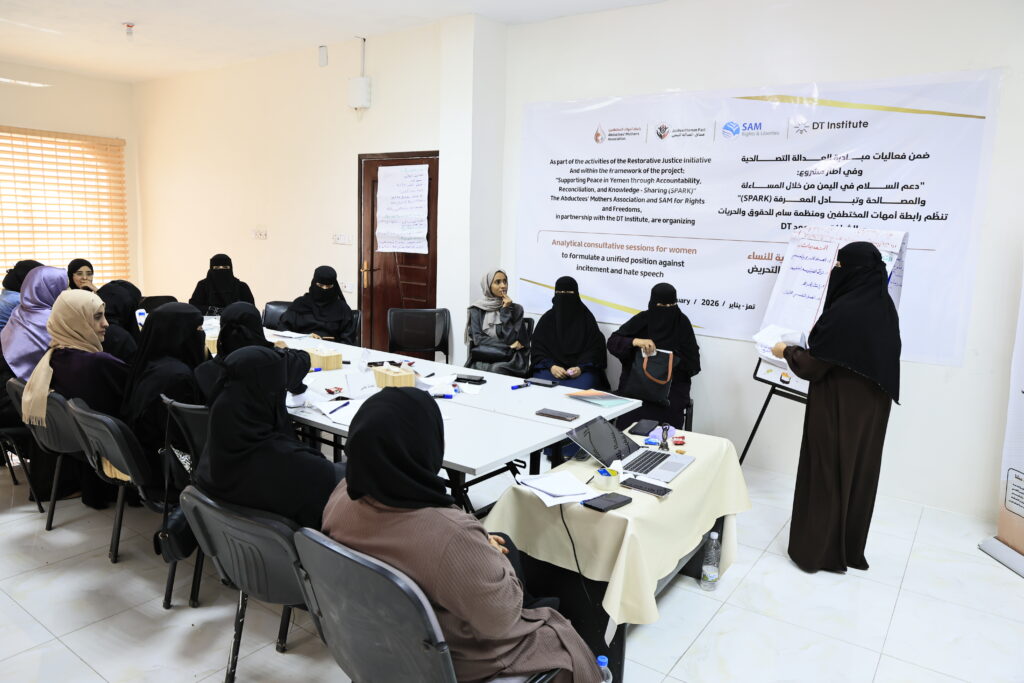
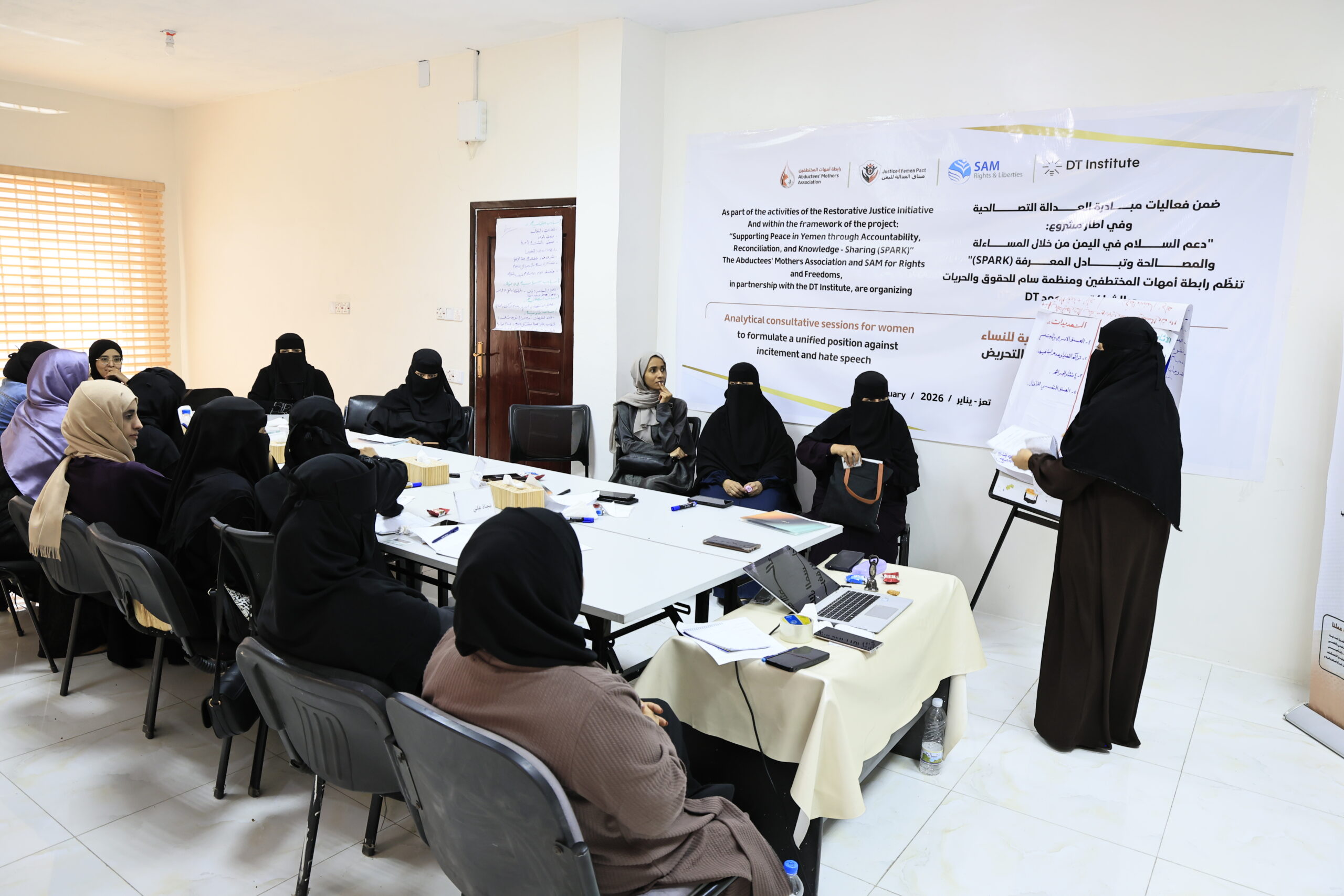
The Peace Dialogue Restorative Justice Pilot, launched in January 2026, has already begun work on the first phase – bringing together female human rights defenders and activists to unify the Yemeni feminist human rights narrative. Starting in January, SPARK partners organized four dialogue sessions between female human rights defenders and activists.
These dialogue sessions engaged a total of 56 participants representing six governorates throughout Yemen. Each of the participants were female human rights defenders and activists. Many also held influential positions as leaders of prominent civil society organizations and feminist groups. Moreover, some of the women also represented institutional entities, including the Yemeni Women’s Union (YWU) and the Social Affairs Office.
The sessions focused on investigating the root causes of incitement against public-facing women. They also explored the specific challenges and difficulties faced by these women as related to smear campaigns, hate, and incitement. Additionally, and most importantly, the sessions provided a collaborative space for the unification of rights-based narratives amongst the women. In doing so, they strengthened strategic coordination and gave the women strength in numbers by building a shared approach to counter incitement, stigma, and social exclusion.
The sessions were held both online and in-person. Two of the sessions, featuring participation from 30 attendees, were held in Taiz. The remaining two sessions were held online for 26 participants from five governorates that tend to receive less media coverage and attention – Lahj, Abyan, Al-Dhalea, Shabwah, and Al-Mahra.
Within the dialogue sessions, the diverse perspectives of the women fed into productive dialogues, revealing routine incitement against female human rights defenders and activists across districts and governorates throughout Yemen. The sessions emphasized this incitement as deep and systematic in its victimization of public-facing women. Furthermore, the sessions emphasized how this incitement is utilized as a tool for disenfranchisement and the silencing of female voices.
💬 “I knew the context was challenging, but I didn’t imagine the level of incitement and suffering.” – Dr. Amat Al-Salam Al-Hajj, President, founder, and CEO of AMA.
Systematic victimization and structured violations against female human rights defenders and activists manifested in several forms, as described by session participants. In areas controlled by the Internationally Recognized Government of Yemen (IRG), including Taiz, accusations of espionage and public incitement claiming that women’s behavior provokes divine punishment and undermines internal morale and prospects for victory were lobbied against them.
These tactics mirror those long-practiced and deeply engrained within the Houthi (Ansar Allah) playbook of disinformation and media manipulation. The J4YP Coalition, of which AMA and SAM are both members, has published multiple reports, documenting the pervasiveness of such media manipulation to further human rights violations against innocents. These pieces also highlight that these tactics are purposeful, honed by the Houthis as a proxy of Iran.
Media challenges and incitement faced by women in IRG-controlled areas are compounded by weak governance, insufficient legislation, and impunity, with women often used as leverage in political disputes. Religious, social, and cultural rhetoric further amplify the narrative that women in civil society promote “western culture.” Moreover, such incitement occurs within the context of a fragmented and ineffective feminist civil society, leaving women vulnerable as they are often forced to confront them alone.
💬 “It is crucial to emphasize that hate speech is not confined to the religious sphere; it also encompasses social incitement directed against women—particularly regarding their employment and participation in the public domain. Consequently, addressing this phenomenon requires a comprehensive approach that tackles such discourse in all its various forms.” – Dr. Amat Al-Salam Al-Hajj, President, founder, and CEO of AMA.
The dialogue sessions revealed several concerning indicators and root causes of incitement and abuse. In Al-Dhalea, participants reported incidents where female human rights defenders were subjected to attempted killings driven by so-called “reputation protection.” In Shabwah, participants highlighted another layer of violations, including digital abuse, where fake accounts on Facebook continue to publish hate speech and incitement against women.
Moreover, their impact upon female human rights defenders, their reputation, and their work can be detrimental. Amat Al-Salam utilized the assassination of Al-Mashari to draw attention to this. She noted that the assassination prompted a serious reflection on the dangers of incitement against women throughout Yemen. Moreover, as one dialogue session participant remarked, “women have constrained their own mobility and participation as a result of societal pressures and fear.”
💬 “This incident served as a catalyst, compelling us to seriously reflect on the dangers of hate speech and incitement — not merely in its religious form, but also in its social and administrative manifestations — given that incitement can easily transform from mere words into dangerous physical violence.” – Dr. Amat Al-Salam Al-Hajj, President, founder, and CEO of AMA.
In Al-Mahra, participants indicated that women may not face systematic hate campaigns or reputational attacks, but that this is partly due to the limited visibility of female human rights defenders. Furthermore, participants also emphasized that the situation varies across districts within the governorate as some areas impose restrictions prohibiting women’s movement. Such restrictions prevent women from participating in public life, doing away with the need for incitement against such women.
In revealing such pervasive incitement and abuse, the dialogue sessions provided a safe space for female human rights defenders and activists. They allowed these women to share harrowing personal experiences, including subjugation to hate speech, abuse, surveillance and attempted killings in the name of “reputation protection.”
While their experiences were not all the same, their sharing contributed to a sense of solidarity and fostered deeper understanding among the women. In this sense, the dialogue sessions brought the women closer together, not just as individuals, but as like-minded colleagues. In turn, this enabled the women to find strength in numbers, moving from the sense that they are isolated victims to an understanding that they have a strong, joint platform to amplify their individual voices.
💬 “Such sessions are important because they bring women together and open discussions on protection issues and hate speech. This helps us better understand the problem and address it collectively rather than confronting it individually.” – Participant in dialogue session.
4. Learning, Documentation, and Replication
To understand and assess the impact of the dialogue sessions and the broader initiative on female human rights defenders and activists, AMA launched surveys. A pre-survey was launched prior to the discussion sessions, and a post survey will also be launched once all discussions have come to a close.
The surveys are structured to assess attendees’ opinions and openness towards restorative justice and reconciliation. Most pre-survey respondents (88 percent) expressed readiness for dialogue and agreement with religious leaders with whom they had previously disagreed with. Moreover, 92 percent agreed that dialogue could establish guidelines to reduce incitement and hate speech among different segments of society. Additionally, 94 percent confirmed that weak communication with religious and community influencers contributes to deepening misunderstandings.
A similar survey will be conducted with religious figures and influencers. It will also seek to assess their opinions and openness towards restorative justice and reconciliation. Furthermore, the survey will compare and contrast the religious figures and influencers’ opinions regarding their readiness for dialogue and agreement with female human rights defenders and activists.
Additionally, amongst the female human rights defenders and activists responding to the pre-surveys, half reported that they had been subjected to hate and incitement speech. All pre-survey respondents but one (who expressed a neutral opinion) agreed that such verbal incitement often translates into physical abuse. Such results underscore the strong need for continuation of this initiative to combat such incitement and abuse.
💬 “We do not anticipate that this initiative will completely eradicate incitement; however, it represents a pivotal step toward curbing it and paving the way for women to engage effectively in the fields of both community-level and international mediation.” – Dr. Amat Al-Salam Al-Hajj, President, founder, and CEO of AMA.
In building off the female human rights defenders and activists’ dialogue sessions, AMA is also taking into account strategic recommendations put forth by the participants. These include establishing a protection belt made up of community leaders and influencers to advocate on their behalf. Recommendations also included using context-sensitive religious messaging to utilizing context-sensitive advocate for women’s participation in public-facing careers. Additionally, many participants sought to strengthen feminist coalitions to effectively confront incitement and protect women’s civic engagement.
5. Scaling the Impact
As described by Dr. Amat Al-Salam, “The ultimate objective [of this initiative] is to foster greater acceptance of women’s roles and to facilitate their access to positions of influence, particularly after their capabilities regarding integrity and professionalism have been clearly demonstrated, as well as to raise awareness among official bodies, including religious institutions, regarding the importance of women’s participation.”
This initiative marks the first step of many in opening the door for female human rights defenders, activists, and women in public-facing careers and positions all throughout Yemen. As highlighted by participants in The Path Towards Peace study, the participation of women in public life and in transitional justice is essential as they have and continue to be more regularly and frequently victimized than their male counterparts. Their victimization is not only a feature of the greater conflict raging within Yemen but also by other factors, including religious, cultural, and social incitement against them.
“Religious discourse remains one of the most influential forces shaping public opinion. In Yemen, negative narratives and incitement against women’s participation in public and professional life have significantly constrained their progress,” explains Sahar Mohammed, DT Institute’s Yemen Programs Assistant. “This incitement is no longer limited to religious platforms, but has expanded across social media, amplifying its reach and impact. Addressing this challenge requires unifying and elevating the voices of Yemeni women to ensure they are heard, recognized, and meaningfully included in shaping the country’s future.”
By raising awareness of transitional justice and engaging all transitional justice stakeholders, raising awareness campaigns foster community responsibility to operationalize transitional justice principles. They envision transitional justice efforts, rooted in local ownership, dignity, and dialogue, serving as foundations for broader restorative justice pilots and raising awareness initiatives.
Through restorative justice pilots, like the Peace Dialogue Restorative Justice Pilot, Yemeni transitional justice continues to be explored and facilitated in thoughtful and innovative ways, building towards effective whole-of-society peacebuilding efforts.