1. Overview of the SPARK Program
Under the SPARK (Supporting Peace in Yemen through Accountability, Reconciliation, and Knowledge-Sharing) program, DT Institute and its local partners, the Abductees’ Mothers Association (AMA) and SAM for Rights and Liberties (“SAM”), launched raising awareness campaigns to complement restorative justice pilots and engage community members in Taiz and Aden.
The restorative justice pilots aim to foster reconciliation and resolve community-level public disputes that have caused human rights violations. While raising awareness campaigns educate community members on transitional justice mechanisms and engage experts and decision makers in thought provoking and effective dialogues and initiatives to advance Yemeni transitional justice.
This model was designed in response to the findings of The Path Towards Peace, a research study published by SPARK in April 2025. This study captured local understandings of transitional justice (TJ) across Yemen, revealing that 64.3 percent of community members prioritize reconciliation and war-ending efforts over retributive accountability. Participants identified clear roles for civil society, including initiating dialogue and reconciliation, raising TJ awareness, and documenting violations. Moreover, female participants emphasized the challenges and difficulties faced by Yemeni women, including fear of shame and scandal (which is related to customs and traditions) and discriminatory treatment by authorities.
Participants in focus sessions also expressed ideas for the inclusion and involvement of women in transitional justice processes. The most prominent suggestion, cited by 48 percent of respondents, was to include women in bodies and committees tasked with designing and implementing transitional justice. Many female participants emphasized that this was important given that women are more likely to be subject to violations and because of their important role in society. However, there was also much discussion on ensuring women’s involvement in transitional justice aligns with Yemeni culture, customs, and traditions.
💬 “Women are the ones most exposed to violations and harm. They were the main group being attacked. They need to be involved in exposing the scope and damage of these violations, as they have paid the highest price for this war. The nature of their participation needs to suit our culture.” – An interviewee from Marib, participating in the Path Towards Peace Study.
In addressing these gaps, SPARK works to advance local and national reconciliation, by furthering initiatives to educate local stakeholders on transitional justice concepts. At the same time, the program builds resilience within divided communities through the pilots, which create sustainable pathways for dialogue and conflict resolution.
Through effective engagement, the program activates all segments of society – from the community level to civil society, experts, and high-level governmental stakeholders. This enables these groups to not only be participants, but central drivers of Yemen’s transitional justice journey. With donor support, these efforts can be scaled to reach more communities, ensuring that reconciliation and peace take root from the ground up.
2. The Weaponization of Digital Violence in the Yemeni Conflict
According to the United Nation Office of the High Commissioner of Human Rights (OHCHR), gender-based violence against women and girls is one of the most prevalent human rights violations in the world. In recent times, technological developments have amplified this pervasive crime, inciting a new type of violation – digital violence against women and girls (DVAWG).
In Yemen, just as around the world, the digital space has become a reflection and expansion of in-person social spheres, reflecting the gender dynamics and inequality present in the real world. However, Yemen is also the site of an over-a-decade long conflict, featuring broad patterns of gendered control, surveillance, and ongoing impunity. The Center for Civilians in Conflict (CIVIC) emphasizes that modern conflicts increasingly extend into the digital realm.
SPARK partners’ findings reflect this severe reality. Field data, analyzed within the policy paper, Towards Legal, Institutional, and Community-Based Protection Frameworks for Women in Yemen’s Civil Space, reflects that 62.1 percent of women in Yemen have experienced online violence, with over 15,000 cases of cyber extortion documented in the last three years. On average, such cases exceed 535 cases per month.
The numbers are even more alarming when one considers female human rights defenders, peace activists, and civil society workers, in specific. According to SPARK data, collected via consultation sessions and in-depth interviews with women, 98 percent of these women reported DVAWG violences. Such violations included defamation and incitement, among others. Moreover, many led to severe consequences for women, ranging from forced withdrawal from work to suicide attempts.
As the policy paper demonstrates, DVAWG in Yemen is not an isolated crime. Rather, it is part of a complex system of violence fostered and sustained by legislative gaps, institutional weakness, a layered cultural legacy, and interconnected structural drivers. Moreover, the paper emphasizes how such violence is directed towards women engaged in the humanitarian relief, human rights, and peacebuilding sectors in a plot to ensure their silence and enforce exclusion.
💬 “The laws that do not protect women in reality are the same laws that fail to protect them online.” – Afraa Al-Hariri, a Yemeni lawyer, human rights defender, and Country Director of the Peace Track Initiative in an interview with the United Nations Entity for Gender Equality and the Empowerment of Women (UN Women).
3. Initiative Spotlight: The Peace Dialogue Restorative Justice Pilot
SPARK partners are working to identify, diagnose, and address this complicated system of oppression and violence through the Peace Dialogue Restorative Justice Pilot. Restorative justice seeks to address harm by creating opportunities for dialogue, understanding, accountability, and relationship-building among affected stakeholders. In contexts affected by conflict and social polarization, restorative justice can help rebuild trust, repair damaged relationships, and create pathways for coexistence and reconciliation.
The Peace Dialogue Pilot applies restorative justice principles by bringing together groups whose relationships had been strained by stigma, misinformation, and mutual mistrust. Through structured dialogue, participants were encouraged to share lived experiences, acknowledge the impacts of harmful narratives and incitement, identify common values, and collectively develop commitments for future action. Rather than focusing on blame, the process emphasized recognition of harm, mutual understanding, and the creation of practical solutions that could strengthen social cohesion and protect civic space.
The pilot was launched in April and has already made strides by engaging both female human rights defenders and key religious figures. At the outset of the initiative, the pilot engaged each of these groups in separate dialogue sessions. Within these dialogues, female human rights defenders shared their diverse perspectives revealing routine incitement against female human rights defenders and activists across districts and governorates throughout Yemen.
The female human rights defender sessions emphasized incitement as deep and systematic in its victimization of public-facing women. Furthermore, the sessions emphasized how this incitement is utilized as a tool for disenfranchisement and the silencing of female voices. In total, four dialogue sessions were conducted for a total of 56 participants representing six governorates throughout Yemen, including Taiz and other governorates that tend to receive less media coverage and attention such as Lahj, Abyan, Al-Dhalea, Shabwah, and Al-Mahra.
Key religious figures and preachers were engaged in one dialogue session, which garnered attendance from 20 key figures according to a strict selection criteria provided by the Endowments Office. According to this criteria, preacher-participants were required to have leadership roles to ensure their ability to make decisions and mobilize their base and advanced analytical abilities enabling them to think strategically. Moreover, the criteria ensured a balanced representation of districts and various political orientations to maintain geographical and political diversity.
Within the session, participants discussed the basic values on which Yemeni society is based and how to abide by these. During the session, SPARK partners presented the policy paper prepared under the initiative. As a result, participants acknowledged that there is a real problem with rumors and readymade accusations spreading through social media, destroying individuals’ reputations.
The policy paper, Towards Legal, Institutional, and Community-Based Protection Frameworks for Women in Yemen’s Civil Space, took the pulse of the current state of hate speech, incitement, and harassment of female human rights defenders and activists. It consolidated the perspectives shared by the women in their dialogue sessions to identify and diagnose this pervasive problem as one that goes beyond individual cases of incitement. The paper revealed that the incitement as part of a complex system of violence and oppression. Additionally, it proposes a roadmap for practical and strategic solutions on the legal, institutional, and societal levels. These solutions are drafted to alleviate such incitement and promote the effective engagement and work of female activists.
💬 “The significance of this position paper lies in the fact that it is grounded in the voices and lived experiences of women and female activists. It precisely delineates existing gaps and challenges while offering a clear vision for potential remedial pathways, thereby serving as a vital tool for guiding future policies and efforts.” – Dr. Amat Al-Salam Al-Hajj, President, founder, and CEO of AMA.
In doing so, the policy paper stood as a strong tool, complementing the female human rights defender perspectives and furthering dialogue sessions of key religious figures and influencers. By clearly illustrating the unified position of female human rights defenders and activists and reflecting their perspectives comprehensively, the paper foster understanding in religious figures’ sessions, bridging the gap between these groups.
4. Agreement
The individual dialogue sessions culminated in a joint roundtable engaging 20 participants, including religious leaders, feminist leaders, and female HRDs. The session was directed by a SPARK-recruited facilitator, who geared the discussion towards reconciliation and healing. Participants were receptive, open, and candid. They shared painful personal stories and experiences. Additionally, they expressed mutual concern and raised sensitive questions about mental image, defamation, religious discourse, and the relationship between civil society and religious conservative society. This prompted robust and detailed discussions.
During the session, feminist leaders and HRDs provided direct testimony about the extent of psychological and social suffering they were subjected to due to their work in civil and humanitarian fields. The facilitator emphasized this as one of the most influential segments of the session. One woman, an information technology specialist, shared how she was banned from providing free services and logistical support to a community initiative by her father after he heard a speech at the mosque that spoke negatively of women working. In response, religious leaders emphasized that the relationship between themselves and feminist leaders should be complementary rather than at conflict.
Others shared hurtful comments or direct accusations received because of their civil society work. One female participant shared that some people refuse to decorate women working in civil society on social occasions and that civil society work is often stigmatized. Still other participants explained that many women have begun to hide their work from society or family for fear of bullying or social stigma. Female HRDs also discussed the extent of pressure on working women, especially considering Yemen’s dire economic and humanitarian conditions created by the war.
After listening to the women’s person and moving testimonies, the religious preachers began to soften. They expressed surprise upon hearing the stories, noting that they had not realized the extent of the harm that women had endured. The discussion drew attention to the significant communication gap between religious figures and female activists, as neither side has had sufficient opportunities to engage directly with the other in the past. This has led to a lack of understanding on both sides.
The openness and newfound understanding of the religious figures was reflected in the interventions of several participants. Some acknowledged that many judgements made about female civil society workers relied on inaccurate information or broad generalizations. One participant stated that the meeting revealed to him that there are female civil society workers who are more committed to upholding community values than many men. Participants also discussed the use of religious morals or values to justify smear and incitement campaigns against certain groups.
Dialogue centered around shared values with participants focusing on transforming shared understandings into shared action. This approach resulted in frank discussions, creation of practical commitments, and the public signing of an honor code. In discussing practical proposals for direct action, participants put forth several suggestions. These included asking preachers to stop generalizing in sermons or community speeches, to promote a culture of verifying information before it is published, and to highlight female role models in community service.
In creating a safe and facilitated space for participants to share personal experiences and listen to one another directly, the roundtable enabled acknowledgment of harm and fostered empathy among groups that often engage with one another through stereotypes or adversarial narratives. The process helped participants move beyond disagreement to identify shared values and responsibilities, resulting in practical commitments designed to prevent future harm and strengthen community relationships. The roundtable concluded with two agreements. Participants agreed to maintain communication channels between religious and feminist HRD leaders and to sign an honor code, reflecting the commitments discussed.
💬 “Promoting a discourse of moderation and centrism that supports social cohesion and reduces discord; respecting the role of women in society and acknowledging their contribution to reform, development, and peacebuilding.” – General Principles of the Honor Code signed under the Peace Dialogue Restorative Justice Pilot.
5. Addressing Challenges and Ensuring Impact
The pilot emphasized a critical takeaway – incitement against women in Yemen is not an isolated phenomenon. It is rooted in a broader system of social, cultural, institutional, and legal barriers that restrict women’s participation in public life. Accordingly, the initiative ensured acknowledgement of this reality and pushed participants to tackle these challenges.
The pilot stressed that addressing individual incidents is not enough. Sustainable change requires tackling the underlying structures that enable discrimination and exclusion. These include the lack of existing, direct communication channels between female activists and human rights defenders, on one hand, and religious figures, on the other. It also includes the Endowments’ Office lack of and weak authority over some mosques and many religious figures.
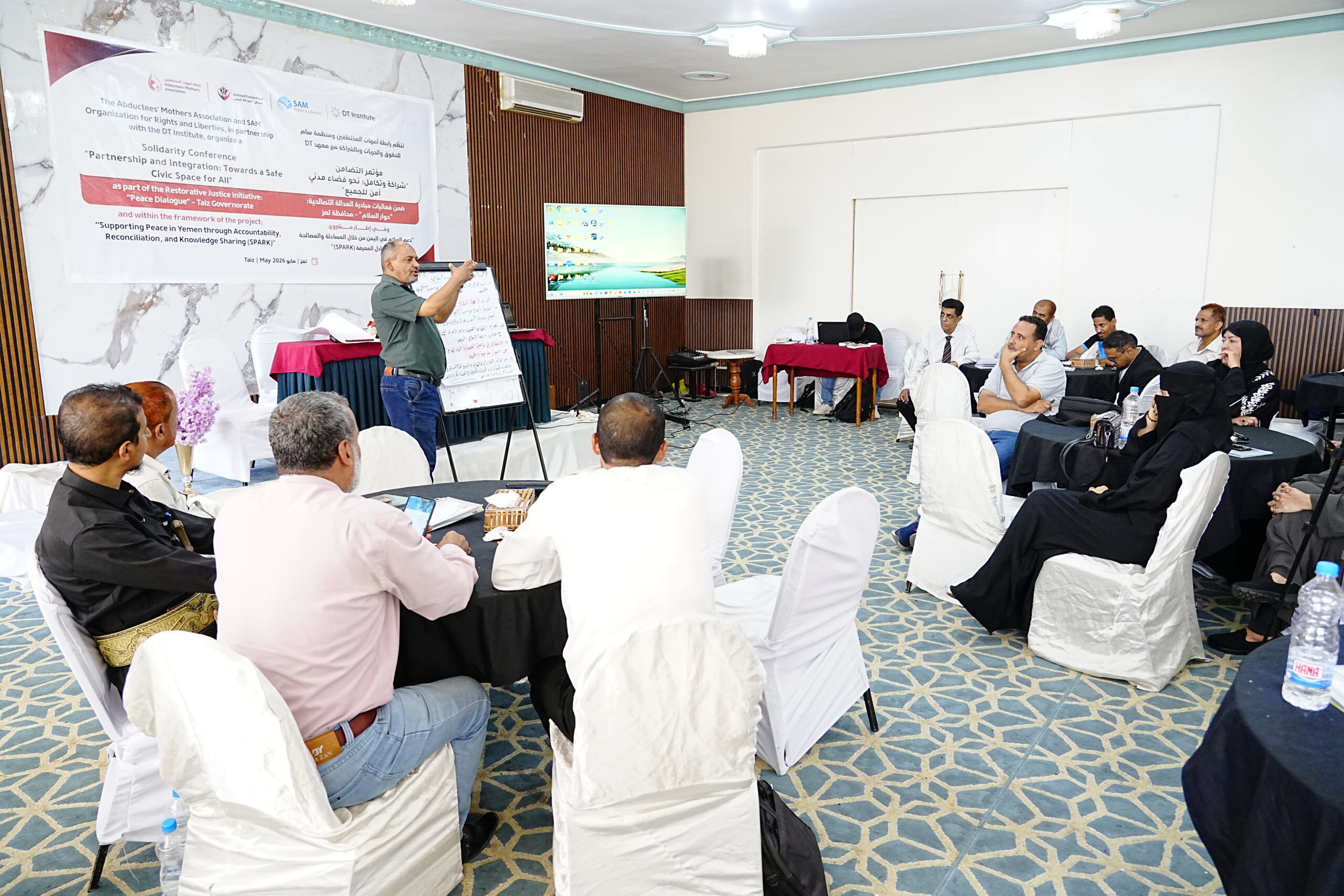
To address these gaps, SPARK partners, under the pilot, implemented a solidarity conference. The conference was attended by 20 participants, including activists, preachers, academics, media professionals, lawyers, and representatives from civil society, the local authority, and security administration.
Within the conference, these diverse participants came together to address these challenges and ensure collective recognition of digital violence and incitement against women as issues of public concern linked to social stability rather than isolated personal grievances. This reframing was critical, because such harms are frequently normalized or addressed informally, leaving victims without protection pathways.
At the outset, AMA and the Director of the Office of Social Affairs and Labor opened the conference, each with a welcoming speech. The Director highlighted the importance of community dialogue to overcome social divisions, maintain the social fabric, and promote cohesiveness. The SPARK project manager also presented an overview of the Peace Dialogue Restorative Justice Pilot, outlining the work that has paved the way for this conference and for broader societal understandings to protect civic space and dialogues surrounding transitional justice.
Throughout the conference, participants engaged in thoughtful discussions fostered by diverse perspectives. Participants discussed the importance of differentiating between fixed Sharia rulings, which champion community peace and cohesiveness, and social norms and tribal practices that may be used to justify exclusion or defamation.
They candidly discussed issues of weak Endowments Office authority, pointing to the lack of regulatory control over sermons and the absence of a binding policy requiring preachers to review or obtain approval for their messages. Moreover, they highlighted the establishment of mosques with external agendas, which combined with the Office’s weak authority, has created space for unregulated religious messaging.
Participants also addressed legal challenges that exacerbated the issue of misunderstandings and incitement. They pointed to the lack of legislation on cybercrimes and the need for clearer legislation to protect victims. Similarly, they addressed the role of media in reducing incitement and hate speech as well as the role of preachers and community leaders in promoting the values of respect and coexistence.
At the conclusion of the conference, participants signed the honor code, discussed previously in the roundtable. The honor code held that the preservation of human dignity and the protection of individuals’ reputations are religious and moral values that must not be violated. It outlined the practical commitments agreed upon by the 18 signatories, including to refrain from incitement against women, prevent the use of mosques or religious platforms for incitement, and act to stop the circulation of rumors. Signatories included representatives from civil society organizations and government entities, including the National Women’s Committee, the Planning Office, the Endowments Office, and the Public Security Office.
In this sense, the honor code operated as a shared framework to strengthen the protection of women and promote responsible, peace-oriented public discourse. It clarified the role of religious preachers in curbing the challenges discussed with the aim of promoting moderate religious discourse that champions the role of women in civic and public space, rather than hinders it.
Additionally, to address challenges related to lack of direct communication between female human rights defenders and religious figures, the conference concluded with the establishment of an enduring communication mechanism between participants. This mechanism allows for continued engagement, which will continue to reduce mistrust and enable ready communication to resolve future tensions. Moreover, this channel will ensure sustainable implementation of the honor code, further contributing to strengthening trust and collaboration between civil society actors, religious leaders, and community stakeholders.
💬 “The conference served as one of the few structured platforms in Yemen designed to foster social cohesion between religious actors and women civil society activists. … The discussions addressed key challenges facing civic space, particularly risks affecting women activists, including defamation, online harassment, and digital targeting, and their implications for participation in public and peacebuilding processes.” – AMA
6. Learning, Documentation, and Replication
To amplify the positive impacts of the pilot and ensure sustainability, SPARK partners will be launching an advocacy campaign. The campaign will feature a series of 10 advocacy messages, developed by pilot participants and AMA to target different stakeholders, including the local authority, religious figures, and civil society actors. It will also include 10 female activist success stories, highlighting their meaningful impact upon their communities and demonstrating the importance of female participation in civic space and peacebuilding endeavors.
In addition to the campaign, publication of the policy paper will raise awareness amongst the public by highlighting significant protection gaps for female activists and providing their shared perspective. In this sense, it also stands as a living reminder of the continuous incitement against female activists and human rights defenders in Yemeni society.
Furthermore, it put forth recommendations to address such gaps, emphasizing the needed legal, institutional, and community-level responses that must be coordinated among the relevant stakeholders. In this sense, the paper not only continues to foster understanding of female perspectives amongst the greater public, but it also provides tangible actions to promote social cohesion and inclusivity in civic participation.
The advocacy campaign and publication of the policy paper will complement the permanent communication channel between pilot participants to ensure sustainable and ongoing implementation of the standards discussed and agreed upon in the honor code. Moreover, it will amplify the need to address the challenges discussed by participants at the solidarity conference, including the Office’s weak authority, unregulated and harmful religious messaging, and the lack of oversight on inflammatory speech.
7. Scaling the Impact
The pilot’s outcomes have begun to rebuild the basic infrastructure of trust, shared norms, and cross-sector coordination that has largely eroded in Yemen and is essential for sustainable protection of civic space, especially for women. This initiative marks the first step of many in opening the door for female human rights defenders, activists, and women in public-facing careers and positions all throughout Yemen. As highlighted by participants in The Path Towards Peace study, the participation of women in public life and in transitional justice is essential as they have and continue to be more regularly and frequently victimized than their male counterparts.
The pilot demonstrates strong potential for expansion to the national level to build off its impactful efforts. Its involvement and cooperation with the Endowments Office have resulted in improved governance coordination that may be expanded in other areas and with other institutional entities. Moreover, its ability to convene female activists, civil society actors, and influential community and religious leaders may be leveraged in the future via the sustainable channels created.
The pilot has illuminated multiple avenues that activists and civil society can push forward to further promote restorative justice for female activists throughout Yemen. It presented several opportunities to further institutionalize engagement with religious leaders via the Endowments Office and the Ministry of Endowments. Such engagement could result in the dissemination of context-sensitive messages to counter incitement and other structured coordination initiatives building off the pilot.
Additionally, the shared cooperation fostered under the pilot can be replicated utilizing the same model. This initiative demonstrated the feasibly and positive impacts of bringing generally adversarial groups together. It has shown it is possible to turn adversaries into colleagues working collectively to increase opportunities for transitional and restorative justice in Yemen via community-led initiatives.
“What makes this initiative particularly promising is its potential for replication and scale,” emphasized Feras Hamdouni, Senior Program Manager at DT Institute. “The dialogue model proved that groups often perceived as adversaries can engage constructively when discussions are grounded in shared values and mutual respect. By strengthening partnerships with religious institutions, civil society, and government actors, this approach can be expanded to other governorates and ultimately contribute to a national movement that promotes social cohesion, counters harmful narratives, and creates safer civic spaces for women.”
A further impactful outcome of this initiative is its exploration and facilitation of transitional justice in Yemen. The Peace Dialogue Restorative Justice Pilot promoted the continuous exploration and facilitation of Yemeni transitional justice in thoughtful and innovative ways, building towards effective whole-of-society peacebuilding efforts. It fostered responsibility, operationalizing transitional justice principles and enabling community members to come together in driving these efforts.
Similar to other restorative justice pilots conducted under SPARK, this pilot has envisioned and actualized transitional justice efforts, rooted in local ownership, dignity, and dialogue. Such efforts serve as foundations for broader restorative and transitional justice throughout the country.