Free Media Center, a member of Justice4Yemen Pact Coalition through its commitment to advancing dialogue and evidence-based reporting, has released a new study titled “Discussion on Transitional Justice: Perspectives of Political Parties and Civil Society Organizations.”
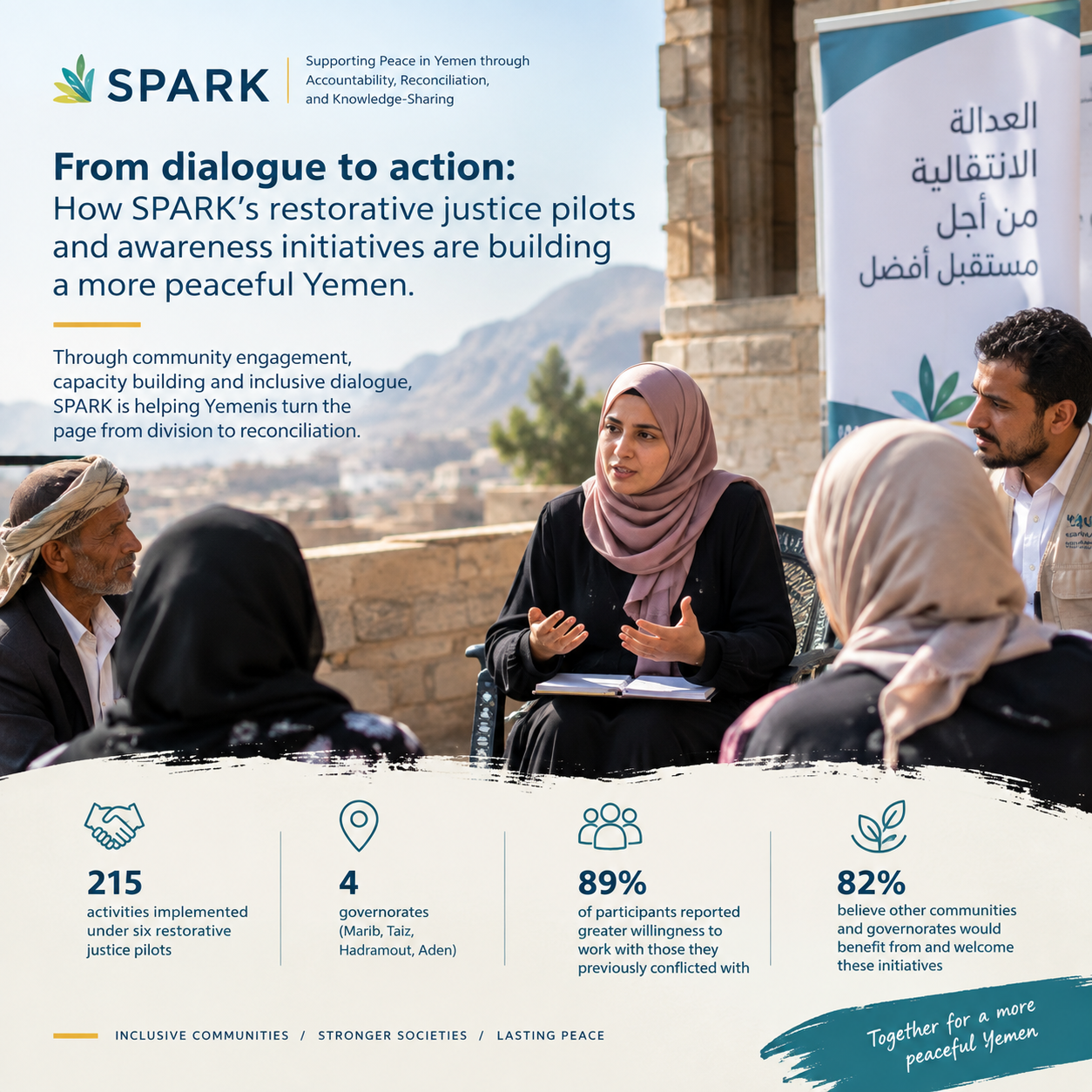
The report, produced under the SPARK Program (Supporting Peace in Yemen through Accountability, Reconciliation, and Knowledge Exchange) and funded by DT Institute, brings together the voices of political parties, civil society organizations, and victims to explore one of Yemen’s most pressing questions: How can justice pave the way for peace?
Drawing from 20 in-depth interviews across Taiz, Sana’a, Aden, Marib, and Al Hudaydah, the paper captures the hopes, challenges, and competing visions that shape Yemen’s transitional justice journey. It reveals a shared recognition that lasting peace must be built not only on political settlements, but also on truth, accountability, and dignity for victims.
What the Report Reveals
- Justice as a Foundation for Peace: Across all groups, there is agreement that no lasting peace can emerge without addressing the legacies of violations and exclusion.
- Victims at the Center: Participants called for a victim-centered process that goes beyond compensation to include truth-telling, psychosocial healing, and public acknowledgment of harm.
- Balancing Peace and Justice: While some actors see peace as a prerequisite, others insist that justice must accompany negotiations from the outset — ensuring victims’ voices are not sidelined.
- Rebuilding Institutions: Reforming Yemen’s judicial system emerged as a priority to restore public trust and guarantee non-recurrence.
- Civil Society’s Role: Local organizations are seen as key to documenting violations, advocating for accountability, and bridging the gap between communities and decision-makers.
A Call for Inclusive Action
The report concludes with practical recommendations for Yemeni and international actors alike:
- For donors and partners: Invest in local capacity and ensure Yemeni-led initiatives drive the justice agenda.
- For political actors: Embed justice and reconciliation within peace efforts, with victims as key partners.
- For civil society: Expand documentation, awareness, and advocacy to shape a unified vision for accountability.
Read the full report here