1. Overview of the SPARK Program
Under the SPARK (Supporting Peace in Yemen through Accountability, Reconciliation, and Knowledge-Sharing) program, DT Institute and its local partners, the Abductees’ Mothers Association (AMA) and SAM for Rights and Liberties (“SAM”), promote transitional justice throughout Yemen. In doing so, SPARK sets the stage for peacebuilding processes that prioritize locals and victims, address social divisions and human rights violations, and halt cycles of violence bolstered by impunity.
Previous peace negotiations have sustained Yemen’s bloody and vicious loop of human rights atrocities by allowing conflict parties and perpetrator affiliates to avoid accountability and conduct dialogues at the expense of victims and local communities, rather than in their interest. To counteract this trend, local partners emphasize that any sustainable ceasefire requires such nationwide reconciliation and transitional justice. Transitional justice must feature victim and local participation and leadership to ensure their voices are effectively and sustainably considered.
By promoting transitional justice, SPARK seeks to stabilize Yemen’s volatile and fractured political and human rights environment. Moreover, the program creates pathways for community healing, reconciliation, and inclusive peacebuilding through which it brings together various sectors of Yemeni society, including civil society, local communities, and governmental entities. In doing so, SPARK bridges the gaps between these sectors of Yemeni society, enabling trust-building between locals and governmental institutions, community healing and resolutions between deeply divided community groups, and fostering political will and proper understanding of transitional justice.
SPARK activities include restorative justice pilots, which foster reconciliation and resolve community-level public disputes causing and sustaining human rights violations and societal unrest. SPARK awareness campaigns educate community members on transitional justice mechanisms and engage experts and decision makers in thought provoking and effective dialogues and initiatives to advance Yemeni transitional justice. Campaigns are critical in enabling Yemeni locals and victims to take part in future transitional justice processes.
This model was designed in response to the findings of The Path Towards Peace, a research study published by SPARK in April 2025. This study captured local understandings of transitional justice across Yemen, revealing that 51 percent of participants had no knowledge of the concept of transitional justice. In addressing these gaps, SPARK works to advance local and national reconciliation, by furthering initiatives to educate local stakeholders on transitional justice concepts. At the same time, the program builds resilience within divided communities through the pilots, which create sustainable pathways for dialogue and conflict resolution.
Through effective engagement, the program activates all segments of society – from the community level to civil society, experts, and high-level governmental stakeholders. This enables these groups to not only be participants, but central drivers of Yemen’s transitional justice journey. With donor support, these efforts can be scaled to reach more communities, ensuring that reconciliation and peace take root from the ground up.
2. SPARK’s Midline Survey
In April of 2026, approximately midway through the SPARK program’s operational period, a survey was conducted by DT Institute to assess community and civil society perspectives on transitional justice and the SPARK program. The survey covered 14 governorates within Yemen, including five under Houthi (Ansar Allah) control and nine under control of the internationally recognized government of Yemen (IRG). It also included multiple respondents located outside of Yemen. The largest proportion of respondents (43 percent) were from Taiz, followed by Aden and Marib. This suggests that civic engagement is more active in major urban centers under IRG control than in areas under Houthi control.
Civil society actors constituted 85 percent of total respondents. ). The majority of these actors reported full or partial engagement in human rights-related work. However, only 25 respondents identified as specialized in human rights and media work, while an equal number described themselves as multi-sectoral, working across the humanitarian, development, research, peacebuilding, and human rights fields. This pattern indicates a tendency toward programmatic diversification, which may be associated with funding constraints and the need to adapt to changing donor priorities. The remaining 14 organizations primarily operate in humanitarian, development, or combined humanitarian-development sectors.
The Impact of the SPARK Program
The SPARK program was widely recognized by 81 percent of respondents who were familiar with the program and its initiatives. This indicates a broad reach across surveyed stakeholders and reflects SPARK’s established presence within civil society and community spaces.
These respondents also indicated the areas where they believed the SPARK program had the greatest impact, selecting multiple answers. Of those who are aware of the SPARK program, 80 percent reported that the program has increased public understanding of transitional justice, extending awareness beyond previously limited circles, including elite groups. This reflects a broader shift toward more inclusive public engagement with transitional justice concepts. This finding is especially significant when compared with the minority of respondents that indicated awareness of transitional justice in The Path Towards Peace study.
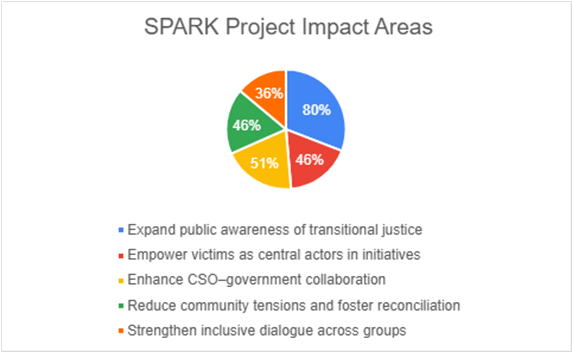
These respondents also emphasized SPARK’s role in strengthening partnerships between civil society and official authorities. This was reported as one of SPARK’s greatest impact areas by 51 percent of these respondents, indicating an effort to bridge community-level initiatives with institutional actors and improve coordination within governance processes.
In parallel, 46 percent of respondents who were aware of SPARK believe the initiative empowers victims by placing them at the center of the transitional justice and peacebuilding process. The same proportion also associated the project with contributing to reduced community tensions, suggesting that SPARK is perceived not only as an awareness-raising initiative but also as a tool for social cohesion and local conflict mitigation.
Additionally, 36 percent of these respondents reported that SPARK has helped enhance a culture of dialogue within communities and between different groups. This reflects SPARK’s contribution to promoting dialogue-based approaches and encouraging more constructive social engagement among different community groups.
💬 “The [SPARK program] has had a significant impact on several levels, including youth, women, victims, and society in general, as well as on those working on the project. … The project also contributed to opening spaces for community dialogue, promoting a culture of not forgetting, and restoring some rights to victims, including the restoration of their homes.” – Moath Al-Fakih, Project Manager, SAM.
Suggested Areas of Expansion and Enhancement to Further SPARK’s Impacts
Respondents were also asked to identify key areas for expansion and enhancement of the SPARK program. The most frequently proposed area for expansion and enhancement, as indicated by 67 percent of respondents, was expansion of the SPARK program’s reach to rural and remote areas.
This was followed by calls to increase the meaningful participation of victims (as reported by 64 percent) and to strengthen engagement with civil society and local authorities (indicated by 61 percent). These elements were already recognized as strengths of SPARK by 46 and 51 percent of respondents respectively. However, an increasing number of respondents noted that further expansion in these areas would increase the value and impact of the program.
Moreover, these suggestions align with one another and others as strengthening coordination mechanisms and outreach strategies is required for further SPARK expansion into remote and rural areas. It would also benefit SPARK in institutionalizing its victim-centered approach and in deepening engagement with local authorities and other civil society organizations in order to continue achieving sustained, structural impacts.
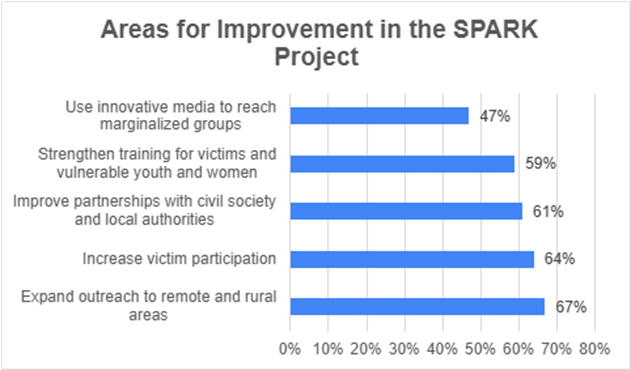
In addition, 59 percent of respondents stressed the importance of enhancing transitional justice training and capacity-building efforts, in particular to target vulnerable populations, including victims, youth, and women. This includes the provision of more structured training and skills development initiatives.
Respondents (47 percent) also emphasized the need to adopt more innovative and creative media approaches to raise awareness and enhance engagement and accessibility across diverse and marginalized community groups. This aligns with earlier findings highlighting the importance of expanding outreach to rural and underserved areas (as indicated by 67 percent).
💬 “There is great potential to build on this project, by expanding the scope of activities to other governorates, and targeting influential groups, such as religious guides, political leaders, media professionals, and tribal leaders.” – Moath Al-Fakih, Project Manager, SAM.
6. Learning, Documentation, and Replication
Public Opinion on Nationalization of Transitional Justice Projects
Under SPARK, restorative justice pilots and raising awareness campaigns foster community responsibility to operationalize transitional justice principles. Through these initiatives, Yemeni transitional justice continues to be explored, facilitated, and actualized for all members of society. This implementation of transitional justice on the local level in thoughtful and innovative ways continues to build toward effective whole-of-society peacebuilding efforts as these projects envision transitional justice efforts, rooted in local ownership, dignity, and dialogue, serving as foundations for broader restorative justice pilots and raising awareness initiatives.
Promotion of inclusive, survivor-led, and sustainable transitional justice is the aim of DT Institute, and local partners, AMA and SAM, under the SPARK program. The program also includes objectives focused on strengthening the capacities of Yemeni civil society and community members to enable them to participate and lead inclusive peacebuilding endeavors built off the principles of transitional justice. Within this framework, SPARK has trained over 150 civil society workers, activists, and representatives on transitional justice principles in preparation for national peacebuilding. The program also engaged over 230 civil society actors within the Transitional Justice Ambassadors Forum (TJAF), a cohesive, coworking space for collaboration and knowledge-sharing on peacebuilding endeavors.
Respondents in the SPARK Midline Survey emphasized the value of nationalizing transitional justice projects and programs like SPARK to contribute to Yemen’s broader context. A near-unanimous majority of respondents (99 percent) expressed a strong need for nationalization of transitional justice initiatives and projects, indicating high relevance and scalability of SPARK’s current projects within the Yemeni environment. They also emphasized the most important opportunities that civil society organizations should leverage in nationalizing such transitional justice projects (selecting multiple answers).
According to respondents, the most important areas to leverage in nationalizing transitional justice were local and international expertise on transitional justice and public awareness of victims’ rights and reconciliation. Most respondents (71 percent in both cases) encouraged civil society to capitalize off the transitional justice knowledge possessed by local and international experts and the increased public awareness fostered by such projects, which was cited as a strength of the SPARK project by 80 percent. They also encouraged civil society to continue increasing public awareness of victims’ rights and reconciliation to complement efforts to nationalize transitional justice.
💬 “One of the most important impacts [of the SPARK program] is that voices that did not previously have space are now finding a place within these discussions [surrounding transitional justice]. I have also seen how victim-led processes can emerge. …It is very important to create larger spaces for victims and to involve them as leaders in these processes.” – Eshraq al-Maqtari, Yemen’s Minister of Legal Affairs.
Respondents also pointed to the presence of established civil society networks. Approximately 68 percent of respondents reported that such networks should be leveraged in nationalizing transitional justice projects. This aligns with respondents’ recommendations to increase partnerships with civil society networks and local authorities (cited by 61 percent of respondents). Most respondents (67 percent) also encouraged civil society to capitalize off community readiness and openness to cooperate and engage in transitional justice processes. At the stakeholder level, respondents highlighted donors’ commitment to supporting long-term programming (cited by 52 percent), while 40 percent emphasized the openness of some official entities towards civil society engagement and initiatives in this field.
Opportunities and Challenges to Civil Society’s Nationalization of Transitional Justice Projects
Despite these enabling factors, respondents also identified structural constraints to nationalization. A majority (72 percent) highlighted limited financial resources and the absence of sustained funding as the primary barrier, compounded by persistent insecurity and instability in several Yemeni regions (also cited by 72 percent of respondents). Restricted access to remote and conflict-affected areas remains a key operational challenge (as reported by 63 percent), driven by road closures, security limitations, and constrained operational flexibility in areas with active conflict dynamics.
Furthermore, 59 percent of respondents pointed to limited public interest, political will, and sustained government support as an additional constraint, despite partial institutional openness, which was cited as an area to leverage by 40 percent (above). Additionally, 51 percent of respondents also emphasized direct threats made to victims, witnesses, and organizations. In addition, 40 percent highlighted the continued lack of technical specialization in transitional justice, despite increasing exposure to the field.
As mentioned above, respondents perceive donor engagement in Yemen’s peacebuilding and stabilization efforts as a potential opportunity for advancing transitional justice, with 52 percent identifying donor interest as an enabling factor. However, this is tempered by significant concerns regarding the sustainability of such support, particularly the lack of sustained funding, identified by 72 percent as a primary structural constraint. This suggests that while donor interest is recognized as important, it is not considered sufficient or reliable over the long term, with funding continuity emerging as the critical determinant of viability.
These align with The Path Towards Peace findings emphasizing the need to build the capacity of civil society organizations and initiatives to enable them to play an effective role in transitional justice mechanisms. At the time, civil society participants in the study identified several steps necessary to build their capacities, including training on transitional justice mechanisms (as reported by 96 percent), as well as strengthening advocacy capacities and facilitating partnership with international organizations.
Challenges facing civil society and hindering their engagement on transitional justice were also identified. These included a pervasive negative perception and lack of interaction with transitional justice focused civil society organizations by the public (due to the community not understanding their importance and value), political parties and international organizations’ lack of interaction with civil society on transitional justice issues, civil society’s general lack of funding, and the absence and weakness of the state. As observed within the Midline Survey, SPARK has contributed to the improvement of many of these areas. Namely by expanding public awareness of transitional justice (as cited by 80 percent of respondents who recognize SPARK) and enhancing civil society and government collaboration (as cited by 51 percent).
💬 “After we started working on [the SPARK] project, other organizations also started working on [transitional justice]. It motivated them to work, and it refreshed the discussion about transitional justice. …Because of this, transitional justice became a subject that is discussed with the presence of marginalized women victims together with the political elite. This is very important. Some years ago, we could never witness something like this. I also noticed that ordinary people and emerging activists started discussing transitional justice. The organizations that were involved in the training also started to learn more about transitional justice. Because of this, the topic became available and accessible to everyone.” – Najla Fadhl, AMA.
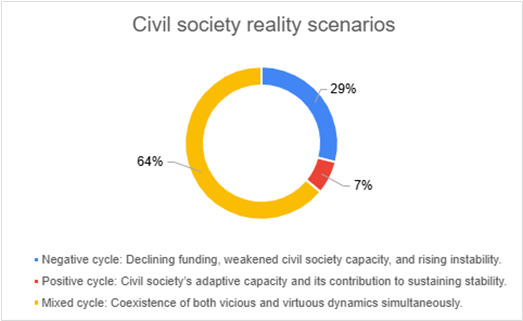
However, many areas still require significant attention and improvement, including civil society funding streams and Yemeni instability. Under the SPARK Midline Survey, respondents were asked to frame the future of civil society by selecting amongst two contrasting dynamics. The first marked by positive cycles of civil society capacity to adapt and contribute to maintaining stability, while the second emphasized negative cycles of declining funding, reduced capacities, and rising instability.
A small minority (seven percent) described the current reality of civil society work as a positive cycle, where organizations possess the capacities to adapt to funding constraints, leading to improved stability over time. In contrast, 29 percent reported a negative cycle, which is marked by declining funding, weaken civil society capacity, and rising instability and social fragility. The majority (64 percent) identified a mixed trajectory, where both dynamics coexist. In this scenario, some organizations manage to adapt and sustain operations through new funding mechanisms, while others are unable to survive. This continuous uneven resilience, if not changed, is expected to shape an increasingly fragmented civil society landscape.
6. Scaling the Impact
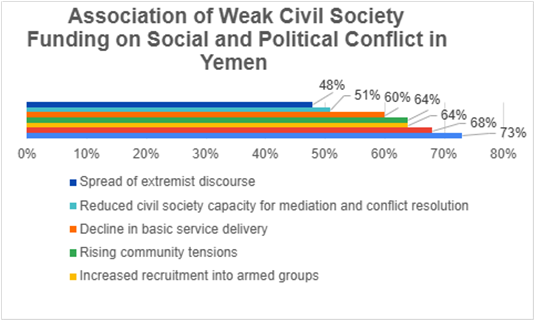
Accompanying widespread emphasis of a strong need for nationalization of transitional justice projects (by 99 percent of respondents), there was also a strong consensus on the systemic consequences of the weakening of civil society by 96 percent of respondents. These respondents held that the underfunding of civil society amidst Yemen’s current unstable conditions contributes to the exacerbation of social and political conflicts. Weakening of civil society efforts was associated with weak accountability mechanisms and with increased political and popular influence of militants and armed groups by 73 percent and 68 percent of all respondents, respectively. It was also associated with increased militarization and recruitment as well as rising social tensions by 64 percent. Furthermore, deterioration of basic services provided to local communities was highlighted by 60 percent of respondents, while 40 percent cited the dominance of extremist discourse.
This pattern suggests that civil society in Yemen is not viewed as limited to relief provision, but as a stabilizing force that helps regulate conflict dynamics through mediation, accountability, and dialogue. Moreover, all respondents agreed that conflict and instability in Yemen is associated with wider regional spillover risks and broader regional instability, extending beyond domestic governance and local stability concerns.
As highlighted by participants in The Path Towards Peace study and respondents in the SPARK Midline Survey, nationalization and expansion of transitional justice concepts and projects is essential for Yemen’s future and for successful peacebuilding endeavors. In Yemen’s current complex environment, it is up to civil society to prioritize transitional justice by educating and raising awareness to build the capacity of locals and victims to lead such processes, foster community ownership and dialogue as the foundations for restorative justice and reconciliation, engage political and governmental forces as diverse transitional justice stakeholders, and through the development of scalable models for the implementation of broader, national transitional justice.
“SPARK’s restorative justice pilots are particularly powerful in actualizing transitional justice across Yemen. These local initiatives not only envision community ownership and victim-led, participatory transitional justice, they actualize it,” emphasized Lynn Arbid, DT Institute’s Program Officer. “By creating and successfully implementing scalable models within Yemen, SPARK’s restorative justice pilots lay the groundwork for successful national transitional justice. They demonstrate that reconciliation and restoration is not only possible but also sustainable and desirable when implemented by the people, for the people with victims intimately involved.”
Through the SPARK program and its various initiatives, including restorative justice pilots and raising awareness projects, Yemeni transitional justice continues to be explored and facilitated in thoughtful and innovative ways, building towards effective whole-of-society peacebuilding efforts.
💬 “The reason this work is so important now is that transitional justice is currently not present in this political track, especially what we call Track One, the political decision-making track. Because of the current conflict, transitional justice is not really present with the decision-makers. This is exactly why the role of civil society becomes essential. …Civil society should continue raising the issue and calling for transitional justice. Even if the full process cannot happen now, there can still be temporary actions. …Even if transitional justice is not active right now, there will come a time when it becomes necessary. When that moment arrives, the groundwork must already exist.” – Rana Ghanim, Member of Yemen’s Consultation and Reconciliation Commission.