1. Overview of the SPARK Program
The SPARK program (Supporting Peace in Yemen through Accountability, Reconciliation, and Knowledge-Sharing) advances local and national reconciliation in Yemen by furthering initiatives to foster engagement with transitional justice. The program engages all segments of society in the transitional justice process, including local community members, civil society experts, high-level governmental stakeholders, and most recently political parties. This engagement enables these groups to come together as joint change makers and central drivers of Yemeni transitional justice.
Under the SPARK program, DT Institute and its local partners, the Abductees’ Mothers Association (AMA) and SAM for Rights and Liberties (“SAM”), launched raising awareness campaigns to educate community members on transitional justice mechanisms and engage experts and decision makers in thought provoking dialogues and initiatives. These awareness raising campaigns complemented restorative justice pilots in Taiz and Aden, which aim to foster reconciliation and resolve community-level disputes that have resulted in human rights violations.
2. Yemen’s Political Parties and Transitional Justice
This model was designed in response to the findings of The Path Towards Peace, a research study published by SPARK in April 2025. This study captured local understandings of transitional justice by interviewing 109 people impacted by the conflict (including victims of human rights violations and displaced persons), and 13 experts on transitional justice across six governorates in Yemen. 64 percent of these 122 interviewees prioritized reconciliation and war-ending efforts over retributive accountability. Participants in the research identified clear roles for civil society in the transitional justice process, including initiating dialogue and reconciliation, raising awareness, and documenting violations.
The study also featured analysis on the divergent positions of Yemeni political parties towards transitional justice based on responses of 13 party members who participated in focus group sessions. The Southern Transitional Council appeared open to a transitional justice process that prioritized the restoration of an independent southern state. As for the General People’s Congress Party, the report noted that the government-aligned wing of the party feared accountability and justice for the abuses of the Saleh regime. The wing of the party aligned with the Houthis fell in line behind their position that “reconciliation is conditional upon the Yemeni parties abandoning their support for foreign powers, and that transitional justice should be based on fair compensation for victims and the restoration of infrastructure.” The report noted that the Islah Party was less enthusiastic about the prospect of justice and accountability for its participation in the 1994 War, and more enthusiastic about transitional justice focused on the current conflict. The Yemeni Socialist Party, on the other hand, emphasized the need to address the legacy of violations suffered by the party following the 1994 War.
These divergences in political parties’ approach to transitional justice emphasize the ways in which they have viewed transitional justice processes in the past – as selective and interest-driven rather than as a consistent commitment to accountability. Their positions are shaped by their roles in past conflicts: parties tend to support justice when they are victims and resist it when they may be held responsible. As a result, transitional justice is treated as a political instrument shaped by power considerations and fear of accountability, rather than a neutral process for achieving justice. These realities emphasize the need for this initiative.
The 13 experts on transitional justice who participated in the study recommended that political parties play defined roles in advancing transitional justice, including the drafting of necessary laws and legislation, supporting national reconciliation initiatives, and facilitating compensation procedures for victims.
💬 “In my opinion, the Yemeni personalities who head these parties are weighed down by historical conflict. Most have been in power for a long time, and every one of them wants to take revenge against the other party. In order to guarantee the participation of the parties, there should be culture workshops for the heads of these parties, in an attempt to educate them on the importance of their role in stabilizing the country and realizing a lasting peace.” – A respondent from Sana’a in The Path Towards Peace Study.
In general, transitional justice experts stress that political negotiations and peace processes aimed at ending violent conflict should almost always deal with past human rights violations. The International Center for Transitional Justice (ICTJ) notes that “[p]eace processes raise fundamental questions about how a peace agreement should tackle the legacy of massive and serious human rights violations committed during a conflict – questions about the kind of justice that is attainable; the treatment that should be afforded to victims; the nature of appropriate criminal accountability, redress, and reform processes; and the balance and complementarity that is needed among justice, security, and lasting peace.” It further notes that justice-related demands and needs are often among the most controversial and complicated elements in peace negotiations.
Conversely, Yemen has typically dealt with conflict through informal reconciliation and political deals, not transitional justice. At the local level, tribal mediation settles disputes through compensation and ceasefire agreements, focusing on ending violence rather than addressing rights violations. At the national level, political settlements — such as the 2011 Yemeni Revolution and the Gulf Initiative — prioritized stability by granting immunity to figures like Ali Abdullah Saleh.
Overall, Yemen’s past approaches emphasize stability over accountability, excluding key transitional justice elements like truth-seeking, victim redress, and institutional reform.
Recent developments, including the STC’s dissolution, the United Arab Emirates’ (UAE) withdrawal from Yemen, and the restructuring of the Saudi-backed internationally recognized government of Yemen (IRG), have provided renewed potential for transitional justice integration into peace processes. At the same time, recent escalations in the region have also increased potential for internationalizing the Yemeni conflict, diverting attention from ongoing peace efforts and complicating negotiations between Yemeni parties.
💬 “Making transitional justice part of Yemen’s political process will require embedding it within the country’s broader transition. … Meaningful and lasting peace demands addressing both the inter-party grievances of today and the deeper grievances stemming from Yemen’s past. Transitional justice has an instrumental role to play in this regard.” – Nour El Bejjani, Head of the ICTJ’s Yemen Program.
3. Initiative Spotlight: The Political Parties Initiative
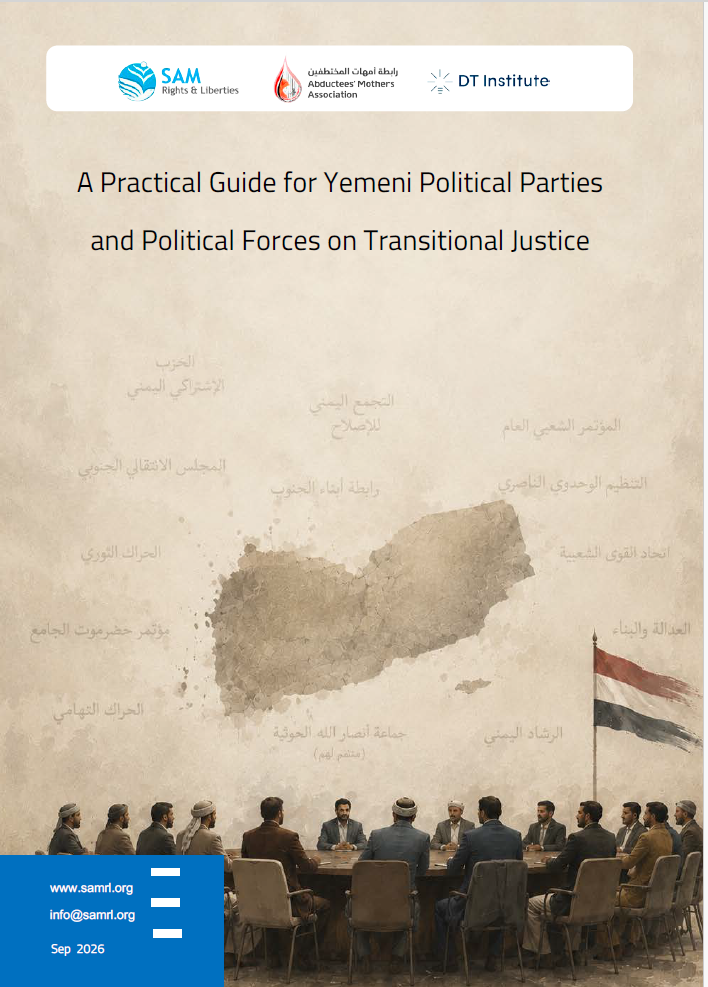
Amidst this complex backdrop, SAM launched the Political Parties Initiative to convene Yemen’s political parties and figures on transitional justice. The initiative seeks to align political parties’ views and build a joint transitional justice narrative. Furthermore, it aims to identify common entry points to integrate this narrative into future political debates and discussions. The initiative will result in a practical guide outlining the shared visions and narratives of political parties and laying the foundation for unified political discourse on transitional justice.
The initiative will do so by conducting independent and joint dialogue sessions with political parties, wherein party representatives will be asked about their outlook on transitional justice and how this outlook intersects with their political aspirations for Yemen. At the outset and close of each of these sessions, surveys will be shared with the parties to collect further information. In addition to political parties, the Consultation and Reconciliation Committee and influential political figures will be consulted.
💬 “These dialogues are very important and are part of a series of activities undertaken by the SAM Organization through dialogues related to transitional justice. These topics are particularly important at this stage because they address many of the violations left behind by the war and previous regimes in Yemen. Transitional justice is a fundamental issue and part of the solution to the problems Yemen is suffering from. It is essential if Yemen is to move to a new phase of lasting peace.” – Yasser Al-Salawi, Head of the Thought and Culture Department of the Socialist Party in Yemen.
4. Agreement and Impact
In April 2026, SPARK partners launched the first phase of Political Parties Initiative, which aims to unify Yemeni political parties’ transitional justice narrative.Partners convened two dialogue sessions, engaging 28 individuals representing eight diverse political parties and five political forces as well as four influential, independents. The sessions took place in-person in Taiz and Hadramout.
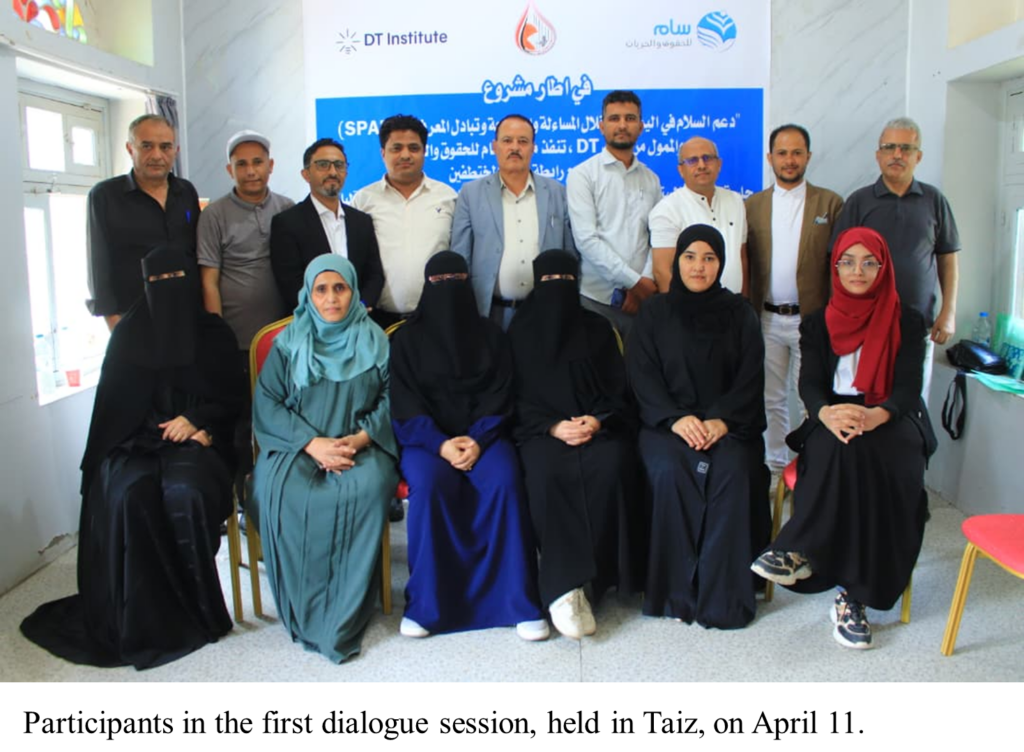
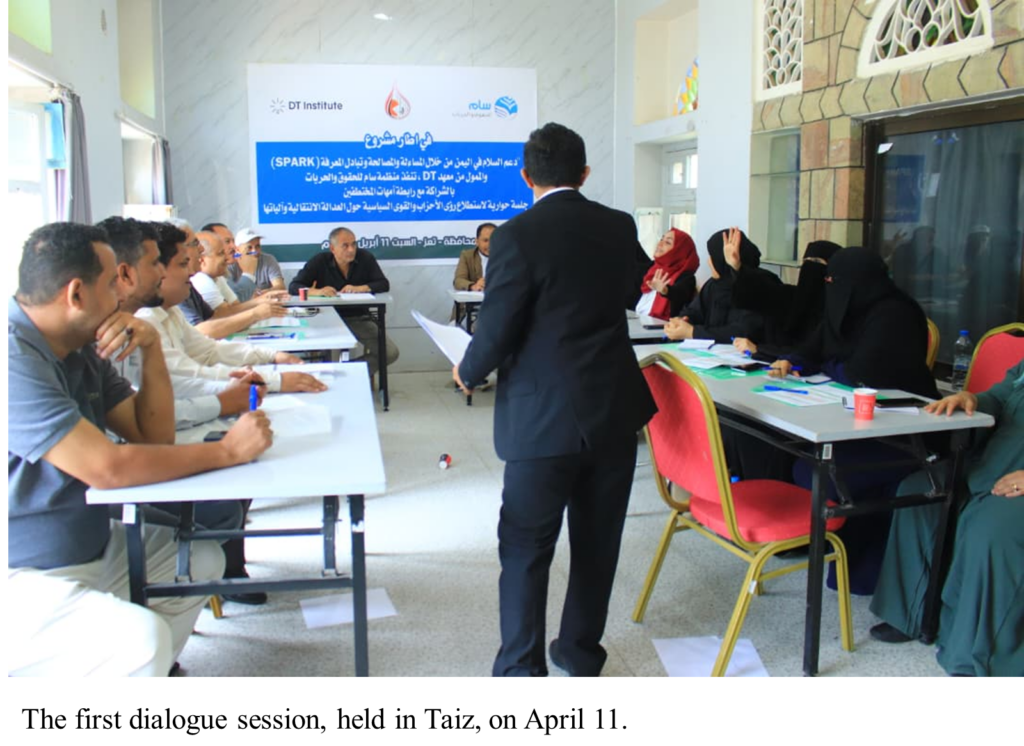
The first dialogue session, in Taiz, was attended by 13 participants representing eight political entities. These included the Yemeni Socialist Party, Islah Party, the Union of Popular Forces, the Justice and Construction Party, the General People’s Congress, the Supreme Council of Popular Resistance, the Nasserist Unionist People’s Organization, and the Political Bureau.
Within the session, all representatives agreed on the importance of transitional justice and demonstrated a general understanding of its core components. In particular, all representatives demonstrated an understanding of victim reparations and accountability – two central transitional justice issues that have been ignored in previous peace talks. Additionally, all political representatives also agreed that any effective transitional justice process requires strong and independent state institutions, which Yemen does not yet possess.
Clear divisions emerged around the issue of accountability. While most participants supported accountability as a key pillar of justice, some representatives expressed reservations. These representatives were from the General People’s Congress —which The Path Towards Peace Study had noted feared accountability for the abuses of the Saleh regime — and the Political Bureau affiliated with Tareq Saleh, whose forces have been accused of widespread human rights violations during the current war. Participants from these groups favored reconciliation approaches that could include concessions in exchange for immunity. Despite this, there was broad consensus on the importance of confession as a first step, potentially followed by pardons.
Diverging views emerged along similar lines regarding political reintegration. Most of the participating parties argued that perpetrators of violations should not return to positions of authority or power. However, representatives from the General People’s Congress and Political Bureau expressed the view that violators should not necessarily be prevented from holding power as long as there are legitimate institutions in place to safeguard justice. In turn, they emphasized the need to strengthen judicial institutions to ensure accountability and protection.
Significantly, only the Yemeni Socialist Party was identified as having taken concrete steps towards internal accountability by conducting internal reviews and publicly acknowledging past mistakes.
Concerns were raised about the risk of “victor’s justice” and the possibility of transitional justice being instrumentalized for political revenge. Participants also warned about the politicization of violations and the manipulation of victims by political actors to target opponents. These concerns echoed those expressed in The Path Towards Peace study. This demonstrated a degree of alignment between political party and community outlooks on transitional justice processes.
All parties agreed on the necessity of reparations for victims, including material and symbolic reparations, such as financial payments and memorialization of atrocities. Disagreement emerged around the definition of victims, with representatives from The General People’s Congress arguing that combatants should not be considered victims. Parties stressed that financial compensation is often not enough without acknowledging and apologizing for violations and past mistakes. All parties stressed the value of revealing the truth of past violations to the public and agreed that there should be an independent national body tasked with doing so.
💬 “The themes of today’s session were important for understanding the parties’ perspectives and their future vision regarding transitional justice, whether in relation to the concept of justice, victims, or forms of reparation. These themes are important, and we need more dialogue and discussion sessions, especially since the nature of the topics discussed requires more sessions because they are important. One of the most important outcomes is understanding the perspectives of the parties’ branches on transitional justice issues. This is an important step in formulating the parties’ visions as they are part of civil society organizations” – Yasser Al-Salawi, Head of the Thought and Culture Department of the Socialist Party in Yemen.
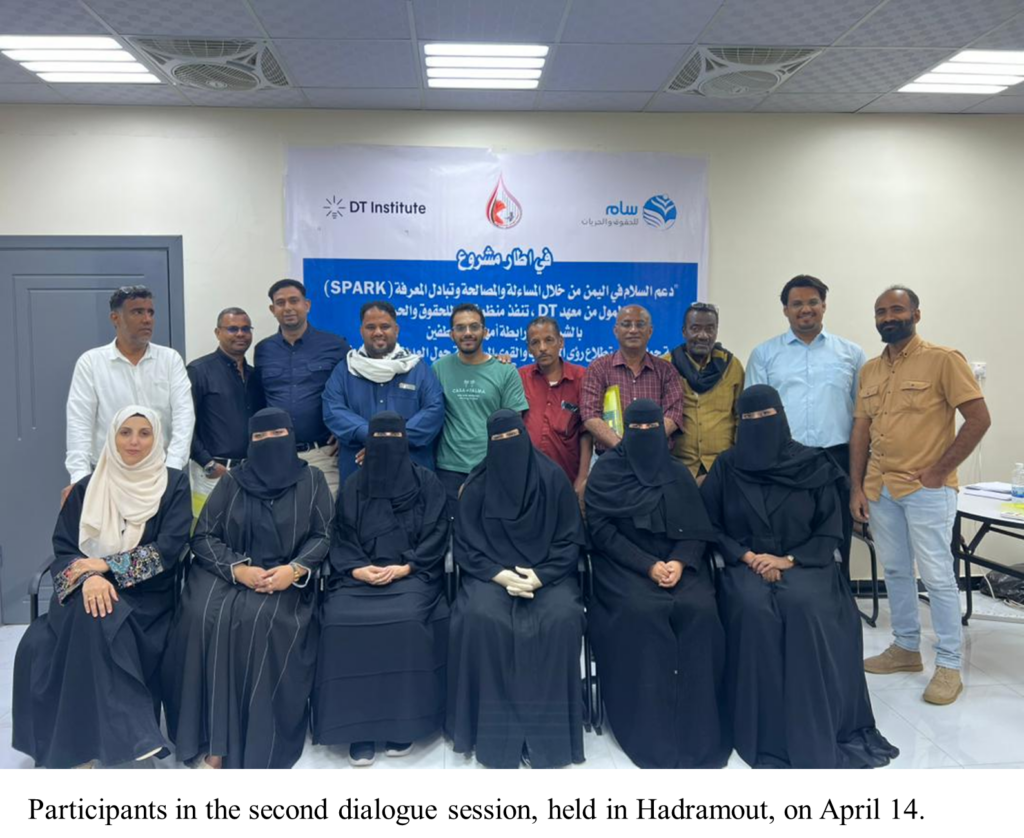
The second dialogue session, in Hadramout, was attended by 15 participants representing five political parties, three political forces, and four independents. Political parties included the Yemeni Socialist Party, Islah Party, the General People’s Congress, the Nasserist Unionist People’s Organization, and Al Rasahd party . Political forces represented included the Hadramout National Council, Hadramout Inclusive Conference, and the Supreme Council of the Revolutionary Movement.
💬 “The session is very important in discussing concepts and understanding the axes of justice that were discussed with the various groups. I believe the participation of these groups is crucial, reflecting a desire to hear their perspectives and understand the points of agreement and disagreement regarding the mechanisms and axes of justice that were discussed. Undoubtedly, the experience of transitional justice is new to the local context, and I believe that the various forces do not yet have a complete vision. I hope that the discussions will culminate in recommendations for developing programs and building the capacities of parties and forces regarding the mechanisms of transitional justice.”– Nashwa Saeed, representative of the Hadramout National Council.
At the outset of the session, attendees took the time to describe their individual understandings of transitional justice. The majority of the parties agreed on this point, noting that transitional justice proceeds in three stages which require disclosure, reparation, and accountability. One representative from the General People’s Congress disagreed. He stated that there was no point in theorizing transitional justice without the existence of real action. A college of his, also from the General People’s Congress, disagreed with him and agreed with the rest of the participants. She stressed that peace and stability will only be reached through transitional justice.
Accordingly, most attendees also agreed that transitional justice is necessary to prevent the recurrence of conflict and promote peacebuilding. Conversely, a representative from the Yemeni Socialist Party shared his belief that justice may limit Yemen’s current state of war but that it does not prevent the recurrence of the conflict itself. At the same time, all attendees expressed that the relationship between transitional justice and peacebuilding is complementary, and that if there is transitional justice, there is peace.
When asked if they had any concerns regarding transitional justice and its mechanisms, attendees noted that there may be some but that these can be diffused and amply managed. A political science professor from the University of Hadramout noted that it was natural for fears to be expressed or felt by those who have done harm, but that these can be managed by working in realistic ways towards reconciliation with partial accountability. Similar sentiments were expressed by representatives from the Nasserist Popular Union and the Hadramout Inclusive Conference.
Participants noted the importance of selecting an appropriate starting point from which transitional justice should address violations. They also noted that there needs to be certain standards to ensure accountability, including an independent, overseeing authority. Many agreed with these points, although a representative from the Supreme Council of the Revolutionary Movement expressed concerns over retaliatory justice and the presence of foreign interventions.
All attendees agreed that victim’s rights must be respected and that some types of reparations should be forthcoming. Parties discussed the minimum that can be done for victims’ rights. These conversations revolved around documentation, accountability, and financial, moral, and material reparations. All attendees also agreed on accountability, fact-finding, formation of dispatch teams, transparency, hearing sessions, forensic teams, and facilitation of access to information as appropriate mechanisms to reveal the truth about past violations.
💬 “These themes are important, and we need more dialogue and discussion sessions, especially since the nature of the topics discussed requires more sessions because they are important. One of the most important outcomes is understanding the perspectives of the parties’ branches on transitional justice issues. This is an important step in formulating the parties’ visions as they are part of civil society organizations.” – Yasser Al-Salawi, Head of the Thought and Culture Department of the Socialist Party in Yemen.
4. Learning, Documentation, and Replication
Within the sessions pre- and post-assessments, participants expressed positivity and openness. The surveys were conducted with 27 participants in total, all representatives of either political parties or forces in Yemen. In pre-surveys, 70 percent of the participants from both sessions reported at least partial agreement on accountability under transitional justice – the most contentious transitional justice principle. While a high level of initial agreement on key transitional justice principles was observed, post-assessment findings provided a more in-depth understanding of remaining differences. All participants agreed that points of disagreement on transitional justice can be resolved. Approximately 51 percent of participants noted that areas of disagreement could be easily resolved, while 48 percent expressed that disagreements can be resolved with time.
Moreover, approximately 56 percent of participants in the pre-surveys expressed their willingness to integrate transitional justice into political discourse as “very ready.” This number went up in the post-assessment to approximately 74 percent of participants, with an additional 26 percent
expressing their willingness as “ready.” When asked about their willingness to collaborate with other political parties on transitional justice, pre- and post-assessment averages from both sessions were virtually at 100 percent as participants expressed that they were “ready” and “very ready” to do so.
Additionally, all participants expressed that they found the sessions to be effective in revealing points of agreement that were not previously apparent. An average of 63 percent of participants confirmed that their perspective on the role of victims and survivors in transitional justice has changed and that they have become more appreciative of their role. Furthermore, 78 percent of participants confirmed that they will submit an official recommendation to their respective parties and forces to formally adopt the political guide that will be produced by this initiative.
Over the coming month, SAM plans to conduct an additional three dialogue sessions bringing together representatives from political parties across Yemen. These sessions will feature participants from Mareb, Aden, and the country’s north that is under the control of the de facto Houthi authorities. Such discussions will continue to focus on exploring the various parties’ views of transitional justice and identifying points of potential consensus and disagreement among them.
💬 “I believe these sessions are the first of their kind in the governorate branches, and they are an important and serious step that requires further steps. To reach understandings and common ground for formulating concepts and finding consensus, at least among the components, on transitional justice and its mechanisms” – Yasser Al-Salawi, Head of the Thought and Culture Department of the Socialist Party in Yemen.
In building off the political party dialogue sessions, SAM will conduct research, including a desk study of reports issued by governmental agencies and local and international organizations related to the intersection of transitional justice and the role of political parties. Such information will supplement the answers provided by political parties in pre- and post-session surveys and their inputs during the sessions themselves. The team will then analyze all this data together to put together the political party transitional justice guide.
5. Scaling the Impact
Previous SPARK research efforts, including The Path Towards Peace study, have emphasized the divergent views of transitional justice held by Yemen’s political parties, each of which has a different geographic area as its center of influence. Convening representatives of these parties from across the country will enable the research team to structure its planned transitional justice guide to identify national-level challenges and potential avenues for cooperation on the transitional justice process.
“This initiative reflects a critical shift, from viewing political fragmentation in Yemen as a constraint to recognizing it as an entry point for more inclusive and grounded transitional justice. While differences among political parties remain, the presence of multiple organized actors with real constituencies can be strategically leveraged as a strength rather than a weakness,” stated Feras Hamdouni, Senior Program Manager at DT Institute. He went on, “What is particularly encouraging is the emerging baseline willingness across parties to engage on core transitional justice elements, including victim recognition, reparations, and truth-seeking.”
He explained that this creates a tangible opportunity to build a shared minimum framework that is both politically informed and locally rooted, increasing its chances of sustainability. To contrast this, he compared Yemen’s situation to that of Syria. “In contrast to contexts such as Syria, where political party structures in transition remain weak or inactive, limiting the ability to anchor transitional justice within formal processes, Yemen’s relatively plural political landscape offers a more immediate pathway forward. Coupled with the current trajectory of de-escalation, this presents a critical window that should be consolidated and leveraged,” Hamdouni explained.
Embedding transitional justice within emerging political settlements will be essential, not as a parallel track, but as a foundational pillar of sustainable peace. Early and structured engagement with political parties provides a practical avenue to integrate accountability, victim recognition, and reconciliation into the core of future agreements, rather than deferring them to a later stage.