1. Overview of the SPARK Program
In April 2025, the SPARK team, composed of DT Institute and its local partners, the Abductees’ Mothers Association (AMA) and SAM for Rights and Liberties (“SAM”), formed the Community and Reconciliation Consensus Committee (CRCC, also known as the al-Wefaq Committee). The CRCC includes 10 prominent social figures in Taiz, who aim to foster reconciliation, document key issues threatening peace community coexistence, and to empower communities to resolve such disputes through community-led resolution processes. CRCC members were selected according to strict criteria taking into account their local influence, the communities represented, and their reputation for trustworthiness, legitimacy, and commitment to transitional justice and to human rights.
The CRCC’s scope of work was designed in response to the findings of The Path Towards Peace, a research study published by SPARK in April 2025. This study captured local understandings of transitional justice across Yemen, revealing an urgent need for legitimate local mechanisms that can translate community grievances and priorities into accountable and effective governance responses.
Study findings held that while most (79 percent) of community members in the study also expressed a need for institutional reforms throughout Yemen, focusing on legal and law enforcement institutions due to their failures to bring justice for victims. In response, the CRCC was designed as a community-based governance mechanism to complement, rather than replace or recreate, the role of state institutions.
The CRCC does so by acting as a trusted intermediary between communities, formal governance structures (including local authorities, security actors, and national institutions), and supplemental stakeholders, such as donors, influencers, international non-governmental organizations, and local civil society. By engaging and coordinating the responses of these entities, the CRCC has enabled state institutions to effectively address local accountability gaps.
Moreover, the CRCC also functions in a watchdog-like capacity by actively involving itself in the resolution of public grievances from start to finish. Through this role, it combats law enforcement corruption – especially in cases where the perpetrators are security members or affiliates – reaching cases in both more dense and rural areas (where additional difficulties in reporting, such as mobilization, exist).
2. One Year In, Numerous Permanent Impacts Made
The Community Consensus and Reconciliation Commission’s Entrenchment as a Pivotal Figure For Positive Change and Reconciliation
One year after the CRCC’s launch in April 2025, the committee has established itself as a strong and penetrating force within Taiz. The CRCC has demonstrated their ability and repeated readiness to amplify community and victims’ voices, resolve sensitive and long-standing disputes, and foster collective understanding.
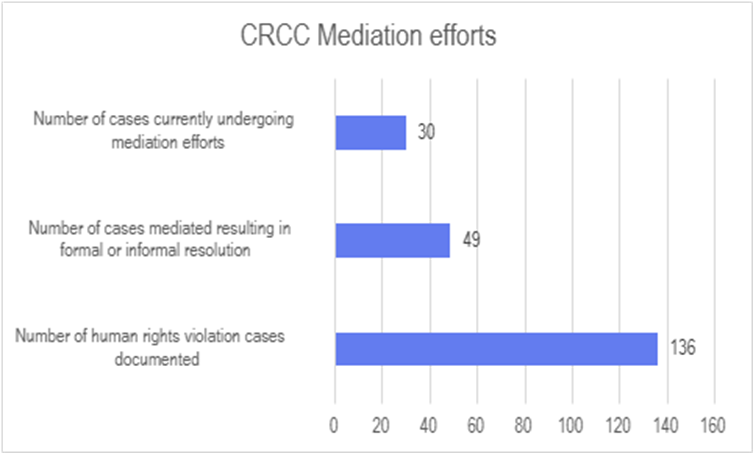
In this time, the CRCC has recorded 136 disputes fostering serious community tensions and threatening peaceful coexistence. Of these, 49 cases have been resolved, while 16 are currently being addressed and 28 are under active follow-up.
In documenting, assessing, and addressing each of the disputes the CRCC engaged with the community on the ground. This included over 100 field visits and coordination meetings with diverse community groups and members of society. These included engagements with local authorities, the Governor’s Office, the Deputy Governor of Taiz, community leaders (akals), victims and affected families, relevant organizations, and the state water corporation. On-the-ground work also included dispute site visits to advise, supervise, and follow up on CRCC-led resolutions.
💬 “What we want to do is engage the victims, to engage the tribal leaders and notables, and to engage the community. People feel comfortable with restorative justice, because it is closer to their hearts and allows them to be hands-on.” – Abdul Gassar, CRCC Member, at the webinar entitled From Conflict to Recovery: Restorative Justice and Community Peacebuilding in Yemen – A Study of the Al-Sarari Experience.
Through these engagements and their individual community influences, CRCC members fostered strategic partnerships and alliances with local authorities, governmental organizations, and local and international non-governmental organizations (NGOs). These relationships allowed the CRCC to enhance the effectiveness of their interventions by enabling the CRCC to act as a bridge between disgruntled, and often unheard, community members and weak state institutions.
Moreover, they allow the CRCC to empower, not only community members and victims, but also to empower state institutions, which have been and continue to be weakened by the ongoing conflict. The CRCC does so by supporting state institutions, acting as a mediator between local institutions and their community, and increasing the ability of governmental entities to act and address local needs.
As Feras Hamdouni, Senior Program Manager at DT Institute, stated at the outset of the CRCC’s work, “importantly, the CRCC is not intended to replace state institutions, but to bridge critical gaps at the local level and translate community-driven solutions into coordinated action with authorities. This linkage between local initiatives and national-level engagement is essential for sustainability and for embedding reconciliation and accountability within longer-term governance systems.”
💬 “We are not a substitute for the state, but a supporter, and we work to involve local authorities and security forces in the initiatives.” – Abdullaah Gassar, CRCC Member, at the webinar entitled From Conflict to Recovery: Restorative Justice and Community Peacebuilding in Yemen – A Study of the Al-Sarari Experience.
By bridging the gap between disputing parties and activating the responsibility of local authorities and governmental institutions, the CRCC has created sustainable solutions contributing to good governance and accountability. Such solutions serve not only to resolve singular or one-off conflicts but as living resolutions, to be benefited from, recreated, and expanded upon by local communities in coordination with relevant authorities.
3. Initiatives Spotlight: Temporary Work Enabling Sustainable Good Governance Changes
After over 10 years of pervasive and violent conflict, Yemen’s third largest city remains in state of high violence and devastation. Fighting between government forces, Houthi fighters, and other local actors continues to plague the city, which has been under Houthi siege for years. The siege has restricted the entry of essential resources, deepening humanitarian crises and further impacting widespread lack of food, clean water, and adequate housing.
💬 “The war has weakened state institutions and fragmented the social fabric, which has highlighted the need for community committees. Achieving transitional and criminal justice is difficult now due to the weakness of judicial institutions. Therefore, the community relies on and benefits from restorative justice.” – Abdullah Gassar, CRCC Member, at the webinar entitled From Conflict to Recovery: Restorative Justice and Community Peacebuilding in Yemen – A Study of the Al-Sarari Experience.
.
Taiz is one of many governorates in Yemen that is on the frontlines of climate change. The region has been experiencing severe water scarcities accompanied by droughts, rising temperatures, unpredictable rainfall, and extreme flooding. These turbulent weather events have destroyed infrastructure and livelihoods throughout the governorate, resulting in agricultural collapse in a heavily agricultural region.
The erratic environmental shocks, coupled with the violent conflict, has displaced thousands of residents throughout Taiz. It has also contributed to ongoing food insecurity and urgent and severe need for humanitarian assistance and emergency support to address flood damage, rampant displacement, and other widespread impacts.
💬 “The issue of water scarcity is considered one of the most critical, recurring, and complex challenges facing the residents of Taiz City — a problem of significant public concern.” – Kamal Al Sharabi, member of the CRCC.
Environmental Peacebuilding
Flash floods have had particularly severe impacts on mountainous districts, including the Salah district of Taiz. In these areas, homes are scattered across the sides of the mountain, below mountain slopes, and one another. Thus, the homes, especially those located below slopes and other homes, are highly exposed to flood risks. Community-built retaining walls, barriers, and small bridges, originally constructed to divert floodwaters, deteriorated in recent periods due to the heavy rain. This contributed to increased risks of rockslides and other detrimental impacts to family homes.
In August 2025, the flash floods caused extensive damage to the homes, farms, livestock, vehicles, and livelihoods of 45 families residing within the area. In particular, the areas of upper and lower Haraziya, Hubail Awsat, Al-Jahmiyah, around the water project, and the Cultural Center were severely affected. Prior to the CRCC’s intervention, the community was helpless. The people lacked the requisite know-how to address the situation. The local authority and local aid organizations also lacked the needed funding and capacity to adequately address the disastrous effects of the flooding.
Against this backdrop, the CRCC stepped in along with a team of volunteers forming an emergency committee. In
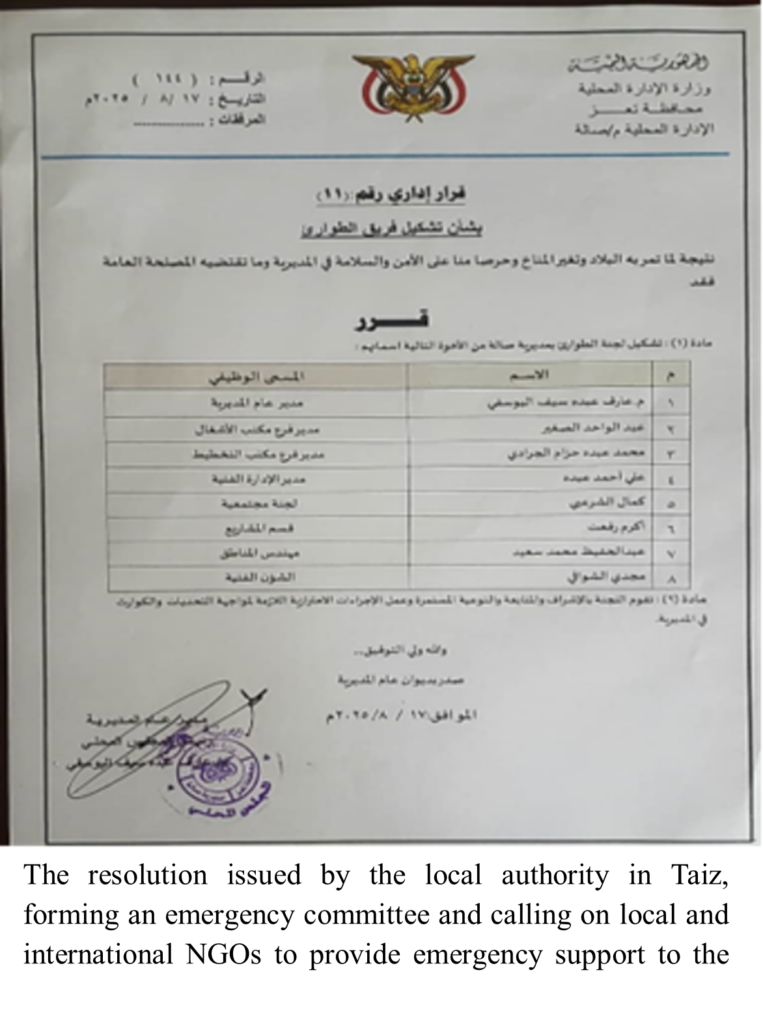
addressing the severe flood impacts and resulting community tension, the CRCC launched an initiative to monitor, assess, and respond to the impact of the flooding in Salah district. The initiative put the volunteers in the emergency committee to work on on-the-ground documentation and field visits to assess the damage and meet with the families affected.
It culminated in issuance of an impactful report to the local authority, summarizing the flood damage and outlining its impact on 45 affected families, their homes, and livelihoods. In doing so, the document provided a comprehensive overview of the damage and loss caused by the flooding. This included detailed description of the damage to homes, food supplies, shelter needs, and vehicles. It also noted the loss of livestock, road outages, collapsed walls, and other severe impacts that would need to be addressed to prevent further detrimental effects and building of community tension.
The report was submitted to the Directors of the Directorate and of the Public Works and Roads Office. In response, the local authority issued a resolution. The resolution formalized the Salah District Emergency Commitee, legitimizing their role and tasking them with staying up to date on climate shocks and their impact on the community. It also called on local and international NGOs to provide emergency support to the 45 affected families. Furthermore, the report led to the immediate intervention of the local authority, which surveyed the damage themselves and worked to dismantle existing flood streams to protect the population from further impacts.
After the report’s submission and circulation of the resolution, local and international organizations responded. They distributed emergency kits with urgently needed essentials. These included mattresses, blankets, kitchen utensils, and food baskets. They also provided financial aid and support to those directly affected, distributing in cash approximately 272,000 Yemeni Rials.
The resolution put forth by the local authority further noted the newly formalized Emergency Committee’s responsibilities. This included monitoring, documentation, and coordination with the local authority. In this respect, the purpose of the committee was to enable the local authority to respond to urgent needs and emergency situations quickly and in a timely manner. This legitimized the committee’s responsibilities, which the people sought to depend on.
💬 “If it were not for the intervention of the [CRCC] and its member, Kamal al-Sharabi, our voice would not have reached the responsible authorities, and the losses could have been much greater.” – An affected community member in Salah district.
The local authority’s recognition significantly strengthened local capacity to address urgent needs and helped prevent the escalation of tensions related to resource scarcity and internal displacement. Since then, the Emergency Committee has remained active, responding in times of crises as needed. The Emergency Committee is made up of eight members and includes representatives from the CRCC, Office of Public Works and Roads, and the Director of the Salah District. The Director himself is an engineer, and the Emergency Committee includes several other engineers and relevant professionals, further establishing its legitimacy and capabilities.
Over the course of a year, the committee successfully submitted numerous proposals, monitored damage assessments, and guided donor efforts in coordination with sub-clusters and civil society organizations. As the wave of flooding persisted, culminating in the drowning of several children during 2026, the Emergency Committee continued its monitoring efforts. To bolster these efforts, the CRCC hosted numerous community-level sessions to raise the awareness and preparedness of the community. These sessions focused on early warning systems and community readiness.
The CRCC, as part of the Emergency Committee, mobilized donors to construct flood barriers in the most severely affected areas, such as the Al-Haraziya site for displaced people. This project was implemented by the Binaa Charity Association with support from the Yemen Humanitarian Fund (YHF) and under the supervision of the Emergency Committee, overseen by the Director of Sala District. Additionally, the CRCC, as part of the Emergency Committee, advocated for and facilitated Rapid Response Mechanism (RRM) interventions for flood victims, identifying their specific needs and coordinating the distribution of aid to alleviate their suffering. Following the success of the Salah District Emergency Committee in alleviating suffering, similar emergency committees were subsequently established in other districts.
Recently, tensions have renewed as retaining walls, barriers, and similar structures have deteriorated. Community members living in lower areas susceptible to rockslides and falling debris are living in fear. The lack of demonstrated concern amongst those living in higher areas, who continue to pass above damaged infrastructure, has led to increased tensions amongst community members. Moreover, they disagreed on whose responsibility it was to maintain the retaining walls and barriers.
The Emergency Committee has surveyed the damage and taken note of community concerns. They did so by conducting field visits and meeting with concerned community members. Moreover, the CRCC and Emergency Committee recruited an engineer to do a comprehensive study of the area. To adequately address the findings, the CRCC intervened to obtain aid to reinforce the barriers. The CRCC’s successful coordination with the Swedish Development Institute has secured 2,000 USD to rehabilitate and reinforce the barriers. Currently, they are coordinating labor and preparation to reduce the immediate risks and prevent further conflict within the community.
💬 “Since the resurgence of catastrophic flash floods and inundations in the city of Taiz, driven by climate change and the escalating severity of their negative impacts since 2025, which have swept away lands and claimed lives while damaging numerous homes, the Al-Wifaq Committee has been actively monitoring these damages. … Notably, the Al-Wifaq Committee, serving as a key member of the Sala District Emergency Committee, succeeded in raising levels of community preparedness.” – Kamal Al Sharabi, member of the CRCC.
Throughout 2025 and 2026, CRCC successfully participated in and resolved numerous water-related disputes. Among its most notable achievements is a case involving the contamination of drinking water wells by sewage. This adversely affected 120 families in Salah District, whose drinking water was contaminated. In response, the CRCC collaborated with the Ibda’ Youth Organization to mobilize community engagement and rally support for the affected families. In doing so, the CRCC engaged local authorities, including the Water and Sanitation Corporation and the local administration of Salah District.
Thanks to the CRCC’s advocacy and coordination, the Water and Sanitation Corporation agreed to contribute pipes and manhole covers and the local administration funded the purchase of additional manhole covers, as needed. Moreover, the community, supported by Mercy Corps, was also actively involved. The community provided their physical labor, installing the manhole covers and pipes as needed to successfully separate the sewage from the drinking water wells. This initiative benefited 480 individuals, including 288 women and 192 men.
Similarly, the CRCC successfully mobilized several other disputes and played a key role in identifying community needs regarding the water crisis. The CRCC successfully mobilized benefactors to distribute over 25 public water tanks and organized volunteers to ensure their regular refilling across the Al-Muzaffar, Sala, and Al-Qahira districts. This initiative benefited a total of 3,200 individuals, including 1,900 females and 1,300 males.
Furthermore, in a workshop concentrated on community-based solutions for water disputes. The CRCC successfully proposed one such solution involving maintenance of a water storage complex comprising three large tanks (each with a 1,500 cubic meter capacity) to serve the community. The maintenance requirement was formally submitted, diligently followed up on, and subsequently approved and funded by Mercy Corps. The maintenance work was executed in two phases in preparation for the commencement of water filling and pumping operations. This initiative is set to benefit more than 50,000 citizens across the Salah and Al-Qahira districts.
In recognition of the committee’s dedicated efforts to resolve water-related disputes, the CRCC was awarded the Community Cohesion Shield by the Water and Sanitation Corporation. This award served as a powerful incentive, affirming the committee’s critical impact and encouraging it to redouble its efforts. Indeed, the CRCC has had many critical successes in improving clean water distribution, fostering community cohesion, and in preventing school dropouts of girls in particular by ensuring access to water in areas where scarcity had previously hindered their education. However, as noted by CRCC Member, Kamal al-Sharabi, “it must be noted that these solutions remain temporary and seasonal in nature. Water-related problems tend to escalate with every new water crisis, leading to the recurring resurgence of disputes.” Thus, the CRCC’s work is not complete. It still has a long way to go in educating and empowering communities and local authorities to leverage their current resources and successfully advocate for further support from local and international NGOs, as needed, to mitigate such disputes as they arise.
Strengthening Good Governance
It has been well established that the conditions within Taiz’s Central Prison are dire. Various reports note severe overcrowding, insufficient food and access to drinking water, dangerous conditions, inadequate medical supplies, and violations of prisoners’ human and legal rights. Due to their role in the community, the CRCC took initiative to investigate for themselves.
In March, SAM and the CRCC received official approval from the Security Unit in Taiz to monitor and visit the prison to ensure compliance with human rights. This reflects the high level of trust and strong coordination that SAM and the CRCC have developed with the local authorities over time. Additionally, it reflects the local authority’s commitment to improving the prison conditions. It provided the CRCC with permission so that the CRCC can assist them in advocating for increased supplies and resources to improve prison conditions.
As provided for in the local authority’s formal approval, the CRCC conducted a field visit to the Central Prison in Taiz. The purpose of the visit was to assess the living conditions and treatment of prisoners and to promote compliance with human rights and legal obligations under Yemeni and international law. During the field visit, the CRCC confirmed the reports. In specific, they observed the prisoners’ deteriorating environment and conditions, characterized by lack of effective medical treatment and inadequate access to safe drinking water.
During the field visit, the CRCC and SAM organized a meeting with the prison director. In the meeting, they discussed the importance of safeguarding prisoners’ rights. Additionally, the CRCC and SAM took the opportunity to highlight the importance of rehabilitation programs. They advocated for psychological rehabilitation programs in specific, to increase prisoners’ social reintegration into society upon their release from prison.
The prison director responded by acknowledging the prison’s shortcomings and explaining that the prison does not have enough resources to provide adequate conditions. He appealed to the CRCC to assist them in raising the funding and resources needed. In response, the CRCC plans to meet with Taiz’s state-run water corporation, Health Office, and the Undersecretary of the Taiz governorate.
After their visit with the prison director, the CRCC visited the prisoners’ cells and met with the prisoners. This included the prisoner, Al Masani, a man who was accused of abusing a judiciary staff member who appealed for help online. In his post (now deleted), he detailed the defiencies of the judicial and prison system in Taiz and throughout Yemen. SAM and CRCC listened to his claims and decided to advocate for his release. In doing so, they emphasized the fact that he had spent more than three months in prison for a minor offense (especially compared to his fellow prison mates) and had committed to not repeating the act.
After their visit, the CRCC launched advocacy activities to improve detention conditions, address prisoner discontent, and advocate for the release of Al-Masani. Thus far, this has included coordination with the state-run water corporation, the Cleaning Fund, and the Deputy Governor of Taiz to support access to essential services and promote a more dignified environment for detainees. The CRCC and SAM have also conducted numerous meetings and calls with judiciary members to request a pardon on behalf of Al Masani. These included calls to the judge, who was victimized by Al-Masani, who agreed to drop the case. As a result of the CRCC’s persuasive and sustained efforts, Al Masani was released this week.
Addressing Community Disputes Involving Retaliation and Revenge-Seeking
Building off the Al-Sarari Restorative Justice Pilot
Under the Al-Sarari Restorative Justice Pilot, AMA addressed deep-seated tensions between communities in Al-Sarari village. Captured by the Houthis (Ansar Allah) in 2015, communities in and around the village were gravely affected by the Yemeni conflict. To protect themselves and in response to the occupation and broader war, community members aligned themselves with conflict parties. Some with the Houthis, while others supported the international recognized government of Yemen (IRG). Over time, these tensions grew and became pervasive throughout society, remaining even after the Houthi withdrawal.
These tensions cultivated serious community impacts, including deep-seeded disputes between community
members as the once-cohesive society split across sectarian lines. This resulted in a toxic environment of mistrust and competition centered around community members with different affiliations. Furthermore, it resulted in divisions and increasingly limited access to basic, key resources and services that were already scarce, including land and water.
To resolve these social tensions and their resulting conflicts, AMA utilized a bottom-up approach, which began with careful field coordination efforts to overcome security challenges and rough terrain, and culminated in productive community dialogue sessions. Through sustained engagement, robust research and understanding of critical issues, and ongoing encouragement, AMA successfully engaged multiple stakeholders. These included military leaders, district directors, and social influencers, who participated alongside victims from both sides, creating a shared space for dialogue.
AMA’s restorative justice pilot resulted in several key successes. Firstly, it succeeded in creating a beneficial exchange between the various sides, accompanied by acknowledgement of each other’s experiences and the mutual pain caused by conflict-related violations. Moreover, community members on all sides further agreed that achieving tolerance and social cohesion throughout the village does not require them to give up their rights – a fear that was frequently expressed by all sides. Finally, community members also acquiesced to the creation of an action committee to resolve ongoing violations and disputes. The initiative also effectively enhanced the presence of the state in isolated villages like Al-Sarari.
Despite the pilot’s numerous successes, the community could not agree on an Honor Code to be signed by community members to solidify their collective commitment to reconciliation. In building off AMA’s significant achievements, the CRCC continues to foster reconciliation and understanding in Al-Sarari. Moreover, the CRCC is working to translate AMA’s successes, including the renewed societal understandings and openness to dialogue, into tangible impacts.
In doing so, the CRCC met with Gamal Al Naqeeb, the General Director in Al Sarari. In this meeting, the CRCC successfully obtained Al Naqeeb’s agreement that revenge-related issues, which escalate tensions, should be resolved through mediation. The CRCC is currently undertaking next steps to initiate mediation on these issues and others in Al-Sarari.
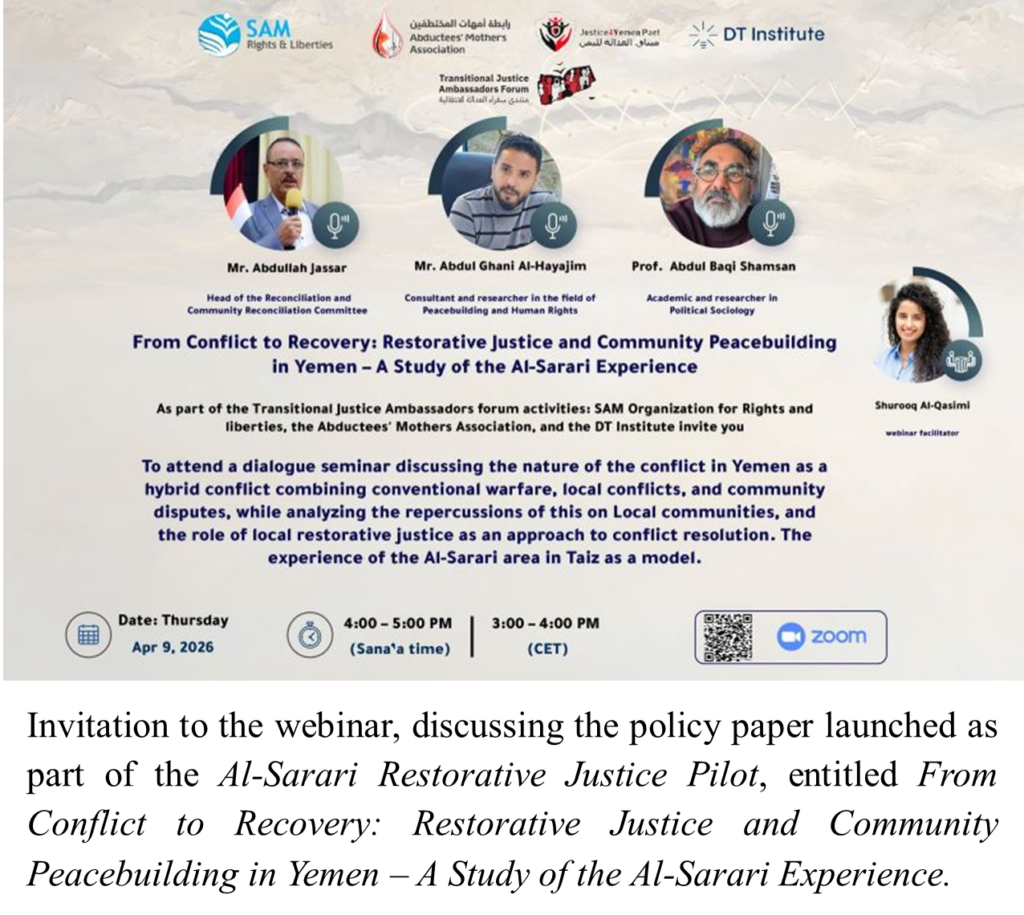
Furthermore, the CRCC participated in the SPARK webinar, entitled From Conflict to Recovery: Restorative Justice and Community Peacebuilding in Yemen – A Study of the Al-Sarari Experience. The webinar, which was attended by over 30 participants, launched the Al-Sarari Restorative Justice Pilot policy paper, entitled From Conflict to Recovery: Resolving Tensions in Al-Sarari Village, Working Along a Roadmap to Expand Restorative Justice and Community-Led Peacebuilding.
The policy paper and webinar discussion examined Al-Sarari as an entry point into the broader, and innately complex, conflict dynamics within Yemen. It illustrated the disputes in Al-Sarari as exemplary of a wider structural pattern, where unresolved grievances repeatedly resurface during times of destabilization as people are suffering. Speakers focused on the importance and methods to address the root causes of these disputes and to strengthen the coordination and collaboration between international and local NGOs and state institutions to prevent this resurfacing.
💬 “As institutions, international and local organizations should make the effort jointly with state institutions, to encourage them to reactivate those institutions and, in light of what is happening now, to seek reconciliation efforts. This is important, so that when the war comes to an end, transitional justice will be easier to deliver.” – Abdul Gassar, CRCC Member, at the webinar entitled From Conflict to Recovery: Restorative Justice and Community Peacebuilding in Yemen – A Study of the Al-Sarari Experience.
Revenge-Related Disputes Between Armed Groups
Additionally, the CRCC is also working to address revenge-related disputes in other areas throughout Taiz. This includes a dispute between soldiers from the 17th and 25th Brigades, which quickly evolved from a dispute amongst individuals affiliated with armed groups to a regional conflict, involving the areas of Al-Suwai (affiliated with one party) and Al-Masrakh (affiliated with the opposing party).
The initial dispute started between two soldiers, one from the 17th Brigade and another from the 35th Brigade, over market taxes on qat. Their dispute led to an exchange of fire, resulting in the killing of a soldier affiliated with the 17th Brigade. This fueled revenge seeking and retaliation from the other side as the dispute spiraled into an area-wide conflict. The clashes continued for nearly two weeks. During this time, security checkpoints were set up to kidnap passers-by from the perpetrator’s area. This has exacerbated tensions and created a regional conflict threatening social peace throughout the region.
To address this, the perpetrator, who killed the 17th Brigade soldier, was later detained. An initial court ruling mandated the payment to the victim’s family. This payment represents financial reparations, or diya, as referred to in Yemen, which is a long-standing practice within the country as authorized by Islamic law. However, the perpetrator has remained unable to pay the money. Meanwhile, the victim’s family and community have rejected the court ruling and continue to oppose reconciliation. They have explicitly threatened that the perpetrator will be killed if released from prison, indicating a persistent risk of renewed violence and unresolved collective grievances.
Thus, while the state is attempting to address the pervasive tensions, it is clearly facing several difficulties. To resolve these difficulties, the CRCC mobilized to raise the funds required, which amounted to 36 million Yemeni Rials. In March, the CRCC finally raised the money required. Moreover, the CRCC met with the perpetrator during their visit to Yemen’s Central Prison. During the visit, they communicated their success and explained their role in the initiative.
To address the unresolved tensions and failed mediation attempts, the CRCC is currently working to ensure that the financial reparations will result in an amicable settlement. In doing so, they held a meeting with the family of the deceased, in which they discussed the importance of peace throughout the community.
Promoting Safe Environments for Children’s Education to Thrive
As part of the CRCC’s work to promote effective transitional justice, the committee has recognized a need to promote safe and dignified learning environments for Yemen’s children. As the next generation, Yemen’s children require a well-rounded education to enable them to thrive as Yemen’s future. Aligning with these views, the CRCC is also working to address a number of cases wherein schools are being occupied and taken over for other purposes.
This includes a case in which three schools in Sakhdija, Al-Shaab, and Al-Wahda were converted into slaughterhouses during Eid Al-Fitr. The temporary use of the schools as slaughterhouses exposed the students to various risks upon their return. The schools were not cleaned properly, leaving harmful bacteria and blood behind. As a result, the schools were left as hotspots for disease, leading to complains and building tensions throughout the community.
This also includes cases of other disturbances at schools, including armed demonstrations, an attempt to convert a school and deprive students from using it, and the continued existence of a military barrack in another school. To address these cases, the CRCC met with the Director of Education in the Cairo Directorate, where all these schools are located. Currently, the CRCC is working to follow up to adequately address these cases and ensure children’s right to education is protected.
- Scaling the Impact
The urgent need for continued CRCC intervention is clear: good governance and accountability are severely fractured and challenged, not only within Taiz, but throughout all of Yemen. Ten years of harrowing conflict has left the country with fragmented governance structures, weak – and in some areas, nonexistent – rule of law, and a grave human rights landscape. State institutions are weak at best, while local institutions are similarly often powerless, lacking access to funding and resources. Among this backdrop, impunity is rampant as it spreads unchecked throughout rural and dense areas alike.
Although the CRCC will continue work via volunteer efforts, the importance of their efforts cannot be understated. The CRCC’s work plays a critical role in easing local unrest, bridging social divides, and laying the groundwork for sustainable peace. In doing so, it primes these communities by building a strong foundation for transitional justice. After more than a decade of failed national peace talks, victim-centered approaches like restorative justice pilots represent a new path forward.
💬 “The CRCC was a critical success of the SPARK program. It represents everything that the SPARK program has been working to achieve and that transitional justice must entail – community-led efforts that work jointly and bridge gaps amongst diverse and divided groups throughout society and that lead the charge in addressing disputes by fostering coordination between the community, state institutions, and local and international NGOs and aid organizations.” – Lynn Arbid, Program Officer at DT Institute.
By demonstrating how good governance and accountability can be achieved at the community level, the CRCC operationalizes transitional justice principles, educating stakeholders, building trust, and fostering shared frameworks for conflict resolution. These pilots serve as blueprints for future transitional justice efforts and larger coordination efforts, rooted in local ownership, dignity, dialogue, and joint action.
At the national level, there is strong potential to institutionalize and scale up community-based committees. Formalizing these structures could play a critical role in mitigating local tensions during ongoing conflict and serve as an effective peacebuilding mechanism in the post-conflict phase. Moreover, these committees could contribute to transitional justice processes, given their close relationships with communities and their deep understanding of local needs and grievances. Their involvement could support the design and implementation of context-sensitive mechanisms that enhance trust, inclusion, and sustainability.