This case study illustrates the detrimental effects of religious extremism on community cohesion, children, and local governance. Lessons learned here will inform the design of future restorative justice pilots, initiatives, and broader policy strategies aimed at countering religious extremism and fostering social cohesion across Yemen.
The Prevalence of Religious Extremism in Yemen
Religious extremism is alive and well in Yemen today. It is fed continuously by conflict parties seeking to capitalize for their own gains and fanatics, whose beliefs are sustained by the ongoing humanitarian crisis. However, religious extremism is not a solely Yemeni problem. Terror organizations with global ambitions and foreign ties, such as the Houthi (Ansar Allah) group and Al-Qaeda in the Arabian Peninsula (AQAP), have long operated within the country. Moreover, the war, which has raged on for over 10 years now, remains complex, fraught with the involvement of regional powers and neighbors alike.
As held by Rashad Ahmad Alhuniti in a case study of Yemeni extremism, published by the Jordanian Journal of Law and Political Science, “Religious extremism is considered a form of violence directed towards those who oppose the extremist. Therefore, religious extremism in Yemen, like any extremism, aims to eliminate the other based on the ideological ideas that the extremist brought up.” Religious extremism threatens national and regional stability by deepening sectarian polarization, weakening state authority, and enabling the proliferation of armed non-state actors. These dynamics create fertile conditions for terrorist groups to recruit, justify violence in religious terms, and expand their operational reach, thereby sustaining cycles of conflict and insecurity.
In Yemen, terrorist groups – most prominently, the Houthi group – are doing just this by taking advantage of the ongoing conflicts in Yemen and abroad. Religious discourse is included in all Houthi actions and statements, as they frame their cause as a religious plight against immoral outside actors. Abu Hamza, a civilian formerly living under Houthi occupation, shared his experience with Reuters, stating, “We are ruled by a militia cloaked in religion.”
Beliefs and Motivations in Political Conflict
Ansar Allah, which translates to “Supporters of God” is the official title of the Houthis. Originally, rooted in Zaydi Shiite Islam, the group emerged to combat what they perceived as an erosion of Zaydi tradition. According to Brookings Institute, the American invasion of Iraq in 2003 deeply radicalized the Houthi movement, leading to their adoption of the slogan “God is great, death to the U.S., death to Israel, curse the Jews, and victory for Islam.” Since October 2023, Houthi disdain for the U.S. and Israel has grown as Israel has delivered crushing blows to Hamas in Gaza and Hezbollah in Lebanon, who both join the Houthis under Iran’s wing as part of its so-called Axis of Resistance.
According to the Armed Conflict Location & Event Data (ACLED), the Houthi’s political stance is framed by “inevitables” the first of which is Israel’s defeat, which they claim is divinely affirmed by the Quran. The second “inevitable” is the defeat of those aligned with Israel, including its western allies. ACLED further notes that the Houthis interpret current events through a perverse manipulation of the Quran, “interpreting both the present and future as extensions of a divinely inspired past” and connecting present-day confrontations with historic conflicts. This includes naming military maneuvers targeted at the US and Israel after Quranic verses, including “To sadden your faces” an expression taken from Surat al-Isra.
Houthi propaganda continuously claims that US involvement has historically sought to influence and control Yemen by intervening in the country’s religious sphere as part of a broader strategy of ideological and political domination, although these claims are presented mainly through political assertions rather than independently verified evidence. The leader of the Houthis, Abdul-Malik al-Houthi claims that the United States does not aim to promote coexistence, but rather seeks to shape religious discourse in ways that would lead Yemenis to accept American dominance, the exploitation of national resources, and Israeli control over Palestine.
Moreover, the Houthis consistently accuse Saudi Arabia of being the United States’ proxy in the region, stemming from their belief that Sunni Islam is a takfeer ideology, i.e., a non-Muslim or anti-Islamic ideology. The Houthi Deputy Minister of Guidance, Hajj, and Umrah has accused the U.S. of controlling and funding most religious platforms in Yemen through Saudi Arabia. He also accused the U.S. of controlling religious discourse in Yemen via previous Yemeni regimes, which, in his words, have enabled the U.S. to spread “criminal takfeeri ideology associated with the Muslim Brotherhood among preachers and prominent figures in particular, and the general public more broadly – an instrument it manipulates as it wishes.”
SAFE Documentation of Houthi Propaganda Victimizing and Manipulating Yemeni Children
Under the SAFE (Supporting Awareness, Facilitating Enforcement of Children’s Rights in the Yemeni Conflict) program, local partners, the Insaf Center for Human Rights (“Insaf”) and the Yemen Coalition for Monitoring Human Rights Violations (YCMHRV, also known as “Rasd”), have observed extensive Houthi propaganda and manipulation of religious. This propaganda has been used to vilify the U.S. and other western actors to the detriment of local civil society and international aid. More significantly, it is also a tool through which the Houthis recruit and manipulate children through the media and in summer recruitment camps.
The Houthis claim that the Americans attempt to manipulate Islamic texts, most prominently in school curricula. In reality, this is a tactic used pervasively by the Houthi group itself, who continue to manipulate Islamic texts, including the Quran, to frame their fight as a holy struggle against American and western interests. As documented by our local partners (including the SAFE partners) under the Justice4Yemen Pact (J4YP) Coalition, this is most prominently observed within Houthi “summer camps” – indoctrination programs wherein children are programmed to revere violence, the Houthis, and hatred for the enemy, designated as the United States, Israel, and western influence.
As the J4YP also notes, “manipulation of the Qur’an is also used, as children are taught to interpret the religious text according to the group’s ideologies, linking it to their military victories and ideologies of American and Israeli hatred.” In doing so, they work to convince children that they are in an existential battle against the U.S. and Israel, utilizing escalations between them and these countries to justify these narratives. A child and attendee at a Houthi recruitment camp in Hajjah (who wished to remain anonymous) explained to YCMHRV’s researchers, “[the Houthis] said the center would teach me the Quran and computers… but they made me wear a military uniform and chant against America.” YCMHRV further points to the stark contrast between Houthi media claims, which note that these camps conduct “cultural and religious activities” and the documented reality, presented in images, which includes children wearing military uniforms, chanting war slogans, participating in combat trainings, and performing salutes.
The Houthis spread their propaganda through sophisticated media manipulation and propaganda, bolstered by Hezbollah and Iran’s support in the form of hosting media networks and trainings of media personnel in “military media,” a term coined by Iran. International media reports that the Houthis control approximately 30 local media outlets, alongside a digital army of hundreds of Houthi-affiliated social media accounts. This includes Saba Agency, whose propaganda has been analyzed by YCMHRV to reveal the extensive recruitment manipulation.
Such propaganda has been further documented by 18 disinformation reports, published under SAFE, which capture Houthi media manipulation tactics, which commonly feature religious rhetoric. For instance, when a Houthi child soldier is killed, he is often considered a “martyr of the Quranic march.” This is true, even for children who were killed by the Houthis themselves for refusing to submit or participate in their so-called religious struggle, as documented by YCMHRV.
SPARK’s Fight Against Religious Extremism
The SPARK (Supporting Peace in Yemen through Accountability, Reconciliation, and Knowledge-Sharing) program supports the Yemeni state in their ongoing aim to rationalize religious discourse as part of their efforts to reconcile the country’s fragmented society, stabilize the nation, and diffuse tensions driving regional insecurity.
Under SPARK, local partners, SAM for Rights and Liberties (“SAM”) and Abductees’ Mothers Association (AMA), launched restorative justice pilots and campaigns raising awareness. These initiatives aim to foster reconciliation, resolve community-level public disputes that continue to perpetuate human rights violations, and to empower locals with the knowledge required to see past pervasive propaganda. In doing so, SPARK partners continue to combat religious extremism in Yemen, among other social issues, working towards a more stable country and region.
Initiative Spotlight : The Role of Religious Leaders Campaign
Under The Role of Religious Leaders Campaign, SPARK partners engaged 20 preachers, including three women and 17 men, in a comprehensive transitional justice training program, aimed at rationalizing religious discourse and combatting religious extremism. The trainees include both religious figures and preachers that are affiliated with the Endowments and Guidance Office, as well as those that lead mosques that are not affiliated with the Office. Some of these preachers are considered radical, underscoring their need for this training and SPARK’s aim in bridging the gap among all preachers throughout Yemen and comprehensively rationalizing religious discourse.
The campaign was a stark success, obtaining support from the Endowments and Guidance Office in Taiz, at the behest of the training participants themselves. The Endowments and Guidance Office manages and protects state-owned endowment properties, including mosques, and conducts religious and community awareness campaigns. Moreover, it resulted in further understanding among diverse preacher trainees. This was especially significant regarding trainees who preached ideologies that were at times considered radical, as it supported them in tampering such sentiments and understanding the value of sewing community cohesion, rather than divisions.
The training program took place over three days. It focused on the basic functions of religious discourse in relation to transitional justice, which were to provide comfort and preach reconciliation and protection of civil peace. It emphasized the symbiotic relationship between transitional justice and religious discourse by noting their moral alignment through seven modules. Each of these modules focused on unique aspects of transitional justice, interwoven with religious concepts. For instance, the first module provided an intricate introduction to transitional justice through the Quranic story of the Prophet Yusuf (Joseph).
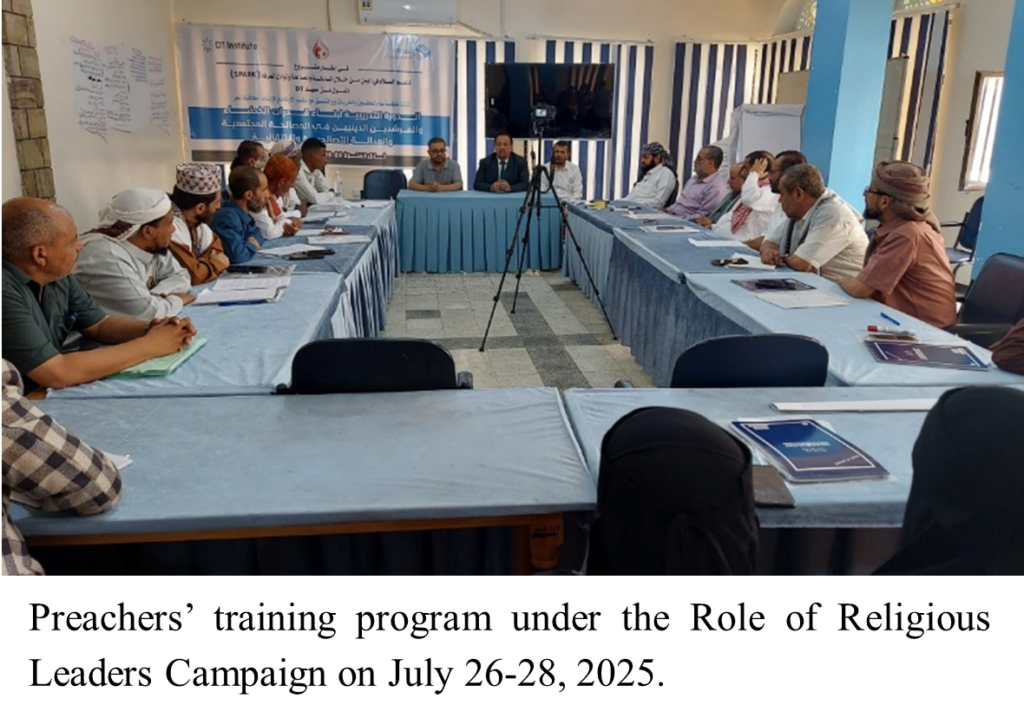
As the trainer noted, “The positive interaction by the religious guides and guides was excellent, as this was evident through practical applications, managing the discussion, and the outputs that characterized the groups.” He continued, noting that the training program involved long days, but that the participants “still in their positive, energetic, and active energy. Without any complaint, and if this indicates anything, it indicates their love for rehabilitation and building their capacities.”
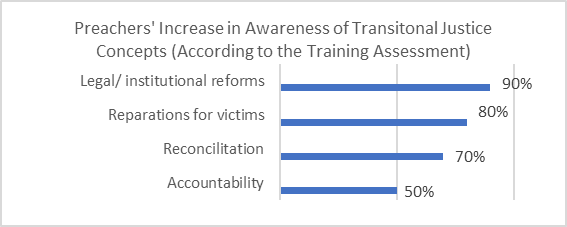
The training concluded with distribution of a thorough guide to be used after the training to assist preachers in embedding transitional justice concepts in religious sermons and lectures with community members. The importance of this guide is underlined by its status as the first guide intertwining transitional justice with religious values. It was developed by SAM with close review and insights from trainees and the Endowments and Guidance Office in Taiz.
💬 “This course was an important qualitative milestone in our journey, as it enabled us to learn… This knowledge has strengthened our conviction that religious discourse is not only preaching and guidance but can also be a practical tool in extinguishing community fires, calming souls, and building bridges of trust, making it a key pillar for overcoming the effects of the painful past and moving towards a more stable and cohesive future.” – Preacher Trainees’ Joint Statement.
Agreement and Impact
In concluding the training program, the participants agreed on a Code of Honor, summarizing their duty as religious preachers and community guides in leading society towards reconciliation and restoring harmony throughout Yemen by bridging gaps, bringing community members together, and resolving differences. Furthermore, they agreed to do so via Friday sermons, awareness-raising initiatives within mosques, schools, public councils, and via social media, among other available means.
The participants also released a joint statement, calling on conflict parties to respect religious and humanitarian values and affirming their commitment to stopping all forms of incitement and sectarian discourse in the name of religion. The statement emphasizes their commitment to create a more stable Yemen through religious tolerance and rationalization.
The statement ends with a final appeal, which reads as such (translated from Arabic), “Oh sons of our great Yemeni people. We appeal to God to strive hard to unite the ranks and address the wounds of the homeland and victory for our oppressed people, and we affirm our commitment to continue our role in serving the community and extend our hands to all parties wishing to build a secure, just and tolerant Yemen, through a successful transitional justice that repairs the wounds of the people and moves them to the better and desired future.”
The program concluded with a closing ceremony, hosted by the Endowments and Guidance Office in Taiz, attended by the Director General of the Office . During the ceremony, the Director General expressed his sincere thanks to SAM for implementing the quality training. The Director of Guidance and Counseling at the Office also emphasized the importance of religious preachers in addressing societal conflicts based on the values of Islam to foster transitional justice and societal cohesion. Photos from the ceremony were shared on the Office’s Facebook page, underlining their broad support for the initiative.
Learning, Documentation, and Replication
After the training program was completed, SPARK supported the 20 preachers in engagement of their communities via sermons and lectures, infusing religious concepts into transitional justice. This resulted in the delivery of 26 sermons to 10,317 community members, including 8,456 men and 1,861 women. Additionally, the preachers continue to engage in a WhatsApp group, wherein they share resources and offer guidance and support to one another.
These sermons effectively infused concepts of transitional justice, reconciliation, and religion, utilizing Islam to foster Yemeni stability. They discussed topics such as justice in Islam, holding that there can be no societal stability without justice institutions. In doing so, the campaign fostered social cohesion by building positive relationships among community members and encouraging religious leaders to preach tolerance, understanding, and unity.
💬 “Initiatives like this foster tolerance among different parties, and their application aligns with the spirit of Islam, despite the unfamiliarity of the term to some. It is crucial for this topic to reach all social groups, including the political class and decision-makers in Taiz, and to be widely addressed in forums and speeches. The broader its reach, the greater its impact.” – Ahmed Kahteeb, Trainee and Preacher at a mosque in Taiz.
In addition to the sermons, SAM produced two radio episodes, broadcasted via Watani FM. The radio episodes were broadcasted to over 11 million potential listeners across 14 governorates. The first episode highlighted the importance of promoting TJ rooted in religious values, while the second episode described the necessary cooperation between political parties and civil society in ensuring TJ successes.
SAM and Global Media Production also produced an impactful podcast. On the podcast, SPARK Community and Reconciliation Consensus Committee (CRCC) member and transitional justice expert, Bassem Al Haj, emphasized that this requires engagement of diverse actors, including preachers, media, CSOs, and government. The podcast was published on Global Media Production’s YouTube, which has 2,300 subscribers, and onto SAM’s Facebook, which generated 1,000 user engagements.
Furthermore, the training itself generated broad local coverage by AdenTV and local journalist, Na’im Khalid, who each published a video documenting the training and interviewing participants. The videos were posted to their YouTube pages, which have over 100,000 collective subscribers.
Additional Spotlight: The Al-Sarari Restorative Justice Pilot
Religious intolerance, extremism, and polarization have impacted communities all throughout Yemen, including those within Al-Sarari, a small village. Prior to the conflict, communities in Al-Sarari belonging to different religious sects coexisted peacefully and intermarried. However, in 2015, the Houthis captured al-Sarari and established a “religious learning” center, which became a hub for radicalism and Houthi ideology.
The occupation and religious radicalization of the Houthis deepened sectarian divisions among local residents as some aligned with the Houthis and others with the internationally recognized government (IRG). Residents of Al-Sarari engaged in armed conflict between themselves and with neighboring villages, creating deep divisions, particularly due to the differing sectarian (Sunni) composition of surrounding villages.
As explained by a member in the community and participant in the restorative justice pilot, Faisal Al Sabri, “The sectarian dimension has contributed to significant social fragmentation linked to identity dynamics. Prior to the conflict, communities in Al-Sarari coexisted peacefully and intermarried. However, the introduction of ideologically driven religious activities and training contributed to deepening divisions, particularly given the differing sectarian composition of surrounding villages.”
This rift remains pronounced in Al-Sarari as these tensions persisted even after the Houthis’ withdrawal. Tension manifested in different forms, often revolving around resources such as land and water distribution. At times, these tensions were so pervasive that they extended to the refusal of community members to gather in the same place as the other communities with differing affiliations. A stark contrast from the intermarriage that was common before Houthi invasion and religious radicalization.
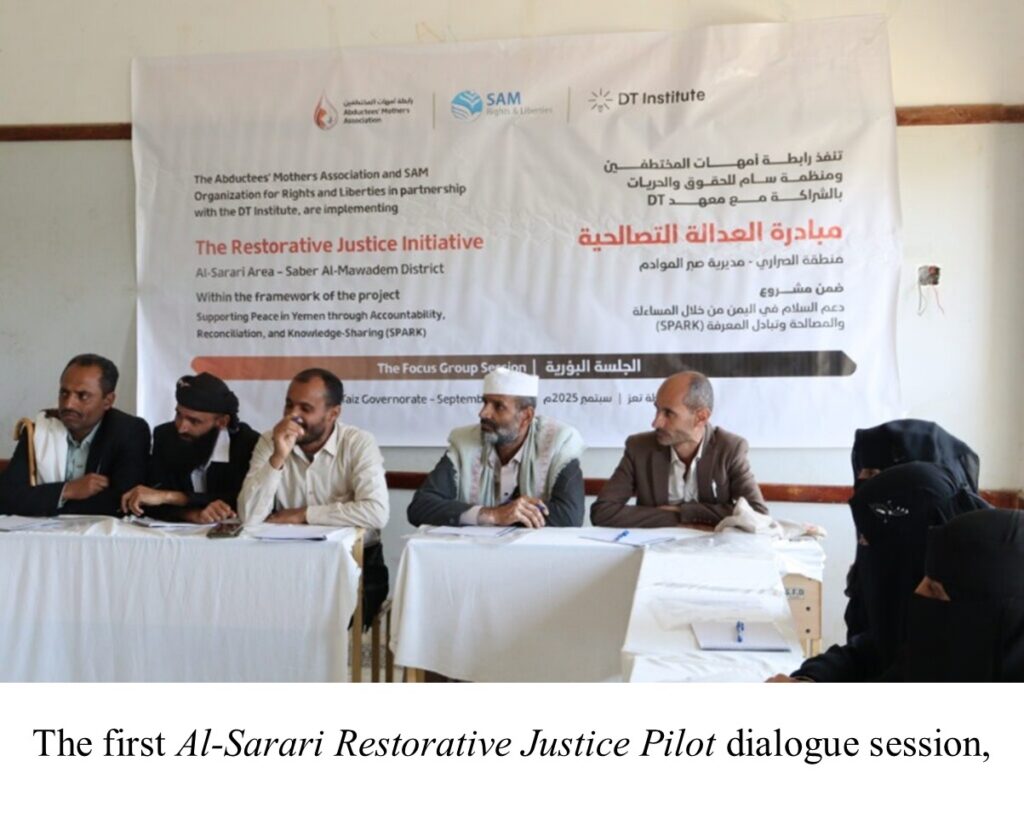
To address this, AMA, under the SPARKAl-Sarari Restorative Justice Pilot, worked intensively to enhance social cohesion by fostering dialogue among disputing parties, including community members and religious leaders, and rebuilding trust among local stakeholders.
In doing so, AMA implemented three dialogue sessions. The first session was attended by 15 diverse participants (three women and 12 men), comprising of social influencers, religious leaders, community members, and representatives from political parties (including the Islah party) and the local authority. The second and third sessions were held in tandem.
Each session brought together 14 diverse participants (11 men and three women), including social influencers, academics, tribal and legal figures, political parties, and local authority representatives. The sessions built off the powerful momentum fostered in the first session, which resulted in the identification of key issues to be addressed for sustainable reconciliation. In the second and third sessions, participants turned identification into action by jointly developing a needs matrix, identifying the most urgent priorities affecting diverse community members.
💬 “We will not wait for the peace process to arrive. We must start and take initiative within our communities, as we are the ones burned by the flames of war and who truly understand the value of peace.” – A participant in the Al-Sarari dialogue sessions.
The restorative justice pilot also featured a psychological support session for 20 female victims, implemented due to the significant need displayed throughout the village. AMA outlined participants’ legal rights and offered avenues for redress in a manner which clearly demonstrated the differences between social reconciliation and restoration of legal rights. Importantly, this approach resulted in participants’ agreement that achievement of tolerance and social cohesion need not come at the expense of their rights.
💬 “We want to reclaim our land but without inheriting hatred for our children.” – A psychological session participant, mother, and Al-Sarari community member.
Pre- and post-assessments conducted by AMA at the start and end of the pilot demonstrated clear progress in shifting participant attitudes away from religious division and towards restorative justice and reconciliation. Participants’ willingness to collaborate with groups they had previously been in conflict with increased by 16 percentage points, from 77 percent in the pre-assessment to 93 percent in the post-assessment. A 13 percentage point increase was observed in participants’ beliefs that other communities would benefit from such activities, from 77 to 90 percent.
💬 “A key strength of the initiative was its success in bringing people together for the first time and creating a safe space for expression and candid dialogue. It also stimulated broader community discussion, with conversations extending into local gatherings and continuing through ongoing discussion circles and WhatsApp groups.” – Faisal Al Sabri, participant in the Al-Sarari Restorative Justice Pilot.
Scaling the Impact
The lessons from these initiatives demonstrate the importance of integrating religious discourse, community dialogue, and restorative justice in countering extremism. Building on these results, future SPARK pilots will expand efforts to strengthen social cohesion, inform policy development, and design interventions that mitigate religious radicalization at both community and institutional levels.
💬 “The [Al-Sarari Restorative Justice Pilot] is both courageous and impactful, and its continuation is essential. Its significance stems from the sensitivity of the conflict it addresses. … Areas such as Mushar‘a and Hadnan could benefit from replicating this model, given the presence of similar social and sectarian fractures, as well as other frontline areas in Maqbanah and Al-Shamaytin.” – Faisal Al Sabri, participant in the Al-Sarari Restorative Justice Pilot.
SPARK partners are already making headway on additional pilots countering religious extremism, including the Peace Dialogue Restorative Justice Pilot. This pilot is focused on restoring relations between female activists and influential religious leaders, in light of the escalation of systematic incitement, smear campaigns, and tools promulgated by religious leaders that mimic repression used in Houthi-controlled areas.
“Religious extremism and radicalism do not confine their effects to a single conflict; they ripple across communities and borders, as we have seen in Yemen, Syria, and Iraq, undermining social cohesion, fueling mistrust, and perpetuating cycles of violence,” explained Feras Hamdouni, Senior Program Manager at DT Institute. “Efforts to counter these dynamics must be coordinated with government structures to ensure that successful local interventions are scaled and adopted nationally, preventing duplication and strengthening the long-term resilience and stability of society.”
The urgent need for additional restorative justice pilots is clear: these initiatives play a critical role in easing local unrest, bridging social divides, and laying the groundwork for sustainable peace. Equally urgent is the broader need for transitional justice and initiatives to effectively counter religious extremism. Such activities are instrumental to Yemen’s overall stability and regional security. After more than a decade of failed national peace talks, victim-centered approaches like restorative justice pilots that preach tolerance, rationalization, and social cohesion represent a new path forward in Yemen.
By demonstrating reconciliation at the community level, restorative justice initiatives operationalize transitional justice principles necessary to effectively counter terrorism, extremism, and rampant propaganda that continues to radicalize youth and expand threats throughout the region. Such initiatives enable SPARK partners to effectively and sustainably reduce continuous causes of instability in Yemen. These initiatives serve as blueprints for future transitional justice efforts, rooted in local ownership, dignity, and dialogue.